

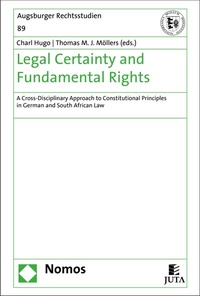
Legal Certainty and Fundamental Rights
A Cross-Disciplinary Approach to Constitutional Principles in German and South African Law
1st Edition
Published on 24. November 2020
440 pages
978-3-7489-0606-3 (ISBN)
Description

Dieses Werk enthält Forschungsergebnisse zu Fragestellungen hinsichtlich der Bedeutung von Rechtssicherheit und Grundrechten in verschiedenen Rechtsbereichen aus südafrikanischer und deutscher Perspektive, die in Zusammenarbeit der Universitäten Augsburg und Johannesburg entstanden sind.
Aktuelle Themen werden von Wissenschaftlern aus Südafrika eingeführt und anschließend von deutschen Kollegen reflektiert. Dies führt zu einem besseren Verständnis ungeklärter Rechtsfragen beider Rechtssysteme.
More details
Other editions
Additional editions
Charl Hugo / Thomas M.J. Möllers
Legal Certainty and Fundamental Rights
A Cross-Disciplinary Approach to Constitutional Principles in German and South African Law
Book
02/2021
1st Edition
Nomos
€114.00
Shipment within 7-9 days
Content
- Cover
- Introduction
- I
- II
- III
- IV
- The Rise of the Neo-Patrimonial State in South Africa: From the Rule of Law to the Rule of Persons
- I. Introduction
- II. Key features of a neo-patrimonial state
- III. The South African version of the rational-legal state
- IV. The South African version of the neo-patrimonial state
- V. Conclusion
- Bibliography
- Register of cases
- Comment: Rule of Law under German and European Constitutional Law - Comments on the Rise of the Neo-Patrimonial State in South Africa: From the Rule of Law to the Rule of Persons
- I. Introduction
- II. The rule of law - "thin" or "thick"?
- III. The rule of law in the German Constitution
- IV. The rule of law in the EU
- V. Conclusion
- Bibliography
- Register of cases
- Legal Certainty in Terms of Head-of-State Immunity from an African and an International Perspective: The Article 27(2) Conundrum
- I. Introduction
- II. Events leading to the "Jordan Appeal"
- III. Interpreting Article 27(2) in accordance with the Vienna conventions
- IV. An overview of the debate as highlighted by the Jordan Referral
- V. International and African Perspectives
- 1. South Africa
- 2. Democratic Republic of the Congo
- VI. Conclusion
- Bibliography
- Register of cases
- South Africa
- ICC Cases
- Comment: Head of State Immunity in Times of Uncertainty for International Law
- I. The ICC Appeals Chamber judgment in the Al-Bashir case and the persisting uncertainty surrounding head of state immunity
- II. Head of state immunity and the uncertain foundations of current international law
- III. The interplay between immunity and methodology in the Al-Bashir case
- IV. Conclusion
- Bibliography
- Register of cases
- International Court of Justice
- International Criminal Court
- Permanent Court of International Justice
- Special Court for Sierra Leone
- Kenya
- South Africa
- United Kingdom of Great Britain and Northern Ireland
- United States of America
- Legal Certainty and International Crimes: A Public International Law Perspective
- I. Introduction
- II. Customary international law and the strict interpretation of opinio juris and usus
- III. The core international crimes and the ICC Statute
- 1. Genocide
- 2. Crimes against humanity
- 3. War crimes
- 4. Crime of aggression
- IV. International crimes in terms of the Malabo Protocol
- V. Conclusion
- Bibliography
- Register of cases
- International Criminal Court
- International Court of Justice
- International Criminal Tribunal for Rwanda
- International Criminal Tribunal for the Former Yugoslavia
- International Military Tribunal
- Permanent Court of International Justice
- Special Court for Sierra Leone
- United Nations Documents
- Internet Sources
- Comment: Legal Certainty and Human Rights in the European Legal Order - The Treatment of Preventive Detention in the German Federal Constitutional Court and the European Court of Human Rights
- I. Introduction
- II. The "lively tension" between legal certainty and substantive justice
- III. The nulla poena and nullum crimen principles in the European legal order
- 1. Legal foundations of the principles
- a) The German Constitution
- b) The European Convention on Human Rights
- c) The European Charter of Fundamental Rights
- d) Difference in scope and content
- 2. Legal certainty caught in judicial dialogue
- a) The German twin-track system of sanctions
- b) Preventive detention as a measure of correction and prevention
- c) Qualifying preventive detention: the BVerfG's view
- d) Strasbourg's divergent view on the definition of "penalty"
- e) The implementation of the ECtHR's judgment in German law
- 3. The role of the Convention in the German legal order
- IV. Reciprocal influences
- V. Conclusion
- Bibliography
- Register of cases
- The Significance of the Erga Omnes Obligation to Prosecute Genocide for Legal Certainty in International Criminal Law
- I. Prefatory remarks
- II. The time period immediately following the commission of gross human rights violations within the responsible state
- 1. The establishment of a new government
- 2. The investigation of alleged violations and establishment of criminal tribunals and courts
- 3. Peacebuilding
- III. Erga omnes obligations regarding individual criminal responsibility
- 1. Aut dedere aut judicare - the duty to extradite or prosecute
- 2. The obligation to cooperate with international or national criminal courts and tribunals
- 3. Primacy and the principle of complementarity: the relationship between national and international criminal courts and tribunals
- IV. Civil accountability in terms of the principles of state responsibility
- V. Conclusion
- Bibliography
- Register of cases
- Permanent Court of International Justice
- International Court of Justice
- International Criminal Court
- International Criminal Tribunal for the Former Yugoslavia
- South Africa
- Preventive Justice and the Dangerous Offender: Seeking Solutions to Protect Society
- I. Introduction
- II. Preventive detention in various jurisdictions
- 1. South Africa
- a) Declaration as habitual criminal
- b) Declaration as dangerous criminal
- c) Life imprisonment
- 2. England and Wales
- a) Life imprisonment
- b) Imprisonment for public protection (IPP)
- c) Extended sentences
- 3. Canada
- a) Dangerous offenders
- b) Long-term offenders
- c) Preventive recognizances
- 4. Germany
- a) Life imprisonment
- b) Post-sentence preventive detention
- III. Discussion
- Bibliography
- Register of cases
- South Africa
- European Court for Human Rights (ECtHR)
- England and Wales
- Canada
- Germany
- The Legislative Possibilities and Challenges Relating to the Private Possession and Use of Cannabis in South Africa
- I. Prefatory comments
- II. Introduction
- III. In the High Court
- IV. In the Constitutional Court
- V. The right of an employer in terms of Section 7 of the Employment Equity Act
- VI. Comparative perspectives
- VII. Concluding remarks
- Bibliography
- Register of cases
- Comment: The Legalization of Cannabis in Germany
- I. The current legal position
- 1. Criminal liability today
- a) The universal problem of criminalizing "soft" drugs
- b) Introducing the BtMG
- c) The term "small quantities"
- 2. The "Cannabis Decision" of the BVerfG
- a) Background
- b) The judgment of the BVerfG
- c) Criticism
- 3. Drug offenses under Section 29 BtMG between 2007 and 2018
- II. Approaches to legalization
- 1. Criticism
- 2. Cannabis allowed as medicine
- 3. Further approaches to legalization
- a) The "Cannabis Control Act" - Green Party
- b) Motions by the Free Democratic Party and the Left Party
- c) The Federal Government's view
- III. Discussion and conclusion
- Bibliography
- Register of cases
- Sustainable Development, Bureaucratic Implementation and the Need for Jurisprudential Certainty
- I. Introduction
- II. The emergence of sustainable development in the international arena
- III. The introduction of sustainable development into South African law
- IV. The nature of environmental decision-making and sustainable development - a challenging mandate
- V. Jurisprudential beginnings - authorisations and adjudication in the early years
- VI. Building new jurisprudential dimensions on decision-making and sustainable development - more recent developments
- VII. Jurisprudential development in the compliance and enforcement context - the early years of adjudication
- VIII. A step backwards? - Concurrent and recent compliance and enforcement judgments
- IX. Conclusion
- Bibliography
- Register of cases
- Comment: Sustainable Legislation
- I. Preliminary remarks
- II. Sustainability in German and European environmental law
- 1. Sustainability in German environmental law
- 2. Sustainability in EU law
- 3. From three pillars of sustainability to 38 reference topics
- III. Sustainability as a procedural concept
- IV. Sustainability as a general guideline for legislation
- 1. Internal guidelines of the Federal Government
- 2. Institutional complementation in the German Bundestag
- V. Conclusion: Disillusion
- Bibliography
- Labour Law, Vulnerable Workers and the Human-Rights Paradigm
- I. Introduction
- II. Labour law and human rights
- III. Significance of interpretation in the activation of human rights
- IV. The role of the courts in extending protection to vulnerable workers
- V. Concluding remarks
- Bibliography
- Register of cases
- Comment: Discrimination in Working Life and Anti-Discrimination Law - Experiments and Experiences in Germany and Europe
- I. Introduction: an era of experiments and experiences in legislation against discrimination
- II. Prosecution of discrimination and available sanctions
- III. Persons protected and persons responsible in cases of discrimination
- IV. Prohibited grounds of discrimination
- 1. Legal situation in Germany
- 2. Legal comparison in Europe: more or less prohibited grounds?
- 3. Practical significance of the listed grounds
- V. Legal consequences of discrimination, and sanctions against discrimination
- 1. Challenges for the legislature
- 2. Current German law
- 3. Experiences and evaluation
- VI. Institutions against discrimination
- VII. The problem of abuse of the law and fraud: major problem or a trivial matter?
- 1. Problems in law and society
- 2. Experiences in practice
- VIII. Conclusion
- Bibliography
- Register of cases
- Equality, Legal Certainty and Insolvency
- I. Introduction
- II. Legal certainty
- III. Equality and insolvency law
- 1. The fundamental right to equality
- 2. Equality in Sarrahwitz
- a) The judgment
- b) Implications and criticism
- 3. The right to equality and the ranking of claims in insolvency
- 4. Equality and the existence of secured claims
- 5. Equality and the recognition of statutory priorities
- IV. Alternatives to the pari passu ranking of remaining claims
- V. Conclusion: To equality and beyond?
- Bibliography
- Register of cases
- Comment: The Principle of Equal Treatment of Creditors and its Limits Under German Law, Illustrated on the Basis of the Law on Limited Liability Companies
- I. The relationship between private autonomy and equal treatment of creditors under German law
- 1. Civil law and commercial law
- 2. Insolvency law
- II. No general principle of equal treatment of creditors (par conditio creditorum)
- III. Insolvency law for legal entities, such as limited liability companies (GmbH)
- IV. Duty to file for insolvency
- V. (Restricted) equal treatment of creditors upon insolvency of the GmbH
- VI. Refusal to open insolvency proceedings for insufficiency of assets
- VII. Objectives of the liquidation of a GmbH
- VIII. No general principle of equal treatment of creditors in the winding up (liquidation) of a GmbH
- IX. Winding up of a GmbH with no assets
- X. Legal policy considerations de lege ferenda
- XI. Summary
- Bibliography
- Register of cases
- Market Conduct Regulation in Perspective: Triumphs and Tribulations post Twin Peaks
- I. Introduction
- II. Supervisory framework: Overview
- III. Legislative instruments
- 1. The Financial Services Regulation Act
- 2. The Insurance Act
- a) Aim of the Act
- b) Classification of insurance business
- c) Financial inclusion and microinsurance
- 3. The Policyholder Protection Rules
- a) Introduction
- b) Product service and design
- c) Promotion and marketing
- d) Advice and point of sale
- e) Information after point of sale
- f) Complaints and claims handling
- 4. The COFI Bill
- IV. Critical evaluation
- V. Conclusion
- Bibliography
- Register of cases
- Comment: Market-Conduct Regulation in Germany and Europe
- I. Introduction
- II. The supervisory system in German capital markets law
- 1. The current position - a critical analysis
- a) The BaFin
- b) The relationship between supervisory authorities and the public prosecutor's office
- 2. Legal proposals
- a) Establishing a Germany-wide public prosecutor's office for capital markets crimes
- b) The right to implement regulatory sanctions
- III. The supervisory system in European capital markets law
- 1. Harmonisation efforts over the past few decades
- a) The Lamfalussy process
- b) Larosière: from the CESR to the ESMA
- 2. Proposals with a view to future regulation
- a) In favour of more: A European task force
- b) In favour of less: devolving authority on the basis of irrelevance to the internal market
- c) Realising European legal principles and regulatory objectives under capital markets law
- Bibliography
- Register of cases
- European Court of Justice (ECJ)
- German Federal Constitutional Court (BVerfG)
- German Federal Court of Justice (BGH)
- Federal Administrative Court (BVerwG)
