

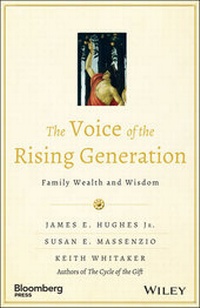
The Voice of the Rising Generation
Description

More details
Other editions
Additional editions
Persons
Content
Introduction
A Well-Known Family
There once was a young man with a very successful father. His father came from a prominent family, but by his own industry and wits he, the father, had risen to become one of the most famous leaders of his time.
As a result, the young man, his son, grew up revering his father's name but not really knowing him as a person. As he became a young adult, he felt unsure of himself. He doubted whether he could ever accomplish much in the world, especially when compared with his father.
Luckily for this family, the young man's mother—who endured years of loneliness, far from her ambitious husband—remained a rock of constancy. And both the son and the father undertook long personal journeys to overcome their distance from each other. After many toils, the father returned home and repaired his marriage. The son underwent his own struggles, and when he at last reunited with his father, he did so both as a son and as a man of his own.
This is not the story of one of the many families with whom we have worked over the years—though, with a few changes here and there, it could apply to quite a few of them. It is the story of The Odyssey, the epic poem composed by Homer almost 3,000 years ago. The Odyssey recounts the wanderings of the hero Odysseus as he struggles to return home to the island of Ithaca from the battlefield of Troy. It also tells of the struggles of Odysseus's son Telemachus, who leaves home and goes on a quest to find his father and himself. All along, Penelope, Odysseus's wife and Telemachus's mother, endures a siege of unwelcome suitors, hoping against hope for the return of her husband and son.
The Challenge
Though Odysseus is a king and his family possesses great resources, The Odyssey is not primarily a story about wealth. It is a story of the human condition, and as such it speaks directly to the challenges faced by families with wealth and without it. It speaks especially to the challenge of the rising generation.
After years of consulting and research, we believe that we have some insight into the central challenge facing families with wealth. It is not a matter of finance. It is not a legal problem. It is not something to be resolved through the application of more, better, or faster resources. It is a human challenge, the challenge of overcoming the silence and finding the voice of the family's rising generation.
We will have much more to say about what we mean by “silence” and “the rising generation.” But, in the spirit of giving voice to the rising generation, we would like to begin by sharing words that we have heard from young family members themselves, in talks we have given to groups of families or in family meetings we have facilitated, words similar to these:
- “I'm grateful for all my parents have done, but I sometimes feel that everything is done for me. I don't really have a voice. How can I find my own way and grow to be a happy, independent, man (or woman) of my own?”
- “I've started on my own path, but I also find myself being pulled back home through all sorts of financial or business arrangements. What are ways to keep to my own course and still remain connected with my parents and larger family?”
- “Everyone tells me to pursue my dreams. But I'm not sure what those are. I also don't know how to ask my parents about what resources I can draw on to figure out my way. Where do I start?”
Sometimes these words are very difficult for members of the rising generation to utter. At least these particular examples were spoken. In many families, in contrast, we find a deafening silence. The unspoken words of the rising generation are like Eduard Munch's The Scream: in our faces yet unheard.
Sometimes people think that the challenge of fostering the voice of the rising generation belongs solely to parents. Or it may be tempting to think that it lies squarely on the shoulders of members of the rising generation themselves. But this challenge does not belong just to parents or just to children. The Odyssey is not a story just of Odysseus's return home, nor is it a tale just of Telemachus's struggles to leave home. The rising generation needs those who have risen, and the risen need the rising.
The Journey
The goal of this book is simple: to engage in a conversation primarily with members of the rising generation, a conversation aimed at helping you meet this central challenge of growing and not losing your voice. Here is our plan:
Chapter 1 will squarely confront the main obstacle to the rising generation's finding its voice. The obstacle is, paradoxically, the great dream of the founder, which often turns into a black hole. In too many cases, this black hole absorbs the dreams of the individuals who came after the founder, leaving them at best to use their lives to steward somebody else's dream. This path diminishes the self, silences the future, and ultimately saps the family's vitality. It is the true cause of dependency, entitlement, and the power of the proverb “shirtsleeves to shirtsleeves (or rice paddy to rice paddy) in three generations.”
With this obstacle in mind, Chapter 2 discusses what we mean by a rising generation. Our goal is to help you, members of the rising generation, recognize yourselves, apart from the distorting influence of the black hole. We will discuss the characteristics of members of any rising generation. We will explore the need for members of the rising generation to explore or struggle in order to grow. And we will touch upon the general challenges that members of rising generations face, with or without wealth.
Chapter 3 moves the conversation from the challenges that members of the rising generation face to strategies for dealing with those challenges. It will offer ways that you, members of rising generations, can come to know yourselves better, in particular your strengths, your beliefs, and your internal hurdles. We also share an updated version of our “Individual & Family Balance Sheet” as a tool for charting progress in this journey of self-understanding.
Chapter 4 takes the step from gaining self-knowledge to developing resilience and independence. Many parents focus primarily on financial literacy as a necessary skill for members of the rising generation. We ask young family members to reflect on what you think that you will need most to find your voice. Following Freud's emphasis on the importance of love and labor, we dwell in particular on the experience of work, managing relationships, and communicating as crucial for developing resilience, confidence, and competence within the context of family wealth.
The first four chapters lay out challenges faced by or strategies open to all members of rising generations in families with wealth. In Chapter 5, we apply this learning to the specific challenges faced by family members in the middle passage of life. If you are in this situation, you may have lived with decades of silence but now want to find your voice. We discuss ways to advocate for yourself as well as to avoid the snares often inherent in the ownership and leadership of family affairs.
The Conclusion reviews many of the lessons and principles that are shared in the five chapters. It also focuses on the question: who can help you, members of the rising generation, navigate your central work of individuation? We discuss two such helpers: elders and mentors. Elders help members of the rising generation through specific transitions. If you are lucky enough to find one, a mentor can help your entire life evolve.
At the end of each chapter we offer you, as a member of the rising generation, a question or questions to reflect upon. The Appendix recapitulates these questions and also provides references for other exercises and tools that you can use to guide yourself in pursuing the strategies discussed in the chapters. If you, your family, or your family's advisers would also like to plan a program to develop the capacities of the rising generation, the Appendix includes reference to a multistep curriculum that reduces the lessons of this book to a form that can be delivered and discussed over several meetings.
Again, our goal is to advance the conversation with the rising generation. Our hope is that, whatever your stage of life, you find that these pages prompt your reflection and growth, and that these chapters and these tools help your entire family rise to the challenge of fostering the flourishing of the rising generation.
Our Approach
Let's turn, then, to the conversation. We do not want to speak about or to members of the rising generation. We want to speak with you. Our goal is a conversation rather than a lecture. That is why each chapter of this book is short, readable on its own, and peppered with self-reflective questions. We want to give you an opportunity both to reflect and to take action. We hope to hear your full-throated voices rather than to cement your deafening silence. Most fundamentally, we want to open up for you a realm of true choice based on self-knowledge.
Our emphasis on choice is not incidental. One of the greatest sources of pain within families with wealth is the belief that there are no choices. Sometimes even wealth creators who feel very able...
