

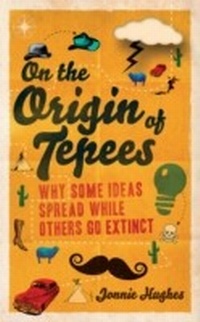
On the Origin of Tepees
Why Some Ideas Spread While Others Go Extinct
1st Edition
Published on 1. July 2012
320 pages
978-1-78074-110-9 (ISBN)
Description

An acclaimed BBC filmmaker uses his anthropological wiles to uncover the evolution of our ideas
Adopting the part of a cultural Darwin, Jonnie Hughes headed off on a road trip across exotic America to observe the natural history of human culture in all its weirdness. As he dissects what makes some ideas flourish and others die off, investigates the fashion for low-riding jeans, the wording of memorable joke punch-lines, and the invenor of the iconic cowboy hat.
"This book is a delight. Hughes's hilarious travels through the American West do for culture what Darwin did for biology." Susan Blackmore, author of The Meme Machine
Adopting the part of a cultural Darwin, Jonnie Hughes headed off on a road trip across exotic America to observe the natural history of human culture in all its weirdness. As he dissects what makes some ideas flourish and others die off, investigates the fashion for low-riding jeans, the wording of memorable joke punch-lines, and the invenor of the iconic cowboy hat.
"This book is a delight. Hughes's hilarious travels through the American West do for culture what Darwin did for biology." Susan Blackmore, author of The Meme Machine
Reviews / Votes
""On the Origin of Tepees" is not your usual sort of book. Jonnie Hughes, a British TV and radio science guy, is like a carnival barker on serious weed. He is like Carl Sagan without segues, Jacques Cousteau without the hat, "Mutual of Omaha's Wild Kingdom" without the kingdom ... Wait, wait, I've got it: "On the Origin of Tepees" reminds me of a mind-blowing book I was given in first grade. It was called "Animals Do the Strangest Things", and it called into question pretty much everything I'd been told so far (at 6) "vis-a-vis" evolution; namely that people were in charge of animals, people were smarter than animals, people were more inventive than animals and, of course, people were funnier and nicer than animals (none of which turned out to be true). Hughes wants us to understand the world differently; to understand the evolution of ideas and how those ideas shape the choices we make (individually and as a species) and our cultural evolution. He has chosen to do this in what he considers a surreal landscape -- America. Now don't get huffy: This is not Baudrillard exclaiming over the American materialist wasteland, or even de Tocqueville marveling in his paternal way over our fabulous optimism; this guy is totally comfortable (maybe too comfortable) with the idea that, grand theories aside, we are not in control of our evolution, any more than the hammerheaded fruit bat, the oarfish, or the naked mole rat. We need new goggles with which to see ourselves and through which to fully appreciate Darwin's work. Hughes has got some."--"Los Angeles Review of Books"More details
Language
English
Place of publication
Oxford
United Kingdom
File size
3,95 MB
ISBN-13
978-1-78074-110-9 (9781780741109)
Copyright in bibliographic data and cover images is held by Nielsen Book Services Limited or by the publishers or by their respective licensors: all rights reserved.
Schweitzer Classification
Other editions
Additional editions
Book
07/2012
Oneworld Publications
€13.50
Article not available at the moment
Person
Jonnie Hughes is a filmmaker in the BBC Natural History Unit and Head of Development for BBC Earth. His documentaries have been shown on the BBC, Discovery, and National Geographic Channel. He studied ecology and evolution at the University of Leeds. He lives in Bristol and this is his first book.
Content
- Intro
- Title page
- Copyright page
- Dedication page
- Contents
- Acknowledgements
- Part I: Only Human
- 1. Weirdoes
- 2. The New World
- Part II: What's the Idea?
- 3. Evolution, Minnesota
- 4. Variation, North Dakota
- 5. Inheritance, South Dakota
- 6. Selection, Wyoming
- Part III: History Lessen
- 7. Mind Out?
- 8. How the West Was Won I: Finding the Edges
- 9. How the West Was Won II: June 25, 1876
- 10. How the West Was Won III: America Making
- Part IV: Who's Driving?
- 11. A Beginner's Guide to Tepee Taxonomy
- 12. Bound by Imagination
- 13. The Genes of Culture
- Part V: Mysteries Solved
- 14. The Past
- 15. The Present
- Notes
- Bibliography: The Goggle Makers
- Index
- About the Author
