

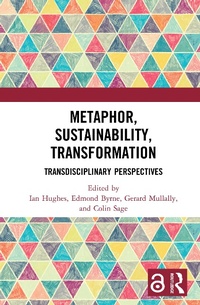
Metaphor, Sustainability, Transformation
Transdisciplinary Perspectives
1st Edition
Published on 29. July 2021
278 pages
978-1-000-40700-6 (ISBN)
Description

This book offers an eclectic range of transdisciplinary insights into the role of metaphor, myth and fable in shaping our understanding of the world and how we interact with it and with each other.
Drawing on innovative perspectives from widely different fields, this book explores how metaphor might facilitate and underpin transformative change towards environmental, ecological and societal sustainability. It illustrates the ways in which contemporary metaphors lock us into patterns of thinking, modes of behaviour, and styles of living that reproduce and accentuate our current socio-environmental problems. It sets itself the task of finding new metaphors and myths that might help move us towards sustainability as societal flourishing. By examining the use of metaphor in diverse fields such as energy use, the food system, health care, arts and the humanities, it invites the reader to reflect on the deep-seated influence of language in general, and metaphor in particular, in shaping how we understand and act upon the world.
Re-imagining the use of language in framing both the problems we face and the solutions we devise, this novel contribution is a vital source of ideas for those aiming to change how we think and act in pursuit of more sustainable futures.
Chapter 1 of this book is freely available as a downloadable Open Access PDF at http://www.taylorfrancis.com under a Creative Commons Attribution-Non Commercial-No Derivatives (CC-BY-NC-ND) 4.0 license.
Drawing on innovative perspectives from widely different fields, this book explores how metaphor might facilitate and underpin transformative change towards environmental, ecological and societal sustainability. It illustrates the ways in which contemporary metaphors lock us into patterns of thinking, modes of behaviour, and styles of living that reproduce and accentuate our current socio-environmental problems. It sets itself the task of finding new metaphors and myths that might help move us towards sustainability as societal flourishing. By examining the use of metaphor in diverse fields such as energy use, the food system, health care, arts and the humanities, it invites the reader to reflect on the deep-seated influence of language in general, and metaphor in particular, in shaping how we understand and act upon the world.
Re-imagining the use of language in framing both the problems we face and the solutions we devise, this novel contribution is a vital source of ideas for those aiming to change how we think and act in pursuit of more sustainable futures.
Chapter 1 of this book is freely available as a downloadable Open Access PDF at http://www.taylorfrancis.com under a Creative Commons Attribution-Non Commercial-No Derivatives (CC-BY-NC-ND) 4.0 license.
More details
Edition
1. Auflage
Language
English
Place of publication
London
United Kingdom
Publishing group
Taylor & Francis Ltd
Target group
College/higher education
Illustrations
4 Tables, black and white; 10 Line drawings, black and white; 8 Halftones, black and white; 18 Illustrations, black and white
ISBN-13
978-1-000-40700-6 (9781000407006)
Copyright in bibliographic data and cover images is held by Nielsen Book Services Limited or by the publishers or by their respective licensors: all rights reserved.
Schweitzer Classification
Other editions
Additional editions
Ian Hughes | Edmond Byrne | Gerard Mullally
Metaphor, Sustainability, Transformation
Transdisciplinary Perspectives
Book
05/2023
1st Edition
Routledge
€65.60
Shipment within 15-20 days
Ian Hughes | Edmond Byrne | Gerard Mullally
Metaphor, Sustainability, Transformation
Transdisciplinary Perspectives
Book
07/2021
1st Edition
Routledge
€206.60
Shipment within 15-20 days
Persons
Ian Hughes is Senior Research Fellow at the MaREI SFI Research Centre for Energy Climate and Marine. His research interests are in deep institutional innovation sustainability and human development. He is author of Disordered Minds: How Dangerous Personalities Are Destroying Democracy, and contributing author to The Dangerous Case of Donald Trump.
Edmond Byrne is Chair Professor of Process and Chemical Engineering at University College Cork. His research interests include transdisciplinary approaches around sustainability. He chairs the 10th Engineering Education for Sustainable Development conference (EESD2021) and co-edited Transdisciplinary Perspectives on Transitions to Sustainability published by Routledge in 2017.
Gerard Mullally lectures in Sociology at University College Cork, specializing in environment, community, climate, energy and sustainable development. He leads 'Imagining 2050' at UCC's Environmental Research Institute, a transdisciplinary research consortium which engages with civic society using innovative approaches, to explore and co-develop future visions of, and pathways to, a low carbon and climate resilient future. He co-edited Transdisciplinary Perspectives on Transitions to Sustainability.
Colin Sage is an independent scholar based in Portugal who works on the interconnections of food systems, environment, and prospects for greater civic engagement around food. He is the author of Environment and Food, 2012; and co-editor of four books, including Food System Transformations: Social Movements, Local Economies, Collaborative Networks, 2021; and Transdisciplinary Perspectives on Transitions to Sustainability, 2017.
Edmond Byrne is Chair Professor of Process and Chemical Engineering at University College Cork. His research interests include transdisciplinary approaches around sustainability. He chairs the 10th Engineering Education for Sustainable Development conference (EESD2021) and co-edited Transdisciplinary Perspectives on Transitions to Sustainability published by Routledge in 2017.
Gerard Mullally lectures in Sociology at University College Cork, specializing in environment, community, climate, energy and sustainable development. He leads 'Imagining 2050' at UCC's Environmental Research Institute, a transdisciplinary research consortium which engages with civic society using innovative approaches, to explore and co-develop future visions of, and pathways to, a low carbon and climate resilient future. He co-edited Transdisciplinary Perspectives on Transitions to Sustainability.
Colin Sage is an independent scholar based in Portugal who works on the interconnections of food systems, environment, and prospects for greater civic engagement around food. He is the author of Environment and Food, 2012; and co-editor of four books, including Food System Transformations: Social Movements, Local Economies, Collaborative Networks, 2021; and Transdisciplinary Perspectives on Transitions to Sustainability, 2017.
Content
1. Metaphor, Transformation and Transdisciplinarity Part 1: Metaphors of Reason 2. Metaphors of Technological Change 3. Nitrogen, Planetary Boundaries, and the Metabolic Rift: Using Metaphor for Dietary Transitions Toward a Safe Operating Space 4. Alchemical and Cyborgian Imaginings in Technoscientific Discourse on Holistic Turns in Food Processing and Personalised Nutrition 5. Carbon Budgets: A Metaphor to Bridge the Science - Policy Interface on Climate Change Action Part 2: Myths and Metaphors of Unreason 6. Why the Metaphor of Complementary Dualism, and Metaphor Itself, are Foundational to Achieving Sustainability 7. Myth Beyond Metaphor: Myths in Transition 8. The Hare and the Tortoise; Metaphorical Lessons Around Sustainability Part 3: Metaphor, Myth and Mind 9. Myth, Metaphor and Parable in the Psychoanalytic Concept of Development 10. The Elusive Target: Towards an Understanding of the Metaphors About Dementia and Sustainability 11. The Shamanic Dream as a Metaphor of Transformative Change Part 4: Metaphors of Creativity and Practice 12. Joyce's Arches / Arcs / Arks: Portals as Metaphors of Transition from the Antediluvian Anthropocene 13. Patterns of Interference: The Ethics of Diffraction in Mike McCormack's Solar Bones 14. The Rain Box: Raining on the Radio and Other Stories
