

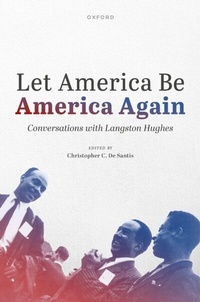
Let America Be America Again
Conversations with Langston Hughes
1st Edition
Published on 28. July 2022
320 pages
978-0-19-266710-6 (ISBN)
Description

A collection of interviews, speeches, and essays by Langston Hughes.
Let America Be America Again: Conversations with Langston Hughes is a record of a remarkable man talking. In texts ranging from early interviews in the 1920s, when he was a busboy and scribbling out poems on hotel napkins, to major speeches, such as his keynote address at the First World Festival of Negro Arts in Dakar, Senegal, in 1966, Hughes's words further amplify the international reputation he established over the course of five decades through more widely-published and well-known poems, stories, novels, and plays.
In these interviews, speeches, and conversational essays, the writer referred to by admirers as the "Poet Laureate of the Negro Race" and the "Dean of Black Letters" articulated some of his most powerful critiques of fascism, economic and racial oppression, and compromised democracy. It was also through these genres that Hughes spoke of the responsibilities of the Black artist, documented the essential contributions of Black people to literature, music, and theatre, and chronicled the substantial challenges that Black artists face in gaining recognition, fair pay, and professional advancement. And it was through these pieces, too, that Hughes built on his celebrated work in other literary genres to craft an original, tragic-comic persona--a Blues poet in exile, forever yearning for and coming back to a home, a nation, that nevertheless continues to disappoint and harm him. A global traveler, Hughes's words, "Let America be America Again" were, throughout his career, always followed by a caveat: "America never was America to me."
More details
Other editions
Additional editions
Langston Hughes | Christopher C. De Santis
Let America Be America Again
Conversations with Langston Hughes
Book
08/2022
Oxford University Press
€46.00
Shipment within 15-20 days
Persons
Christopher C. De Santis is Professor of English at Illinois State University, where he served as Graduate Program Director from 2009-2013 and Chair of the Department of English from 2013-2022. He is editor of Langston Hughes: A Documentary Volume; Langston Hughes and the Chicago Defender: Essays on Race, Politics, and Culture, 1942-62; and two volumes in The Collected Works of Langston Hughes-Essays on Art, Race, Politics, and World Affairs and Fight for Freedom and Other Writings on Civil Rights. His work has also appeared in African American Review, American Studies, CLA Journal, Contemporary Literary Criticism, Langston Hughes Review, The Oxford Companion to African American Literature, The Southern Quarterly, and other publications.
Content
- Introduction
- 1: From Busboy Poet to an International Voice for the Working Masses
- "Langston Hughes, 'Busboy Poet' and Writer of 'Weary Blues,' Tells How a Long Shot First Gave Him a Chance to Scale Height," 1926
- Langston Hughes, "The Negro Artist and the Racial Mountain," 1926
- Floyd J. Calvin, "Langston Hughes Answers His Critics," 1927
- Langston Hughes, "These Bad New Negroes: A Critique on Critics," 1927
- Nicolás Guillén, Translated by Edward J. Mullen, "Conversation with Langston Hughes," 1929
- Langston Hughes, "Negro Art and Its Audience," 1931
- Langston Hughes, "Negro Art and Publicity Value," 1931
- Langston Hughes, "Negro Art and The Artist," 1931
- "Langston Hughes Sends Message From Russia to Voters: Noted Poet Sees Hope in Communist Party," 1932
- Langston Hughes, "Portion of a Speech by Langston Hughes Before the Pan-Pacific Club of Tokyo, June 30, 1933, As Reported in the Japan Advertiser Tokyo, July 1, 1933"
- Langston Hughes, "From Moscow to Shanghai," 1933
- "Negro Author Is Tossed Out by Japanese-Writer Prohibited to Stay in Japan After Visits to Russia and Shanghai," 1933
- Langston Hughes, "To Negro Writers,""1935
- Langston Hughes, Radio Broadcast Regarding the Third United States Congress Against War and Fascism, Cleveland, Ohio, 1936
- Langston Hughes, Excerpt from "The Negro Faces Fascism," a speech Hughes made at the Third U. S. Congress Against War and Fascism, Cleveland, Ohio, 1936
- Langston Hughes, "Too Much of Race," 1937
- Langston Hughes, "Negroes in Spain," 1937
- Langston Hughes, "Madrid's House of Culture," 1937
- "Negro Poet Notes Racial Prejudices-Langston Hughes Declares It Exists Throughout North America," 1938
- George Harris, "The Worker's Poet: An Interview with Langston Hughes," 1938
- Langston Hughes, "Writers, Words and the World," Speech at the International Writers Association for the Defense of Culture, Paris, France, 1938
- Langston Hughes, "Democracy and Me," Speech at the Public Session of the Third American Writers' Congress, Carnegie Hall, New York City, 1939
- 2: Jim Crow, Economics, War, and the Black Writer
- "Dunbar Gave Inspiration to His Work, Author Says," 1940
- Langston Hughes, "Let's Get It Straight [Concerning 'Goodbye, Christ']," 1941
- Langston Hughes, "Democracy, Negroes, and Writers," Speech made in absentia, Fourth Congress of the League of American Writers, New York City, 1941
- "Poet Explains Crux of Color Problem Here-Langston Hughes Reads Many Poems at Century Club," 1943
- Langston Hughes and Others, "Let's Face the Race Question," 1944
- "Hughes Speaks On Racial Works: Tells of His Observations of Minority Problems in Other Nations," 1944
- "Poetry To Be Appreciated Must 'Come Easy'-Langston Hughes," 1944
- William A. Caldwell, "Decay of an Idea: II," 1945
- Stella Kamp, "Langston Hughes Speaks to Young Writers," 1946
- Mary Harrington, "Jim Crow Can't Keep a Poet Down," 1947
- Langston Hughes and the Editors, "Some Practical Observations: A Colloquy," 1950
- Langston Hughes, "Ten Ways to Use Poetry in Teaching," speech at the Public Meeting of the College Language Association's Eleventh Annual Conference, Morgan State College, Baltimore, Maryland, 1951
- 3: Hughes Faces McCarthyism
- Testimony of Langston Hughes (Accompanied by His Counsel, Frank D. Reeves), Tuesday, 24 March 1953
- Public Testimony of Langston Hughes (Accompanied by His Counsel, Frank D. Reeves), 26 March 1953
- "Langston Hughes Speaks," 1953
- 4: The Racial Artist Confronts the Blacklist
- Langston Hughes, "Jazz as Communication," 1956
- Langston Hughes, "Humor and the Negro Press," 1957
- Langston Hughes, "Langston Hughes Speech at the National Assembly of Authors and Dramatists Symposium: 'The Writer's Position in America," 1957
- Martha MacGregor, "Simple Is Back," 1957
- Ted Poston, "Closeup: The 'Simple' World of Langston Hughes," 1957
- Jim Davis, "F.Y.I.-For Your Information," 1958
- Langston Hughes, "Writers: Black and White," Speech at The American Society of African Culture's Conference of Negro Writers, New York City, 1959
- Langston Hughes, "Langston Hughes' Acceptance of the Spingarn Medal," 1960
- "Langston Hughes, Writer (No Date)," 1960
- "Ministers Protest Poet's Mills Talk," 1961
- "Langston Hughes Interviewed by Reuben and Dorothy Silver," 1961
- 5: The International Dignitary Caps a Distinguished Career
- Nat Hentoff, Moderator, with Langston Hughes and Others, "The Negro in American Culture," 1961
- Ted Poston, "Closeup: At Home with the Poet," 1962
- Langston Hughes, "American Interest in African Culture," Address at the Opening of the USIS Center and Library, Accra, Ghana, 1962
- Lewis Nichols, "Poems to Play: Langston Hughes Describes the Genesis of His 'Tambourines to Glory,'" 1963
- Walter Kerr, "Banned on TV, Writer's Story Told: 'I'm Not a Formal Poet . . . Highly Conventional,'" 1963
- Langston Hughes, "Hold Fast to Dreams," Address at Lincoln University, Pennsylvania, 1964
- Langston Hughes and Geoffrey Bridson, "Langston Hughes Discusses the Position of the Negro in America Today," 1964
- Langston Hughes, "A Letter from America," 1965
- Langston Hughes, "Black Writers in a Troubled World," Address at the First World Festival of Negro Arts, Dakar, Senegal, 1966
- Richard Rive, "Taos in Harlem: An Interview with Langston Hughes," 1967
- Notes
