

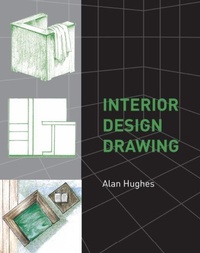
Interior Design Drawing
Published on 31. August 2013
176 pages
978-1-84797-667-3 (ISBN)
Description

Interior design is a multidiscipline profession blending spatial, technical and aesthetic knowledge. The skill involved in manipulating these elements to solve specific design problems is intrinsically linked to drawing. Interior Design Drawing explores all aspects of this vital design skill, from sketching to record information, through orthographics and development to analyse the problem, to presentation drawing to communicate the solution.
Explore the role of drawing in the design process
Understand the main orthographic drawings
Use line, tone and colour across 2D and 3D drawings
Add texture and atmosphere to drawings
Consider aspects of composition and presentation of a set of drawings
Explore the role of drawing in the design process
Understand the main orthographic drawings
Use line, tone and colour across 2D and 3D drawings
Add texture and atmosphere to drawings
Consider aspects of composition and presentation of a set of drawings
More details
Language
English
Place of publication
Marlborough
United Kingdom
Target group
College/higher education
Illustrations
Illustrations; 130 Illustrations, color
File size
20,63 MB
ISBN-13
978-1-84797-667-3 (9781847976673)
Copyright in bibliographic data and cover images is held by Nielsen Book Services Limited or by the publishers or by their respective licensors: all rights reserved.
Schweitzer Classification
Other editions
Additional editions
Alan Hughes
Interior Design Drawing
Book
09/2008
The Crowood Press Ltd
€27.50
Shipment within 15-20 days
Person
Alan Hughes has a degree in Visual Communication and an MA in Interior Architecture. He has taught at undergraduate and post-graduate levels in many institutions and is currently Faculty Director and Vice Principal at the Inchbald School of Design in London. He has worked in 2D and 3D design across many disciplines, with clients ranging from museums to commercial architectural and landscape practices. Resident - Sussex
Content
- Intro
- INTERIOR DESIGN DRAWING
- CONTENTS
- CHAPTER 1 INTRODUCTION
- The Purposes of Interior Design
- Methods of Communication in Interior Design
- Designing with Intention
- Why Designers Draw
- CHAPTER 2 SKETCHING
- Why We Need to Sketch
- Seeking and Looking
- Understanding What Can Be Seen
- Tools for the Job
- A ring-bound, hard-cover sketch pad (A4 or larger, cartridge paper)
- Graphite pencils (2B, 3B, 4B and 6B)
- Coloured pencils
- Fine felt-tip pens
- An eraser
- A pencil sharpener
- The Process
- Interest
- Analysis
- Form
- Scale and proportion
- Light and shade
- Perspective
- Texture and surface detail
- Method
- The 2D view
- The 3D view
- Sketching to Scale
- Method
- CHAPTER 3 ORTHOGRAPHICS
- Orthographic Projection
- Tools for the Job
- A drawing board
- An adjustable set square
- A scale rule
- Paper
- Masking tape
- Pencils and pens
- Erasers
- Compasses and circle templates
- On the Drawing Board: The Plan
- Seeing the plan
- Drawing method
- Tracing and inking your copy negative
- The Hierarchy of Line
- Multi-View Drawings
- The Elevation
- Elevational hierarchy of line
- The Cross Section
- Sectional hierarchy of line
- CHAPTER 4 3D PROJECTION
- The Formal and the Instinctual
- The Axonometric
- First principles
- Method
- Axonometric hierarchy of line
- Perspective
- One-point perspective
- Supporting the illusion of depth within a drawing
- Two-point perspective
- Creating circles in perspective
- CHAPTER 5 RENDERING TECHNIQUES AND SHADING
- Finishing Your Drawing to Suit Its Purpose
- Rendering Methods
- Rendering in black and white
- Coloured pencils
- Pastels
- Marker pens
- Technical Tips
- Wooden floorboards
- Stone
- Stone paving and similar
- Tiles and shiny unit surfaces
- Glass
- Mirrors
- Sky
- Fabric
- Metal
- Water
- Foliage
- People
- Summary
- CHAPTER 6 PRESENTATION
- Your Portfolio
- Keep it simple
- Selecting and arranging your work
- Electronic portfolios
- Presentation and Graphic Identity
- Page design
- Text
- Layout and composition
- Style
- Precision and dimensioning
- The Mechanics of Presentation
- Professional printing
- Fabrics, illustrations and mood boards
- Presentation examples
- CHAPTER 7 INSPIRATION
- Examining Historical and Contemporary Designs
- Communicating the Use of the Space
- Absorbing Influences and Gleaning Ideas
- Visual reference
- Compiling Drawings for Presentation
- Composition considerations
- The Ongoing Importance of Drawing
- FURTHER READING
- LIST OF SUPPLIERS
- Art Shops in London
- Commercial Printers in London
- GLOSSARY
- GLOSSARY OF EQUIPMENT
- INDEX
