

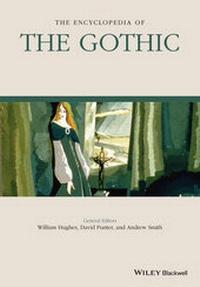
The Encyclopedia of the Gothic
Description

Reviews / Votes
"The essays are well written and interesting, and many of them provide moments of real and pleasurable insight ... [It is] a testament to the breadth and depth of knowledge about its central subject among the more than 130 contributing writers, and also among the three editors, each of whom is a significant figure in the field of gothic studies ... A reference work that's firmly rooted in and actively devoted to expressing the current state of academic scholarship about its area." New York Journal of Books "It includes over 200 commissioned essays from experts in gothic studies ...The entries are well written and vary in length from one to five thousand words. Recommended." Choice "A substantial achievement ... An essential addition for humanities libraries, particularly those with researchers active in Gothic." Reference Reviews"A substantial achievement ... "--(ReferenceReviews, 1 November 2013)More details
Other editions
Additional editions
Persons
Content
Notes on Contributors
Jane Aaron is a Professor in the School of Humanities at the University of Glamorgan, where she teaches courses on Welsh writing in English. She is the author of A Double Singleness: Gender and the Writings of Charles and Mary Lamb (1991); Nineteenth-Century Women's Writing in Wales: Nation, Gender and Identity (2007), which won the Roland Mathias Prize in 2009; and coeditor of Our Sisters' Land: The Changing Identities of Women in Wales (1994), Postcolonial Wales (2005), and Gendering Border Studies (2010). She is also the series editor of Honno Press' reprints of Welsh women writers and coeditor of two of the University of Wales Press' book series, Gender Studies in Wales and Writers of Wales.
Emily Alder is a part-time Lecturer in Literature at Edinburgh Napier University and Associate Lecturer at the Open University in Scotland. She researches intersections of literature and science, particularly in the late-Victorian and Edwardian period, but also in contemporary science fiction; she has published articles on H. G. Wells, William Hope Hodgson, and Stephen Donaldson, and is coeditor of Gothic Science Fiction, 1980-2010 (2011).
Katarzyna Ancuta is a Lecturer at Assumption University in Bangkok, Thailand. Her publications are concerned with interdisciplinary contexts of contemporary Gothic and Horror, (South)-East Asian cinema, and supernatural anthropology. She is currently working on a book on Asian Gothic, a multimedia project on Bangkok Gothic, and a number of local film projects.
Agnes Andeweg is a Lecturer at the Centre for Gender and Diversity of Maastricht University. In her PhD thesis she analyzed Gothic in contemporary Dutch novels (Griezelig gewoon. Gotieke verschijningen in Nederlandse romans, 1980-1995, forthcoming). She published on the same topic in Van Elferen, Nostalgia or Perversion (2007). Currently she is working on a project about Gothic kinship.
Lucie Armitt is Professor of Literary and Cultural Studies at the University of Salford, where she teaches nineteenth-, twentieth-, and twenty-first-century fiction, including a Master's level module on the Gothic. Her principal publications include Where No Man Has Gone Before: Women and Science Fiction (1991), Theorising the fantastic (1996), Contemporary Women's Fiction and the Fantastic (2000), George Eliot: Readers' Essential Guide to Criticism (2000), Fantasy Fiction (2005), and Twentieth-Century Gothic (2011).
John S. Bak is Professeur at Nancy-Université in France, where he teaches courses in literary journalism, American drama, and American Gothic. His books on the Gothic and on Tennessee Williams include Post/modern Dracula: From Victorian Themes to Postmodern Praxis (editor, 2006), New Selected Essays: Where I Live (editor, 2009), and Ernest Hemingway, Tennessee Williams, and Queer Masculinities (2009).
Colette Balmain is an independent scholar as well as a Lecturer in Film and Media Studies. Her area of research is horror cinema and Gothic studies, with a particular research interest in East Asian cinema and cultures. Her first book, Introduction to Japanese Horror Film, was published in 2008. She is currently working on her second book, on Korean horror cinema, and is also the editor for Directory of World Cinema: South Korea.
Mackenzie Bartlett is a Lecturer in English Literature at Mount Saint Vincent University, Canada. She completed her PhD at Birkbeck College (University of London) in 2009 and has published and presented papers on Gothic fiction and the pathologization of laughter in late Victorian Britain. Her current research is in humor theory and the expression of laughter in twentieth-century horror films.
Mark Bennett is a PhD student at the University of Sheffield, researching the relationship between travel writing and the emergence of the Gothic at the end of the eighteenth century. He is an ongoing contributor to the Routledge A. B. E. S. database and a reviewer for the journal Gothic Studies, and has produced material for The Victorian Literature Handbook (ed. Alexandra Warwick and Martin Willis, 2008).
Christine Berthin, Professor of English, Université de Paris Ouest Nanterre, has published widely on Gothic topics and on Romanticism. She is the author of Gothic Hauntings: Melancholy Crypts and Textual Ghosts (2010).
Ruth Bienstock Anolik teaches at Villanova University and Temple University. Most of her work focuses on the Gothic with a special interest in the interplay between Gothic literature and social and cultural structures. She has published essays in Modern Language Studies, Legal Studies Forum, Partial Answers, and Studies in American Jewish Literature. Her essay on Toni Morrison's A Mercy appears in the collection 21st Century Gothic (2010) She has edited three collections of essays on the Gothic: The Gothic Other: Racial and Social Constructions in the Literary Imagination (2004), Horrifying Sex: Essays on Sexual Difference in the Gothic Imagination (2007), and Demons of the Body and Mind: Essays on Disability in Gothic Literature (2010).
Francesca Billiani is Senior Lecturer in Italian Studies at the University of Manchester. She is the author of Culture nazionali e narrazioni straniere, Italia 1903-1943 (2007), editor of Modes of Censorship and Translation: National Contexts and Diverse Media (2007) and coeditor of The Italian Gothic and Fantastic: Encounters and Rewritings of Literary Traditions (2007). She has published articles on Italian literature and culture, Fascist censorship, cosmopolitanism, and several contributions on nineteenth-century Italian Gothic literature. She is currently working on a monograph on Modernism and Italian Fascism as well as on a coauthored book on post-1945 Italian intellectual engagement.
Peter Billingham is Head of the Performing Arts Department and Reader in Political Drama at the University of Winchester. He is a very experienced teacher, researcher, and writer. His monograph At the Sharp End (2008) was nominated for the Theatre Book Prize and the Writers' Guild Theatre Book Award. He is currently researching Edward Bond: A Critical Study (forthcoming in 2013). He is also an award-winning playwright and his latest play, The Pornographer of Vienna, is about the controversial artist Egon Schiele.
Linnie Blake is Principal Lecturer in Film in Manchester Metropolitan University's Department of English. She has contributed a range of papers to national and international conferences in the area of film and Gothic studies and has published widely on topics ranging from Torchwood's queer Gothic to Edgar Allan Poe and from the Situationist International to gameshow horror in recent Thai cinema. Her most recent book is The Wounds of Nations (2008), a study of the politics of national trauma as evinced in the postwar horror cinemas of America, Britain, Germany, and Japan.
Fred Botting is Professor in the School of Humanities, Kingston University, London. His two most recent books are Limits of Horror (2008) and Gothic Romanced (2008). He is coeditor (with Scott Wilson) of Bataille: A Critical Reader (1998). His research interests include cultural and critical theory (psycho- and schiz-analysis); Bataille and general economy; romanticism and postmodernism; techno-poiesis; uncanny media (Gothic technologies, cybergothic, neuromanticism); smoking; sublimity; consumption and horror; and zombies.
Benjamin A. Brabon is Senior Lecturer in English Literature at Edge Hill University. His book-length publications include (with Stéphanie Genz) Postfeminist Gothic: Critical Interventions in Contemporary Culture (2007) and Postfeminism: Cultural Texts and Theories (2009), as well as the single-authored monograph Gothic Cartography: A Literary Geography of Haunting (2011). He is currently editing a collection of essays on The Postfeminist Eighteenth Century.
Elisabeth Bronfen is Professor for English and American studies at the University of Zurich. She is the author of Over Her Dead Body: Death, Femininity and the Aesthetic (1992), The Knotted Subject: Hysteria and its Discontents (1998), and a cultural history of the night, forthcoming from Columbia University Press.
Glennis Byron is Professor of English at the University of Stirling. She has published various books and articles on Victorian and contemporary Gothic. Global Gothic, a collection of essays emerging from the AHRC Global Gothic network, is forthcoming from Manchester University Press.
James Campbell is a doctoral student at the University of Stirling, where in 2009 he completed a BA in English Studies before taking the department's MLitt in The Gothic Imagination. His thesis, begun in 2010, reframes American Gothic in the context of globalization. To date, he has presented papers on DC Comics' Batman franchise and Washington Irving's "The Legend of Sleepy Hollow," and recently contributed an article scheduled for inclusion in Glennis Byron's forthcoming critical anthology Globalgothic.
Stephen Carver gained his PhD in English Literature from the University of East Anglia in 2000. He currently teaches creative writing...
