

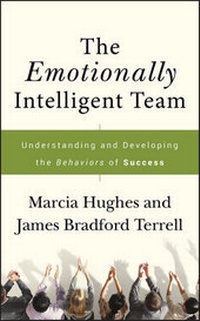
The Emotionally Intelligent Team
Understanding and Developing the Behaviors of Success
Published on 13. January 2011
224 pages
978-1-118-04740-8 (ISBN)
Description

"Finally, a resource....guide...roadmap....to help team members andteam leaders alike understand what it takes to function as a highperforming team, how doing so can personally enrich your life, andwhy it's critical for organizations to function only in this way.The Emotionally Intelligent Team connects the dots betweenthe task at hand, achieving and making a difference, and personalhappiness. Imagine where humankind would be if every entity on theplanet operated within a series of high performing teams. MarciaHughes and James Terrell show us that it's possible!"
--Suzanne Kirk, SVP, Branch Service Center, Bank of the West
"We value teams at Medtronic so we know that this book will be apowerful tool in understanding and developing successful teambehaviors!"
--Michael Mihalczo, District Manager, Walter Cooper, DistrictManager, Medtronic CRDM
"Marcia Hughes' and James Terrell's latest book, TheEmotionally Intelligent Team, is a 'must read' for every schooldistrict, business and organization that wants to ensure highfunctioning and productive teams. Based on solid research, thiseasy-to-read book describes the seven social emotional skillsnecessary for effective teams, and includes practical strategiesany team leader can use to develop and maintain an emotionallyintelligent team. Marcia's and James' book has been of tremendousvalue to the work of the senior administrative team in our schooldistrict!"
--Linda Fabi, Director of Education, Waterloo Region DistrictSchool Board
"Marcia and James provide a good lens for the way people viewothers in a team environment. This insight, when combined withmeasuring one's own EQ through a test such as the EmotionalQuotient inventory (EQ-i ®), provides a powerful lever forimproving team performance."
--Steven J. Stein, Ph.D., Founder and CEO of MHS, Co-author ofthe best seller The EQ Edge: Emotional Intelligence and YourSuccess and author of Make Your Workplace Great: The 7 Keysto an Emotionally Intelligent Organization
"Discovering ways to strengthen teams in an organization canlead to impressive improvement in morale, engagement, productivity,and results. The Emotionally Intelligent Team will help anyteam take practical steps toward greater collaboration andeffectiveness."
--Brian Twillman, EPA Training Officer & OrganizationDevelopment Specialist, Lead Author EPA's Team Leader ResourceGuide US EPA - Office of Executive Services, Office of theAdministrator
"The most important issue in our networked world is teamworkacross levels and boundaries. This masterful work offers acompletely new perspective, bringing the power of emotional andsocial intelligence through engaging insights, exercises andstories to high performance teamwork - creating the opportunity forpotentially extraordinary results that are seamless, dynamic, andproductive."
--Eileen Rogers, Global Director, Leadership ExcellencePrograms, Deloitte
In this compelling book, authors Marcia Hughes and James Terrelloffer practical information and a guide for businesses that want todraw on the power of the emotional competencies of their teams.They reveal how individuals, team members, and leaders can take thesteps to become more emotionally intelligent team (ESI) members andshow how to put in place the practices and exercises that will helpany team grow in emotional intelligence. The book outlines theseven emotional competencies of teams.
--Suzanne Kirk, SVP, Branch Service Center, Bank of the West
"We value teams at Medtronic so we know that this book will be apowerful tool in understanding and developing successful teambehaviors!"
--Michael Mihalczo, District Manager, Walter Cooper, DistrictManager, Medtronic CRDM
"Marcia Hughes' and James Terrell's latest book, TheEmotionally Intelligent Team, is a 'must read' for every schooldistrict, business and organization that wants to ensure highfunctioning and productive teams. Based on solid research, thiseasy-to-read book describes the seven social emotional skillsnecessary for effective teams, and includes practical strategiesany team leader can use to develop and maintain an emotionallyintelligent team. Marcia's and James' book has been of tremendousvalue to the work of the senior administrative team in our schooldistrict!"
--Linda Fabi, Director of Education, Waterloo Region DistrictSchool Board
"Marcia and James provide a good lens for the way people viewothers in a team environment. This insight, when combined withmeasuring one's own EQ through a test such as the EmotionalQuotient inventory (EQ-i ®), provides a powerful lever forimproving team performance."
--Steven J. Stein, Ph.D., Founder and CEO of MHS, Co-author ofthe best seller The EQ Edge: Emotional Intelligence and YourSuccess and author of Make Your Workplace Great: The 7 Keysto an Emotionally Intelligent Organization
"Discovering ways to strengthen teams in an organization canlead to impressive improvement in morale, engagement, productivity,and results. The Emotionally Intelligent Team will help anyteam take practical steps toward greater collaboration andeffectiveness."
--Brian Twillman, EPA Training Officer & OrganizationDevelopment Specialist, Lead Author EPA's Team Leader ResourceGuide US EPA - Office of Executive Services, Office of theAdministrator
"The most important issue in our networked world is teamworkacross levels and boundaries. This masterful work offers acompletely new perspective, bringing the power of emotional andsocial intelligence through engaging insights, exercises andstories to high performance teamwork - creating the opportunity forpotentially extraordinary results that are seamless, dynamic, andproductive."
--Eileen Rogers, Global Director, Leadership ExcellencePrograms, Deloitte
In this compelling book, authors Marcia Hughes and James Terrelloffer practical information and a guide for businesses that want todraw on the power of the emotional competencies of their teams.They reveal how individuals, team members, and leaders can take thesteps to become more emotionally intelligent team (ESI) members andshow how to put in place the practices and exercises that will helpany team grow in emotional intelligence. The book outlines theseven emotional competencies of teams.
More details
Other editions
Additional editions
Marcia Hughes | James Bradford Terrell
The Emotionally Intelligent Team
Understanding and Developing the Behaviors of Success
Book
11/2007
1st Edition
Jossey-Bass
€26.50
Shipment within 10-20 days
Persons
The Authors
MARCIA HUGHES is president of Collaborative Growth, L.L.C.,a firms pecializing in emotional intelligence, leadership and team development, and conflict resolution, through keynotes, training, executive coaching, and strategic design.
JAMES TERRELL, her partner, develops EI applications and coaches individuals, teams in transition, and senior management in anticipating change and responding to it resiliently.
MARCIA HUGHES is president of Collaborative Growth, L.L.C.,a firms pecializing in emotional intelligence, leadership and team development, and conflict resolution, through keynotes, training, executive coaching, and strategic design.
JAMES TERRELL, her partner, develops EI applications and coaches individuals, teams in transition, and senior management in anticipating change and responding to it resiliently.
Content
Introduction 1
PART ONE: THE VALUE OF EMOTIONAL AND SOCIAL INTELLIGENCE FOR YOUR TEAM 9
1 Why Emotional Intelligence Is So Valuable for Teams 11
2 The Business Case for Team Emotional Intelligence 26
PART TWO: THE SEVEN SKILLS OF A TEAM'S EMOTIONAL AND SOCIAL INTELLIGENCE 35
3 The First Skill: Team Identity 37
4 The Second Skill: Motivation 55
5 The Third Skill: Emotional Awareness 69
6 The Fourth Skill: Communication 88
7 The Fifth Skill: Stress Tolerance 106
8 The Sixth Skill: Confl ict Resolution 121
9 The Seventh Skill: Positive Mood 139
PART THREE: RESULTS GAINED BY EMOTIONALLY AND SOCIALLY INTELLIGENT TEAMS 155
10 The Emotionally Intelligent Team Player 157
11 Leading the Emotionally Intelligent Team 169
12 Values and Ethics 182
13 Results 190
14 Conclusion 202
References 204
Acknowledgments 209
About the Authors 211
Index 213
PART ONE: THE VALUE OF EMOTIONAL AND SOCIAL INTELLIGENCE FOR YOUR TEAM 9
1 Why Emotional Intelligence Is So Valuable for Teams 11
2 The Business Case for Team Emotional Intelligence 26
PART TWO: THE SEVEN SKILLS OF A TEAM'S EMOTIONAL AND SOCIAL INTELLIGENCE 35
3 The First Skill: Team Identity 37
4 The Second Skill: Motivation 55
5 The Third Skill: Emotional Awareness 69
6 The Fourth Skill: Communication 88
7 The Fifth Skill: Stress Tolerance 106
8 The Sixth Skill: Confl ict Resolution 121
9 The Seventh Skill: Positive Mood 139
PART THREE: RESULTS GAINED BY EMOTIONALLY AND SOCIALLY INTELLIGENT TEAMS 155
10 The Emotionally Intelligent Team Player 157
11 Leading the Emotionally Intelligent Team 169
12 Values and Ethics 182
13 Results 190
14 Conclusion 202
References 204
Acknowledgments 209
About the Authors 211
Index 213
INTRODUCTION Everyone has inside of him a piece of good news. The good news is that you don't know how great you can be! How much you can love! What you can accomplish! And what your potential is! ANNE FRANK
Forget about the "flavor of the month" management strategy fraught with consultants and catchy programs: this isn't that book. This is about how to thrive in this nutty world and nuttier business environment by intentionally evolving, albeit quickly, because you can't even afford to wait a year, let alone a couple of hundred millennia. Your organization is on the edge of obsolescence if it's not evolving its emotional and social intelligence (ESI). You've heard the bottom line before: IQ is important, but emotional intelligence is the true brain trust of the organization. Using emotional intelligence effectively is the next evolution of human enterprise. The world has changed. Once we thought it was flat. It wasn't. Once we thought it was run by monolithic factories and assembly lines built to last. It's not. Once we thought that an M.B.A. and wireless technology would secure the future. They won't. Reams of research all point to a single golden ticket. The passport to sustained viability is emotional intelligence. There is great news for teams. The fields of neurology and organizational development are advancing so quickly that a body of evidence has emerged that demonstrates which emotionally and socially intelligent behaviors have a direct correlation with organizational success. We're talking about measurable success, not simply an improvement on the "feel-good meter." There are practical steps to take as an individual, a team member, and a leader that yield tangible results such as improved productivity, higher profits, lower turnover, fewer errors, greater innovation, and better efficiency-the Holy Grail of successful organizations. Our focus on team emotional and social intelligence is truly a practical opportunity to evolve and prosper. The purpose of this book is to clarify the systematic process that will enable you to reduce the unproductive conflict, uncertainty, and delays all teams encounter. It will help teams of all shapes and sizes respond more resiliently to the continuous onslaught of change they must tame and transform into successful projects and productive results. Every team-whether it's a permanent work team, a committee, a project team, or a family-needs better ESI. If you are involved in a team, that team has deep and significant emotional interactions, guaranteed. Furthermore, by virtue of being on a team, you are in a social environment. Because these emotional and social implications for your team are enormous, it is imperative that you care, if you care to succeed. The Emotionally Intelligent Team applies to all kinds of teams-at work, at play, at church, on the diamond, on the gridiron, or anywhere else. Because so much research and attention is focused on teams in the workplace, we drew most of our examples from there. Our research and examples span a wide spectrum of team types, from industry to government to nonprofits. You'll encounter a rich diversity of executive teams, departmental teams, IT teams, construction teams, nonprofit boards, and many more. The list is long and colorful. The principles that affect team dynamics are true, regardless of whether it is an interdisciplinary medical team, a group of high school cheerleaders, or contenders for the Super Bowl. Sports teams epitomize the profound role that emotions have in the workplace-it's the same as on the field. Nervous energy, jubilation, panic, anxiety as the momentum shifts, utter despair, supreme joy. How teams manage the extreme range of emotions that are packed into a game often determines the outcome. One of the beauties of sports is the unabashed role and importance accorded to emotional intelligence. Its presence is considered a huge competitive advantage, while its absence is often criticized as the hallmark of an undisciplined team. Corporations and nonprofits would do well to recognize the same.
The real act of discovery consists not in finding new lands but in seeing with new eyes. MARCEL PROUST
Emotional and social intelligence is all about seeing with new eyes, hearing with new ears, and acting with new awareness and sensitivity. The key concepts that frame this book are the following: Emotional and Social Intelligence (ESI). Because it is impossible for a group of people to interact and not have social implications, we use the concept of emotional and social intelligence to help teams understand and master the behaviors of success. We have developed one of the first tools designed for determining team ESI, not just individual ESI. The Collaborative Growth Team Emotional and Social Intelligence Survey (TESIT) is a self-assessment tool used to help team members recognize and develop specific skills for success. (The survey will be published in 2008; you can contact us if you'd like more information.) Collaborative Intelligence. Collaboration is a composite skill that emerges from the masterful use of your ESI skills. The members of a football team collaborate when they huddle and agree that they will each do their part to execute a particular play. In the middle of the play, except in the face of an unexpected opportunity, the fullback won't decide to change the play because he'd prefer to run the ball rather than block! Team loyalty is unquestioned. When your team collaborates, you take time to explore alternative answers and find a solution that integrates the wisdom of the team. It takes more time up front, because you invest in listening to one another, to thinking things through, and to coordinating the execution of your response with genuine respect for one another. Collaboration pays off big time as you and your team progress. Your self-discipline and collective intuition will make the future much easier to navigate because teams that coordinate their ESI skills naturally act with collaborative intelligence. This set of coordinated competencies is the birthplace of synergy. Teams tap into their shared memory and individual capacities to maximize their knowledge, problem-solving capabilities, and resilience. They respond with agility to the fluctuating emotional and social contexts of the team and the organizational dynamics. The correct blend of ESI skills is the rocket fuel that propels your team to achieve its full collaborative capacity. Emotional Literacy for Your Team. Team smarts are the powerful result of learning to read. Read between the lines, read the writing on the wall, read people's lips! Team smarts call for: Reading one another to understand how you feel and why, to determine the most effective response given the situation. Reading the group as a whole to determine what is needed to keep your team highly energized and effective. Reading the environment and accurately discerning and responding to the organization and leadership dynamics, politics, and shifting winds.
Jeremy Irons won the 2007 Golden Globe award for best supporting actor for his role in Elizabeth I. In his acceptance speech, he said, "Why is it that the jobs that are the most fun are the ones for which you get the rewards?" His big smile indicated the honesty of this powerful reflection. The three parts of this book, and the explanations, wisdom, and tips packed inside, are designed to help your team gain rewards-both intrinsic and extrinsic-while you have fun with your work and with one another. Part One explains what constitutes an ESI team, why it is valuable, and how to understand emotional intelligence. Part Two is the heart of the book. It covers the seven skills that make up ESI. It explores the intricacies of each skill and provides examples of the skill in action and ways to incorporate the skill into your repertoire. It's not rocket science; it's brain chemistry. Much of ESI is rooted in how the brain works and responds to stimuli. Seven skills are essential to an emotionally intelligent team: identity, motivation, emotional awareness, communication, stress tolerance, conflict resolution, and positive mood. These competencies are like the Seven Wonders of the World. They are powerful abilities that can redefine the landscape in which your team operates. Undoubtedly, as you apply them to your team, you'll discover unique ways to incorporate these behaviors to maximize your team's success. Part Three completes your discovery by identifying what the individual team player needs to bring to the table, what the ESI leader needs to add, and values and ethics central to the integrity required of an ESI team. All of this leads to the extraordinary results you are seeking. Believe it or not, teams seek trust, loyalty, and effectiveness above all, and those drive performance.
To be an ESI team, you need to understand what makes teams work together well and how they can become even more productive and rewarding to their members. Building that understanding is a core purpose of this book. We assert that human behavior is motivated by the desire to improve the quality of life and that teams exist because the tasks that improve the quality of life are often too complex for...
Forget about the "flavor of the month" management strategy fraught with consultants and catchy programs: this isn't that book. This is about how to thrive in this nutty world and nuttier business environment by intentionally evolving, albeit quickly, because you can't even afford to wait a year, let alone a couple of hundred millennia. Your organization is on the edge of obsolescence if it's not evolving its emotional and social intelligence (ESI). You've heard the bottom line before: IQ is important, but emotional intelligence is the true brain trust of the organization. Using emotional intelligence effectively is the next evolution of human enterprise. The world has changed. Once we thought it was flat. It wasn't. Once we thought it was run by monolithic factories and assembly lines built to last. It's not. Once we thought that an M.B.A. and wireless technology would secure the future. They won't. Reams of research all point to a single golden ticket. The passport to sustained viability is emotional intelligence. There is great news for teams. The fields of neurology and organizational development are advancing so quickly that a body of evidence has emerged that demonstrates which emotionally and socially intelligent behaviors have a direct correlation with organizational success. We're talking about measurable success, not simply an improvement on the "feel-good meter." There are practical steps to take as an individual, a team member, and a leader that yield tangible results such as improved productivity, higher profits, lower turnover, fewer errors, greater innovation, and better efficiency-the Holy Grail of successful organizations. Our focus on team emotional and social intelligence is truly a practical opportunity to evolve and prosper. The purpose of this book is to clarify the systematic process that will enable you to reduce the unproductive conflict, uncertainty, and delays all teams encounter. It will help teams of all shapes and sizes respond more resiliently to the continuous onslaught of change they must tame and transform into successful projects and productive results. Every team-whether it's a permanent work team, a committee, a project team, or a family-needs better ESI. If you are involved in a team, that team has deep and significant emotional interactions, guaranteed. Furthermore, by virtue of being on a team, you are in a social environment. Because these emotional and social implications for your team are enormous, it is imperative that you care, if you care to succeed. The Emotionally Intelligent Team applies to all kinds of teams-at work, at play, at church, on the diamond, on the gridiron, or anywhere else. Because so much research and attention is focused on teams in the workplace, we drew most of our examples from there. Our research and examples span a wide spectrum of team types, from industry to government to nonprofits. You'll encounter a rich diversity of executive teams, departmental teams, IT teams, construction teams, nonprofit boards, and many more. The list is long and colorful. The principles that affect team dynamics are true, regardless of whether it is an interdisciplinary medical team, a group of high school cheerleaders, or contenders for the Super Bowl. Sports teams epitomize the profound role that emotions have in the workplace-it's the same as on the field. Nervous energy, jubilation, panic, anxiety as the momentum shifts, utter despair, supreme joy. How teams manage the extreme range of emotions that are packed into a game often determines the outcome. One of the beauties of sports is the unabashed role and importance accorded to emotional intelligence. Its presence is considered a huge competitive advantage, while its absence is often criticized as the hallmark of an undisciplined team. Corporations and nonprofits would do well to recognize the same.
KEY CONCEPTS
The real act of discovery consists not in finding new lands but in seeing with new eyes. MARCEL PROUST
Emotional and social intelligence is all about seeing with new eyes, hearing with new ears, and acting with new awareness and sensitivity. The key concepts that frame this book are the following: Emotional and Social Intelligence (ESI). Because it is impossible for a group of people to interact and not have social implications, we use the concept of emotional and social intelligence to help teams understand and master the behaviors of success. We have developed one of the first tools designed for determining team ESI, not just individual ESI. The Collaborative Growth Team Emotional and Social Intelligence Survey (TESIT) is a self-assessment tool used to help team members recognize and develop specific skills for success. (The survey will be published in 2008; you can contact us if you'd like more information.) Collaborative Intelligence. Collaboration is a composite skill that emerges from the masterful use of your ESI skills. The members of a football team collaborate when they huddle and agree that they will each do their part to execute a particular play. In the middle of the play, except in the face of an unexpected opportunity, the fullback won't decide to change the play because he'd prefer to run the ball rather than block! Team loyalty is unquestioned. When your team collaborates, you take time to explore alternative answers and find a solution that integrates the wisdom of the team. It takes more time up front, because you invest in listening to one another, to thinking things through, and to coordinating the execution of your response with genuine respect for one another. Collaboration pays off big time as you and your team progress. Your self-discipline and collective intuition will make the future much easier to navigate because teams that coordinate their ESI skills naturally act with collaborative intelligence. This set of coordinated competencies is the birthplace of synergy. Teams tap into their shared memory and individual capacities to maximize their knowledge, problem-solving capabilities, and resilience. They respond with agility to the fluctuating emotional and social contexts of the team and the organizational dynamics. The correct blend of ESI skills is the rocket fuel that propels your team to achieve its full collaborative capacity. Emotional Literacy for Your Team. Team smarts are the powerful result of learning to read. Read between the lines, read the writing on the wall, read people's lips! Team smarts call for: Reading one another to understand how you feel and why, to determine the most effective response given the situation. Reading the group as a whole to determine what is needed to keep your team highly energized and effective. Reading the environment and accurately discerning and responding to the organization and leadership dynamics, politics, and shifting winds.
THE GEOGRAPHY OF THE EMOTIONALLY INTELLIGENT TEAM
Jeremy Irons won the 2007 Golden Globe award for best supporting actor for his role in Elizabeth I. In his acceptance speech, he said, "Why is it that the jobs that are the most fun are the ones for which you get the rewards?" His big smile indicated the honesty of this powerful reflection. The three parts of this book, and the explanations, wisdom, and tips packed inside, are designed to help your team gain rewards-both intrinsic and extrinsic-while you have fun with your work and with one another. Part One explains what constitutes an ESI team, why it is valuable, and how to understand emotional intelligence. Part Two is the heart of the book. It covers the seven skills that make up ESI. It explores the intricacies of each skill and provides examples of the skill in action and ways to incorporate the skill into your repertoire. It's not rocket science; it's brain chemistry. Much of ESI is rooted in how the brain works and responds to stimuli. Seven skills are essential to an emotionally intelligent team: identity, motivation, emotional awareness, communication, stress tolerance, conflict resolution, and positive mood. These competencies are like the Seven Wonders of the World. They are powerful abilities that can redefine the landscape in which your team operates. Undoubtedly, as you apply them to your team, you'll discover unique ways to incorporate these behaviors to maximize your team's success. Part Three completes your discovery by identifying what the individual team player needs to bring to the table, what the ESI leader needs to add, and values and ethics central to the integrity required of an ESI team. All of this leads to the extraordinary results you are seeking. Believe it or not, teams seek trust, loyalty, and effectiveness above all, and those drive performance.
WHAT MOTIVATES BEHAVIOR?
To be an ESI team, you need to understand what makes teams work together well and how they can become even more productive and rewarding to their members. Building that understanding is a core purpose of this book. We assert that human behavior is motivated by the desire to improve the quality of life and that teams exist because the tasks that improve the quality of life are often too complex for...
