

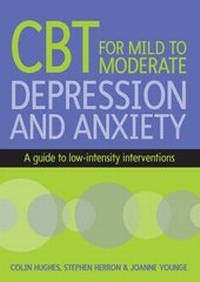
Cbt For Mild To Moderate Depression And Anxiety
1st Edition
Published on 1. September 2014
258 pages
978-0-335-24210-8 (ISBN)
Description

The book gives information and support using evidence-based, low-intensity psychological treatments involving CBT for mild to moderate mental illness.
More details
Other editions
Additional editions
Colin Hughes | Stephen Herron | Joanne Younge
CBT for Mild to Moderate Depression and Anxiety
A guide to low-intensity interventions
Book
11/2014
Open University Press
€54.65
Shipment within 15-20 days
Content
- Cover page
- Halftitle page
- Title page
- Copyright page
- Praise
- Dedication page
- Contents
- Acknowledgements
- Preface
- Introduction
- Overview of chapters
- Overview of CBT
- Evidence base for low-intensity cognitive behavioural interventions
- What this book will and will not cover
- Improving Access to Psychological Therapies (IAPT) and the growth in intensity treatments
- Upskilling the current mental health workforce
- 1 Interpersonal communication
- Introduction
- Establishing the therapeutic alliance
- Where to start
- Collaboration throughout treatment
- The impact of the practitioner's beliefs and values on communication
- The importance of questioning
- Conclusion
- 2 Cognitive behavioural assessment and session structure
- Introduction
- The aims of a cognitive behavioural assessment
- Conditions necessary for an effective assessment interview
- Explaining what you are doing each step of the way
- Introducing and explaining the assessment session
- A four-step approach to assessment
- Risk assessment
- Session structure
- Conclusion
- 3 Problem identification and goal setting
- Introduction
- Problem identification
- Goal setting
- 4 Depression
- Introduction
- A cognitive behavioural approach
- Assessment
- Linking behaviour change to values
- When behaviour change isn't enough
- Medication
- 5 Anxiety
- Introduction
- Understanding anxiety
- Panic disorder
- Treatment
- Interrogating the effectiveness of current strategies employed (the workability criteria)
- Situational behavioural experiments
- Medication
- The role of psychological wellbeing practitioners with medication
- 6 Sleep
- Introduction
- Understanding the impact of sleep problems
- How much sleep is enough?
- Why do we sleep and why do sleep problems occur and persist?
- Assessing sleep
- Cognitive behavioural interventions
- Conclusion
- 7 Recovery and maintaining wellness
- Introduction
- The client becomes the therapist
- How do we maintain wellness?
- How can the practitioner help the client develop a maintaining wellness plan?
- Treatment continuation
- Medication
- General advice
- 8 Supervision
- Introduction
- What is supervision?
- What are the functions of supervision?
- Guidelines on supervision
- What is the evidence for supervision?
- Clinical case management supervision (Richards and Whyte, 2009)
- Supervision contracts
- What do you want from supervision?
- Supervisee goals
- Supportive supervision
- Supervision problems
- Appendix 1: Client history form
- Appendix 2: SMART goal setting form
- Appendix 3: Client information sheet What we do and how we feel: behavioural imbalance
- Appendix 4: Client information sheet on bodily changes during stress
- Appendix 5: Fear hierarchy
- Appendix 6: Exposure diary
- Appendix 7: Behavioural experiment worksheet
- Appendix 8: Maintaining wellness form
- Appendix 9: Summary: staying well
- Appendix 10: Professional and Ethical Practice Code
- References
- Index
