

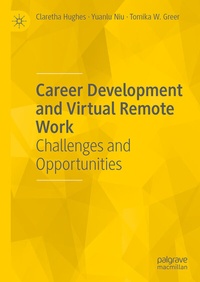
Career Development and Virtual Remote Work
Description

Amidst the COVID-19 pandemic, a surge in virtual remote work prompted a significant workforce shift from the office building to the home environment. Once workplaces reopened, a considerable portion of employees expressed a preference for sustained virtual remote arrangements. This development prompts an inquiry into whether employees opting for virtual remote work enjoy comparable career advancement opportunities as their in-office counterparts. This book explores the intersection of career development and virtual remote work and its dual impact on employees' careers and organizational success.
The authors examine the positive and negative impacts of virtual remote work on career development. While virtual remote work may pose challenges in relationship-building and communication, it concurrently offers enhanced flexibility, autonomy, and self-direction. The authors also investigate gender-related hurdles in the realm of virtual work and the pivotal role of leaders in navigating the career development of virtual remote team members. With discussions of best practices and strategies for effective virtual remote career development, this book will appeal to HRD and HRM scholars and scholar-practitioners seeking to understand how organizations can adeptly navigate the rapidly changing virtual remote world of work.
More details
Other editions
Additional editions
Persons
Claretha Hughes is Professor of Human Resource Development at the University of Arkansas, USA. Her research interests include valuing people and technology in the workplace, technology development, diversity intelligence®, learning technologies, and ethical and legal issues.
Yuanlu Niu is Assistant Professor of Human Resource Development at the University of Arkansas, USA. Her research aims to enhance employability and career development in the digital age by addressing social biases-including lookism, linguistic profiling, gender, and cultural influences-and facilitating technology adoption among diverse workforces to create equitable and inclusive workplaces.
Tomika W. Greer is Assistant Professor of Human Resource Development and Undergraduate HRD Program Coordinator at the University of Houston, USA. Her research focuses on trends and challenges associated with career development for women, implementation and outcomes of "family-friendly" organizational policies and programs, and curriculum, pedagogy, and outcomes of academic programs in human resource development.
Content
Chapter 1: Introduction.- Chapter 2: The Landscape of Virtual Remote Work.- Chapter 3: Career Development in Virtual Remote Work.- Chapter 4: Challenges in Virtual Remote Career Development.- Chapter 5: Opportunities in Virtual remote Career Development.- Chapter 6: Gender Differences in Virtual Remote Career Development.- Chapter 7: Gender Differences in Virtual Remote Career Development.- Chapter 8: Conclusion.
