

Bleeding Edge
Description

It's hammered into us from birth that 'all good things come at a price'. Today, that price looks apocalyptic, with wars, exploitation and environmental collapse in every part of the globe. Some suggest that the carnage is "a price worth paying" for technological progress. No pain, no gain.
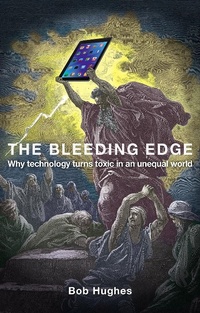
But technology is precisely the business of minimising the costs and impacts of existence... and by whole orders of magnitude. By now, all human beings should be leading creative, leisure-filled lives in a pristine world of burgeoning diversity. So how did it go so wrong? In a word, inequality. In The Bleeding Edge, Bob Hughes argues that unequal societies are incapable of using new technologies well. Wherever elites exist, self-preservation decrees that they must take control of new technologies to protect and entrench their status, rather than satisfy people's needs.
Hughes pursues the latest discoveries about the effects of social inequality on human health, into the field of human environmental impact, and traces today's ecological crisis back to the rise of the world's first elites, 5,000 years ago. He argues that new technologies have never emerged from elites or from the clash of competitive forces, but from largely voluntary, egalitarian collaborations of the kind that produced the world's first working computers.
Finally, Hughes shows that an egalitarian world is not 'pie in the sky' but our evolutionary homeland, the glue that holds societies together, and the "cradle of invention" from which all our best ideas emerge. The book concludes: 'Let's assume that the commitment to human equality that's written into the Universal Declaration of Human Rights means exactly what it says, and take it from there.'
More details
Person
Bob Hughes is an academic, activist, and author, and has taught electronic media at Oxford Brookes University. He is the author of Dust or Magic, a book for digital multimedia workers, about how people "do good stuff with computers." He is a member of No One is Illegal.
Content
- Foreword-Danny Dorling
- Introduction
- Chapter 1: Technofatalism and the future - is a world without Foxconn even possible?
- Chapter 2: From water mills to iPhones: why technology and inequality do not mix
- Chapter 3: What inequality does to people
- Chapter 4: The environmental cost of human inequality
- Chapter 5: Ever greater impact, ever less benefit: high-tech capital's mysterious lack of growth
- Chapter 6: The invisible foot: why inequality increases impact
- Chapter 7: Enclosure in the computer age: the magic of control
- Chapter 8: Sales effort: from the automobile to the microchip
- Chapter 9: Technoptimism hits the buffers
- Chapter 10: The data explosion: how the cloud became a juggernaut
- Chapter 11: 'The least efficient machine humans have ever built': how capitalism drove the computer down a dead end
- Chapter 12: Planning by whom and for what? The battle for control from the Soviet Union to Walmart
- Chapter 13: A socialist computer: Chile, 1970-1973
- Chapter 14: Utopia or bust
