

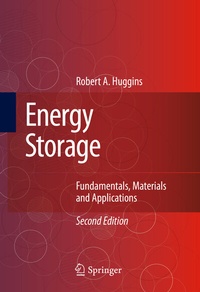
Energy Storage
Description

More details
Other editions
Additional editions
Person
Professor Huggins obtained his B.A. in Physics from Amherst College and his M.S. and Sc.D. in Metallurgy from the Massachusetts Institute of Technology. After serving as an Instructor at MIT, he joined the Stanford faculty, where he initiated the Department of Materials Science and founded Stanford's Center for Materials Research. His career has included a National Science Foundation Fellowship and guest lectureship at the Max-Planck-Institute, as well as terms as Director of Materials Sciences at ARPA, Chief Scientist of the Center for Solar Energy and Hydrogen Research in Ulm, Germany, and Chairman of the Solid State Sciences Committee. He was a member of the Committees on Advanced Energy Storage Systems and Battery Materials Technology of the US National Academy of Sciences and the first President of the International Society for Solid State Ionics. He was also one of the Founders, and later twice a Counselor, of the Materials Research Society. He is Honorary Professor at the University of Ulm and the University of Kiel.
Dr. Huggins is recipient of many awards including the American Society for Engineering Education's Vincent Bendix Award, the Research Award of the Electrochemical Society's Battery Division, and the Research Award of the International Battery Association.
His research activities have included studies of imperfections in crystals, solid-state reaction kinetics, ferromagnetism, mechanical behavior of solids, crystal growth, and a wide variety of topics in physical metallurgy, ceramics, solid state chemistry and electrochemistry. Topics of particular recent interest have been hydrogen transport and hydride formation in metals, alloys and intermetallic compounds, and especially, various aspects of materials and phenomena related to advanced batteries.
He is author or co-author of over 400 publications, including 150 articles or chapters in books and conference proceedings, as well as 13 patents. He isEditor of several books, including of the 23-volume book series Annual Review of Materials Science. He has also been an Editor of Solid State Ionics journal, Associate Editor of the Materials Research Bulletin, on the Advisory Review Board of the Journal of Materials Research, and on the Editorial Boards of Progress in Solid State Chemistry, the Journal of Power Sources, and Ionics, as well as the European Journal of Solid State and Inorganic Chemistry. In addition to his many research publications, he is the author of two recent books published by Springer, Advanced Batteries: Materials Science Aspects and Energy Storage.
