

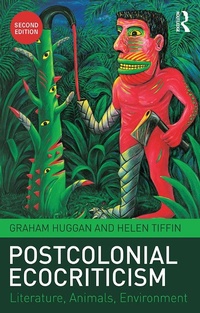
Postcolonial Ecocriticism
Literature, Animals, Environment
2nd Edition
Published on 17. April 2015
306 pages
978-1-317-66615-8 (ISBN)
Description

This second edition of Postcolonial Ecocriticism, a book foundational for its field, has been updated to consider recent developments in the area such as environmental humanities and animal studies. Graham Huggan and Helen Tiffin examine transverse relations between humans, animals and the environment across a wide range of postcolonial literary texts and also address key issues such as global warming, food security, human over-population in the context of animal extinction, queer ecology, and the connections between postcolonial and disability theory. Considering the postcolonial first from an environmental and then a zoocritical perspective, the book looks at:
Narratives of development in postcolonial writing
Entitlement, belonging and the pastoral
Colonial 'asset stripping' and the Christian mission
The politics of eating and the representation of cannibalism
Animality and spirituality
Sentimentality and anthropomorphism
The changing place of humans and animals in a 'posthuman' world.
With a new preface written specifically for this edition and an annotated list of suggestions for further reading, Postcolonial Ecocriticism offers a comprehensive and fully up-to-date introduction to a rapidly expanding field.
Narratives of development in postcolonial writing
Entitlement, belonging and the pastoral
Colonial 'asset stripping' and the Christian mission
The politics of eating and the representation of cannibalism
Animality and spirituality
Sentimentality and anthropomorphism
The changing place of humans and animals in a 'posthuman' world.
With a new preface written specifically for this edition and an annotated list of suggestions for further reading, Postcolonial Ecocriticism offers a comprehensive and fully up-to-date introduction to a rapidly expanding field.
Reviews / Votes
Praise for first edition:"This volume will be required reading for anyone interested in the debate about the literary in the era of environmental apocalypse." American Book Review
"This book--the critical meeting of the methods of ecocriticism and postcolonialism--is long overdue. Essential." CHOICE
"By grounding issues of representation in issues of environmental activism, Huggan and Tiffin remind ecocritics of the importance of this type of work. In this sense, their book makes an important contribution to ecocriticism in its steps to internationalise the field while also creating space for literary analysis within environmental activism around the world." Green Letters
"Postcolonial Ecocriticism: Literature, Animals, Environment offers a rich and timely discussion of the ecocritical turn within postcolonial literary studies. This volume is an introduction to the field and is thus especially valuable to readers invested in postcolonial studies but new to ecocriticism...This volume further distinguishes itself by bringing together ecocriticism and the much newer zoocriticism" Aarthi Vadde, Duke University, Contemporary Literature
"... there is much to admire in the book's breadth and usefulness, including pithy and accessible introductions to the politics of postcolonial development, racism's links with speciesism, and the role of post-humanism in a putatively "post-natural" world." Anthony Carrigan, Keele University, Journal of Postcolonial Writing
"Postcolonial Ecocriticism offers a comprehensive summary and intelligent analysis of concerns and debates that define the terrain between and within the fields it surveys...Postcolonial Ecocriticism covers an impressive range of texts, including mainly fiction, but also poetry and drama, from India, Canada, Australia, New Zealand, South Africa, the Caribbean, and the postcolonial diaspora...The effect is consistently engaging and insightful." Susie O'Brien, McMaster University, Postcolonial Text
"This thorough and well-written introduction to the field of postcolonial ecocriticism...offers a useful foundation by meticulously mapping the territory." Roman Bartosch, Universities of Cologne/Duisburg-Essen, Ecozon Praise for first edition:
"This volume will be required reading for anyone interested in the debate about the literary in the era of environmental apocalypse."- American Book Review
"This book--the critical meeting of the methods of ecocriticism and postcolonialism--is long overdue. Essential."- CHOICE
"By grounding issues of representation in issues of environmental activism, Huggan and Tiffin remind ecocritics of the importance of this type of work. In this sense, their book makes an important contribution to ecocriticism in its steps to internationalise the field while also creating space for literary analysis within environmental activism around the world." - Green Letters
"Postcolonial Ecocriticism: Literature, Animals, Environment offers a rich and timely discussion of the ecocritical turn within postcolonial literary studies. This volume is an introduction to the field and is thus especially valuable to readers invested in postcolonial studies but new to ecocriticism...This volume further distinguishes itself by bringing together ecocriticism and the much newer zoocriticism" -Aarthi Vadde, Duke University, Contemporary Literature
"... there is much to admire in the book's breadth and usefulness, including pithy and accessible introductions to the politics of postcolonial development, racism's links with speciesism, and the role of post-humanism in a putatively "post-natural" world." - Anthony Carrigan, Keele University, Journal of Postcolonial Writing
"Postcolonial Ecocriticism offers a comprehensive summary and intelligent analysis of concerns and debates that define the terrain between and within the fields it surveys...Postcolonial Ecocriticism covers an impressive range of texts, including mainly fiction, but also poetry and drama, from India, Canada, Australia, New Zealand, South Africa, the Caribbean, and the postcolonial diaspora...The effect is consistently engaging and insightful." -Susie O'Brien, McMaster University, Postcolonial Text
"This thorough and well-written introduction to the field of postcolonial ecocriticism...offers a useful foundation by meticulously mapping the territory." -Roman Bartosch, Universities of Cologne/Duisburg-Essen, Ecozon
More details
Edition
2nd edition
Language
English
Place of publication
London
United Kingdom
Publishing group
Taylor & Francis Ltd
Target group
College/higher education
Professional and scholarly
Product notice
Reflowable
File size
2,98 MB
ISBN-13
978-1-317-66615-8 (9781317666158)
Copyright in bibliographic data and cover images is held by Nielsen Book Services Limited or by the publishers or by their respective licensors: all rights reserved.
Schweitzer Classification
Other editions
Additional editions
Book
04/2015
2nd Edition
Routledge
€206.40
Shipment within 10-20 days
Book
04/2015
2nd Edition
Routledge
€63.00
Shipment within 10-20 days
Persons
Helen Tiffin was formerly Canada Research Chair in English and Post-Colonial Studies at Queen's University, Ontario, and is now Professor of English at the University of Tasmania, Australia.
Graham Huggan is Professor of Commonwealth and Postcolonial Literatures at the University of Leeds, UK.
Graham Huggan is Professor of Commonwealth and Postcolonial Literatures at the University of Leeds, UK.
Content
Introduction Part I. Postcolonialism and the environment 1. Development 2. Entitlement Part II. Zoocriticism and the postcolonial 1. Ivory and elephants 2. Christianity, cannibalism and carnivory 3. Agency, sex and emotion Postscript: After Nature Works Cited Index
