

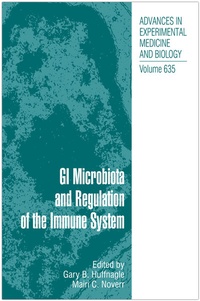
GI Microbiota and Regulation of the Immune System
Description

Gary B. Huffnagle , PhD, is a Professor of Internal Medicine (Pulmonary
Diseases) and Microbiology and Immunology at the University of Michigan Medical
School. He holds a BS in microbiology from Pennsylvania State University and a
PhD in immunology from the University of Texas Southwestern Medical School.
In addition to conducting research, he teaches undergraduate and graduate classes
in eukaryotic microbiology, microbial symbiosis and experimental immunology
at the University of Michigan. Dr. Huffnagle's research focuses on the regulation
of pulmonary immunity to infectious agents and allergens. In the past 5 years, his
attention has turned to the role of the indigenous microbiota in immune system
functioning, as well as the role of probiotics in animal and human health. He has
been awarded research grants from the National Heart, Lung and Blood Institute
(NHL BI), National Institute of Allergy and Infectious Diseases (NIAID), the Francis
Families Foundation and the Burroughs-Wellcome Fund. Dr. Huffnagle serves or
has served on editorial boards for the American Society for Microbiology (ASM)
and the American Association of Immunologists (AAI), as well as on advisory and
review panels for the National Institutes of Health (NIH).
Mairi C. Nove rr , PhD, is an Assistant Professor of Immunology and
Microbiology at Wayne State University Medical School. She earned a BA in biology
from Kalamazoo College in 1996 and a PhD in microbiology and immunology
from the University of Michigan in 2002. Dr. Noverr's current research focuses on
investigating mechanisms of immunomodulation by the opportunistic yeast Candida
albicans during host-pathogen interactions and how interactions with other members
of the microbiota influence these interactions. Her laboratory is investigating
signaling compounds called oxylipins that are produced by both Candida and the
host, which can influence the microbiology of the fungus and the activity of host
immune system cells. Projects in the laboratory include molecular characterization
of the fungal oxylipin biosynthetic pathways and determining the effects of oxylipins
during Candida pathogenesis, in modulating host immune cell function, and
during fungal-bacterial interactions. She has been awarded research funding from
the Francis Families Foundation.
More details
Other editions
Additional editions

Persons
Gary B. Huffnagle, PhD, is a Professor of Internal Medicine (Pulmonary
Diseases) and Microbiology and Immunology at the University of Michigan Medical
School. He holds a BS in microbiology from Pennsylvania State University and a
PhD in immunology from the University of Texas Southwestern Medical School.
In addition to conducting research, he teaches undergraduate and graduate classes
in eukaryotic microbiology, microbial symbiosis and experimental immunology
at the University of Michigan. Dr. Huffnagle's research focuses on the regulation
of pulmonary immunity to infectious agents and allergens. In the past 5 years, his
attention has turned to the role of the indigenous microbiota in immune system
functioning, as well as the role of probiotics in animal and human health. He has
been awarded research grants from the National Heart, Lung and Blood Institute
(NHL BI), National Institute of Allergy and Infectious Diseases (NIAID), the Francis
Families Foundation and the Burroughs-Wellcome Fund. Dr. Huffnagle serves or
has served on editorial boards for the American Society for Microbiology (ASM)
and the American Association of Immunologists (AAI), as well as on advisory and
review panels for the National Institutes of Health (NIH).
Mairi C. Nove rr, PhD, is an Assistant Professor of Immunology and
Microbiology at Wayne State University Medical School. She earned a BA in biology
from Kalamazoo College in 1996 and a PhD in microbiology and immunology
from the University of Michigan in 2002. Dr. Noverr's current research focuses on
investigating mechanisms of immunomodulation by the opportunistic yeast Candida
albicans during host-pathogen interactions and how interactions with other members
of the microbiota influence these interactions. Her laboratory is investigating
signaling compounds called oxylipins that are produced by both Candida and the
host, which can influence the microbiology of the fungus and the activity of host
immune system cells. Projects in the laboratory include molecular characterization
of the fungal oxylipin biosynthetic pathways and determining the effects of oxylipins
during Candida pathogenesis, in modulating host immune cell function, and
during fungal-bacterial interactions. She has been awarded research funding from
the Francis Families Foundation.
