

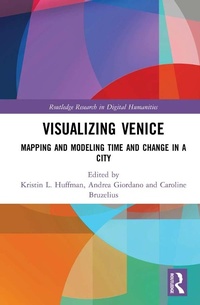
Visualizing Venice
Mapping and Modeling Time and Change in a City
Published on 4. October 2017
174 pages
978-1-351-58684-9 (ISBN)
Description

Visualizing Venice presents the ways in which the use of innovative technology can provide new and fascinating stories about places and times within history. Written by those behind the Visualizing Venice project, this book explores the variety of disciplines and analytical methods generated by technologies such as 3D images and interoperable models, GIS mapping and historical cartography, databases, video animations, and applications for mobile devices and the web.
The volume is one of the first collections of essays to integrate the theory and practice of visualization technologies with art, architectural, and urban history. The chapters demonstrate how new methodologies generated by technology can change and inform the way historians think and work, and the potential that such methods have to revolutionize research, teaching, and public-facing communication.
With over 30 images to support and illustrate the project's work, Visualizing Venice is ideal for academics, and postgraduates of digital history, digital humanities, and early modern Italy.
The volume is one of the first collections of essays to integrate the theory and practice of visualization technologies with art, architectural, and urban history. The chapters demonstrate how new methodologies generated by technology can change and inform the way historians think and work, and the potential that such methods have to revolutionize research, teaching, and public-facing communication.
With over 30 images to support and illustrate the project's work, Visualizing Venice is ideal for academics, and postgraduates of digital history, digital humanities, and early modern Italy.
More details
Series
Language
English
Place of publication
London
United Kingdom
Publishing group
Taylor & Francis Ltd
Target group
College/higher education
Illustrations
33 Illustrations, black and white
File size
2,53 MB
ISBN-13
978-1-351-58684-9 (9781351586849)
Copyright in bibliographic data and cover images is held by Nielsen Book Services Limited or by the publishers or by their respective licensors: all rights reserved.
Schweitzer Classification
Other editions
Additional editions
Kristin L. Huffman | Andrea Giordano | Caroline Bruzelius
Visualizing Venice
Mapping and Modeling Time and Change in a City
Book
12/2019
1st Edition
Routledge
€68.90
Shipment within 15-20 days
Kristin L. Huffman | Andrea Giordano | Caroline Bruzelius
Visualizing Venice
Mapping and Modeling Time and Change in a City
Book
10/2017
1st Edition
Routledge
€245.12
Shipment within 10-20 days
Persons
Kristin L. Huffman is an Instructor in the Department of Art, Art History, and Visual Studies at Duke University.
Andrea Giordano is Professor at the University of Padua and coordinator of the Visualizing Venice's 3D modeling team.
Caroline Bruzelius is the A.M. Cogan Professor of Art and Art History and a founder the Wired! Lab at Duke University and of Visualizing Venice.
Andrea Giordano is Professor at the University of Padua and coordinator of the Visualizing Venice's 3D modeling team.
Caroline Bruzelius is the A.M. Cogan Professor of Art and Art History and a founder the Wired! Lab at Duke University and of Visualizing Venice.
Content
Overview: The Visualizing Venice Enterprise
Part 1: Introductory Essays
1 The Role of Digital Visualization for the History of the City
2 Visualizing Venice: Teaching, Training, and Imagining a New Kind of Urban and Architectural History
3 Visualizing Venice: Developing a Methodology for Historical Visualization
Part 2: Historical Case Studies
4 Buildings that Never Were: The Unbuilt Projects for the Civic Hospital of Venice
5 Architectural and Urban Change Over Time: The School, Church, and Monastery of Santa Maria della Carita
6 Mapping Change and Motion in the Lagoon: The Island of San Secondo
7 Visualizing the Treves Botanical Garden in Padua: From Documentary Research to Laser Survey and 3D Modeling
8 Research on Lost Buildings in Venice: The Cathedral of San Pietro di Castello
Part 3: Tools, Technologies, and Training
9 Visualizing Venice: An Historical Overview of the Role and Application of Architectural and Urban Modeling
10 The History of Cities and HGIS
11 Digital Technologies and Exhibition Culture: Reactivating Art Installations through Virtual Reconstructions
12 Interactive Exhibitions: New Interfaces for Engaging Visualizations
13 Guidebooks and Mobile Applications: A New Mode of Communication
14 Digital Art History: Building a "Model" for Student Engagement
15 Visualizing Venice Summer Workshops for Graduate Students and Beginning Scholars
Visualizing Venice to Visualizing Cities: Future Horizons
Conclusion
Appendix
Part 1: Introductory Essays
1 The Role of Digital Visualization for the History of the City
2 Visualizing Venice: Teaching, Training, and Imagining a New Kind of Urban and Architectural History
3 Visualizing Venice: Developing a Methodology for Historical Visualization
Part 2: Historical Case Studies
4 Buildings that Never Were: The Unbuilt Projects for the Civic Hospital of Venice
5 Architectural and Urban Change Over Time: The School, Church, and Monastery of Santa Maria della Carita
6 Mapping Change and Motion in the Lagoon: The Island of San Secondo
7 Visualizing the Treves Botanical Garden in Padua: From Documentary Research to Laser Survey and 3D Modeling
8 Research on Lost Buildings in Venice: The Cathedral of San Pietro di Castello
Part 3: Tools, Technologies, and Training
9 Visualizing Venice: An Historical Overview of the Role and Application of Architectural and Urban Modeling
10 The History of Cities and HGIS
11 Digital Technologies and Exhibition Culture: Reactivating Art Installations through Virtual Reconstructions
12 Interactive Exhibitions: New Interfaces for Engaging Visualizations
13 Guidebooks and Mobile Applications: A New Mode of Communication
14 Digital Art History: Building a "Model" for Student Engagement
15 Visualizing Venice Summer Workshops for Graduate Students and Beginning Scholars
Visualizing Venice to Visualizing Cities: Future Horizons
Conclusion
Appendix
