

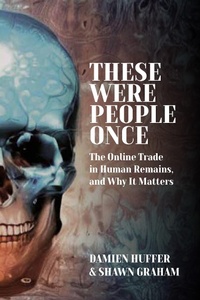
These Were People Once
Description

People buy and sell human remains online. Most of this trade these days is over social media. In a study of this 'bone trade', how it works, and why it matters, the authors review and use a variety of methods drawn from the digital humanities to analyze the sheer volume of social media posts in search of answers to questions regarding this online bone trade. The answers speak to how the 21st century understands and constructs 'heritage' more generally: each person their own expert, yet seeking community and validation, and like the major encyclopedic museums, built on a kind of digital neocolonialist othering of the dead.
Reviews / Votes
"An easy read on a difficult subject, its beautiful encapsulations of the tragic lives behind their commodified remains highlight the urgency of the authors' project and public and commercial responses to it. The grim thread of mistreatment of the dead guides the reader through the labyrinth of Big Tech, how cynical tech companies and equally-cynical users are complicit in each other's harms." * Samuel Andrew Hardy, Cultural Property Criminologist
<em>"An easy read on a difficult subject, its beautiful encapsulations of the tragic lives behind their commodified remains highlight the urgency of the authors' project and public and commercial responses to it. The grim thread of mistreatment of the dead guides the reader through the labyrinth of Big Tech, how cynical tech companies and equally-cynical users are complicit in each other's harms."</em> <strong>* Samuel Andrew Hardy</strong>, Cultural Property Criminologist
More details
Other editions
Additional editions
Persons
<strong>Damien Huffer</strong> is an osteoarchaeologist and interdisciplinary illicit trafficking researcher. He was most recently Lecturer in Criminology in the School of Social Science at the University of Queensland, Australia. He is one of the cofounders of the Alliance to Counter Crime Online.
Content
Acknowledgements
List of Figures
List of Tables
<strong>Preface:</strong> They sell what online?
<strong>Chapter 1.</strong> The Lives Behind The Photos
<strong>Chapter 2.</strong> The Dead For Sale
<strong>Chapter 3.</strong> Looking At Bodies
<strong>Chapter 4.</strong> The Lies Behind the Bodies?
<strong>Chapter 5.</strong> Why Does It Matter?
Glossary of Terms
<strong>Appendix A:</strong> A Walk Through of the InstagramCLI Python Package
<strong>Appendix B:</strong> A Walk Through of the PixPlot Python Package
<strong>Appendix C:</strong> Text Analysis with Python and Jupyter
References
