

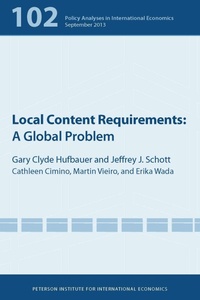
Local Content Requirements
Description

In the wake of the Great Recession of 2008-09, economists feared that protectionist policies might sweep the world economy, echoing the wave of tariff escalations during the Great Depression of the 1930s. To some surprise, officials were more restrained and largely avoided traditional forms of protection (tariffs and quotas). As a result, economists underestimated the incidence of new protectionism because policymakers increasingly turned to more opaque behind-the-border nontariff barriers (NTBs).
Using a combination of statistical analysis and case studies, the authors show that local content requirements (LCRs), a form of NTB, have become increasingly popular. How much was global trade actually reduced on account of LCRs? A conservative estimate might be $93 billion. Case studies featured cover the healthcare sector in Brazil, wind turbines in Canada, the automobile industry in China, solar cells and modules in India, oil and gas in Nigeria, and "Buy American" restrictions on government procurement.
More details
Other editions
Additional editions
Persons
Gary Clyde Hufbauer, Reginald Jones Senior Fellow since 1992, was formerly the Maurice Greenberg Chair and Director of Studies at the Council on Foreign Relations (1996-98), the Marcus Wallenberg Professor of International Finance Diplomacy at Georgetown University (1985-92), senior fellow at the Institute (1981-85), deputy director of the International Law Institute at Georgetown University (1979-81); deputy assistant secretary for international trade and investment policy of the US Treasury (1977-79); and director of the international tax staff at the Treasury (1974-76).
Jeffrey J. Schott joined the Peterson Institute for International Economics in 1983 and is a senior fellow working on international trade policy and economic sanctions. During his tenure at the Institute, Schott was also a visiting lecturer at Princeton University (1994) and an adjunct professor at Georgetown University (1986-88). He was a senior associate at the Carnegie Endowment for International Peace (1982-83) and an official of the US Treasury Department (1974-82) in international trade and energy policy. During the Tokyo Round of multilateral trade negotiations, he was a member of the US delegation that negotiated the GATT Subsidies Code. Since January 2003, he has been a member of the Trade and Environment Policy Advisory Committee of the US government. He is also a member of the State Department's Advisory Committee on International Economic Policy.
Cathleen Cimino-Isaacs, research associate, has been with the Peterson Institute since August 2012. She works with Senior Fellows Gary Clyde Hufbauer and Jeffrey J. Schott on economic issues relating to international trade policy, free trade agreement negotiations, and the future of the World Trade Organization.
Martin Vieiro was a research analyst with the Peterson Institute from June 2011 to March 2013. He worked with Senior Fellows Gary Clyde Hufbauer and Jeffrey J. Schott. His research focused on international trade, economic development, and the future of the World Trade Organization.
Erika Wada, former visiting fellow at the Peterson Institute, is a PhD candidate at Michigan State University. She is coauthor of The Benefits of Price Convergence: Speculative Calculations (2002) and coeditor of Unfinished Business: Telecommunications after the Uruguay Round (1997).
Content
- Cover
- Table of Contents
- Preface
- Acknowledgments
- Abbreviations
- Executive Summary
- Alternatives to LCRs
- Survey Snapshot
- Case Studies
- Plan of the Study
- Chapter 1 - Introduction: The LCR Phenomenon
- Characteristics of LCRs
- Why LCRs Are Bad Policy
- Motives behind and Effects of LCRs
- Pushback against LCRs
- Plan of the Book
- Chapter 2 - Alternatives to Local Content Requirements
- Creating a Business-Friendly Environment
- Encouraging Corporate Social Responsibility
- Expanding Training
- Improving Logistics
- Increasing Investment in Infrastructure
- Imposing Tariffs and Subsidies
- Conclusion
- Chapter 3 - Survey and Case Studies
- Chapter 4 - Healthcare Industry in Brazil
- Healthcare Industry Trade
- Global Harmonization Movement
- Cost of LCRs and Related Barriers
- Alternatives to LCRs
- Chapter 5 - Wind Turbines in Canada
- Sources of Energy in Canada
- Efforts to Reduce Greenhouse Gas Emissions
- Wind Energy Regulations
- Wind Power in Ontario
- Wind Power in Quebec
- Impact of LCRs in Ontario and Quebec
- Alternatives to LCRs
- Chapter 6 - Automobile Industry in China
- Automobile Production and Role of the State
- Investment Barriers and Incentives
- Automobile Prices
- Effect of Trade Barriers on Productivity
- Alternatives to LCRs
- Chapter 7 - Solar Cells and Modules in India
- Demand for Energy in India
- Subsidies to the Solar Industry
- Barriers to Competitiveness
- Overview of the Jawaharlal Nehru National Solar Mission
- Effects of LCRs
- Alternatives to LCRs
- Chapter 8 - Oil and Gas Industryin Nigeria
- Human Development and Security Conditions in Nigeria
- Importance of the Industry and Role of Foreign Firms
- The Nigerian Oil and Gas Content Development Act
- Alternatives to LCRs
- Chapter 9 - Not Buying It: Buy American/Buy America
- History of LCRs in the United States
- Recent Rhetoric and Proposals
- The WTO Government Procurement Agreement and Free Trade Agreements
- Legal Gap for Stimulus Measures
- Transportation and Water Infrastructure
- Clean Water and Drinking Water State Revolving Funds
- Steel Costs and Industry Delays
- Alternatives to LCRs
- Chapter 10 - Conclusions andRecommendations
- Advice to Governments
- Advice to Trade Officials and Negotiators
- Appendix A - Local Content Requirements since 2008
- References
- Index
- Other Publications of the Peterson Institute for International Economics
