

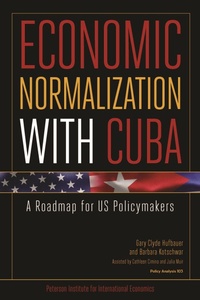
Economic Normalization with Cuba
Description

Will the Obama administration's decision to normalize relations with Cuba usher in a new era of economic cooperation, trade, and investment between the two countries? This prescient book, published only eight months before President Obama's historic announcement at the end of 2014, provides answers to that question and offers a roadmap for a sequenced lifting of the Cold War era economic sanctions against Cuba.
Gary Clyde Hufbauer and Barbara Kotschwar lay out the difficulties of achieving a dynamic economic relationship. They caution that a unilateral dismantling of US sanctions without insuring that proper institutions are in place in Cuba could squander this golden opportunity for US companies and hurt Cubans. They argue that US policies should encourage Cuba to liberalize its economy and adopt democratic institutions, so that it does not transition from a Communist dictatorship to a corrupt and authoritarian oligarchy. This farsighted book, produced in anticipation of an opening with Cuba that seemed impossible to some skeptics, is a must-read for anyone interested in the evolution of a historically contentious relationship that promises to evolve productively if the right policies are pursued.
More details
Other editions
Additional editions
Persons
Gary Clyde Hufbauer, Reginald Jones Senior Fellow since 1992, was formerly the Maurice Greenberg Chair and Director of Studies at the Council on Foreign Relations (1996-98), the Marcus Wallenberg Professor of International Finance Diplomacy at Georgetown University (1985-92), senior fellow at the Institute (1981-85), deputy director of the International Law Institute at Georgetown University (1979-81); deputy assistant secretary for international trade and investment policy of the US Treasury (1977-79); and director of the international tax staff at the Treasury (1974-76).
Barbara Kotschwar, former research fellow, was associated with the Peterson Institute for International Economics from 2007 to October 2015. Her research focuses on trade, investment, and regional integration. Recent projects include comparative analyses of Latin American experiences with free trade agreements, Chinese foreign direct investment (FDI) in Latin America, an assessment of Mexico's economy, and studies on commercial relations between the United States and Middle East and North Africa (MENA) partners.
Cathleen Cimino-Isaacs, research associate, has been with the Peterson Institute since August 2012. She works with Senior Fellows Gary Clyde Hufbauer and Jeffrey J. Schott on economic issues relating to international trade policy, free trade agreement negotiations, and the future of the World Trade Organization. She is coauthor of Local Content Requirements: A Global Problem (2013).
Content
- Front cover
- Copyright
- Contents
- Preface
- Board of Directors
- Acknowledgments
- Map of Cuba
- Chapter 1 A Half Century of Separation
- Chapter 2 Cuban Economic Reforms
- Chapter 3 Cuba in the International Economy
- Chapter 4 US Sanctions against Cuba
- Chapter 5 Initial Steps to Normalization
- Chapter 6 Potential Commerce with the United States: Starting from a Low Base
- Chapter 7 Brass Tacks: Deeper Integration
- Chapter 8 US Offensive and Defensive Interests
- References
- Index
- Other Publications from the Peterson Institute for International Economics
