

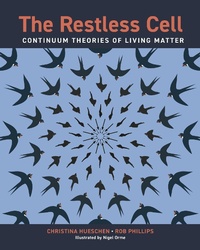
The Restless Cell
Continuum Theories of Living Matter
1st Edition
Published on 15. August 2024
440 pages
978-0-691-23637-7 (ISBN)
Description

An essential introduction to the physics of active matter and its application to questions in biology
In recent decades, the theory of active matter has emerged as a powerful tool for exploring the differences between living and nonliving states of matter. The Restless Cell provides a self-contained, quantitative description of how the continuum theory of matter has been generalized to account for the complex and sometimes counterintuitive behaviors of living materials.
Christina Hueschen and Rob Phillips begin by illustrating how classical field theory has been used by physicists to describe the transport of matter by diffusion, the elastic deformations of solids, and the flow of fluids. Drawing on physical insights from the study of diffusion, they introduce readers to the continuum theory protocol-a step-by-step framework for developing equations that describe matter as a continuum-and show how these methods and concepts can be generalized to the study of living, energy-consuming matter. Hueschen and Phillips then present a range of engaging biological case studies across scales, such as the symmetry breaking that occurs in developing embryos, the perpetual flows that take place in giant algal cells, and the herding of wildebeest on the plains of the Serengeti.
An essential resource for students and researchers in biological physics and quantitative biology, The Restless Cell gives complete derivations of all calculations and features illustrations by Nigel Orme that seamlessly bridge conceptual models and continuum descriptions of living matter.
In recent decades, the theory of active matter has emerged as a powerful tool for exploring the differences between living and nonliving states of matter. The Restless Cell provides a self-contained, quantitative description of how the continuum theory of matter has been generalized to account for the complex and sometimes counterintuitive behaviors of living materials.
Christina Hueschen and Rob Phillips begin by illustrating how classical field theory has been used by physicists to describe the transport of matter by diffusion, the elastic deformations of solids, and the flow of fluids. Drawing on physical insights from the study of diffusion, they introduce readers to the continuum theory protocol-a step-by-step framework for developing equations that describe matter as a continuum-and show how these methods and concepts can be generalized to the study of living, energy-consuming matter. Hueschen and Phillips then present a range of engaging biological case studies across scales, such as the symmetry breaking that occurs in developing embryos, the perpetual flows that take place in giant algal cells, and the herding of wildebeest on the plains of the Serengeti.
An essential resource for students and researchers in biological physics and quantitative biology, The Restless Cell gives complete derivations of all calculations and features illustrations by Nigel Orme that seamlessly bridge conceptual models and continuum descriptions of living matter.
More details
Other editions
Additional editions
Book
08/2024
Princeton University Press
€87.00
Shipment within 10-20 days
Persons
Christina Hueschen is assistant professor of cell and developmental biology at the University of California, San Diego. Rob Phillips is the Fred and Nancy Morris Professor of Biophysics, Biology, and Physics at the California Institute of Technology. His books include The Molecular Switch (Princeton) and (with Ron Milo) Cell Biology by the Numbers.
Content
- Cover
- Contents
- Preface
- Part I: The Field Theory Revolution
- 1. How Can We Understand Living Matter?
- 1.1 The Vital Challenge of LivingMatter
- 1.2 The ActiveMatter Landscape
- 2. The Power of the Field
- 2.1 Origins of the Field Concept
- 2.2 A Mathematical Partner to the Field Concept: The Infinity Principle
- 2.3 Turning Materials into Fields
- 2.4 Biological Fields and Defects
- 3. How to Build a Field Theory: The Example of Diffusion
- 3.1 What Is a Continuum Theory?
- 3.2 Defining Flux Vectors
- 3.3 Mass Flux and Conservation of Mass
- 3.4 The Theory of Diffusion as a Paradigm in the Field Theory of Matter
- 4. Using Field Theory: Adventures in Diffusion
- 4.1 What Do We Do with Field Equations Once We Have Them?
- 4.2 The All-Important Solution for a Point Source
- 4.3 Mass Conservation and Diffusion in Three Dimensions
- 4.4 Solving Field Equations for Unreal Biological Shapes: Cubes, Cylinders, and Spheres
- 4.5 Solving Field Equations for Real Biological Shapes: Beyond Cubes, Cylinders, and Spheres
- Part II: The Classical Field Theories of Matter
- 5. Continuum Theory of Heat Flow
- 5.1 A Field Theory for Transfer of Heat
- 5.2 Two for the Price of One: Fourier's Law and Heat Transfer
- 5.3 Cooking and Cooling
- 5.4 The Heat Equation and Dissipation in Living Cells
- 5.5 The Cooling of the Earth and the Theory of Evolution
- 6. Adding Reaction to Diffusion
- 6.1 The Idea of Positional Information and Body Plans
- 6.2 Biological Nonconservation
- 6.3 Expanding the Field Theory Palette: Reaction-Diffusion Equations
- 6.4 Closing the Loop:Measuring Morphogens
- 6.5 Tackling Morphogen Dynamics
- 6.6 The Turing Mechanism and Spatial Patterning
- 6.7 Turing's Numbers: From Bits to Digits
- 7. Mathematics of Fields: From Notation to Calculation
- 7.1 Beyond Scalar Fields
- 7.2 New Ways of Writing Scalars, Vectors, and Tensors: Indicial Notation
- 7.3 Einstein's Labor-Saving and Intuition-Driving Notational Move
- 7.4 Multiplying Vectors and Tensors
- 7.5 Calculus with Fields: The Gradient, Divergence, and Laplacian Operators
- 7.6 Calculus on Fields Foreshadowed: Putting the Mathematics of Fields in Action
- 8. Accounting for Forces and Momentum
- 8.1 Force Is Tricky!
- 8.2 Conservation of Linear Momentum
- 8.3 The Stress Tensor: A First Look
- 8.4 ContinuumTheory of Force Balance
- 8.5 The Key Governing Equation of Continuum Mechanics
- 8.6 Measuring Stress
- 9. Continuum Theory of Elastic Matter
- 9.1 The Springiness of Matter: Elasticity Revealed
- 9.2 Matter Is Tensorial: The Strain Tensor
- 9.3 The Theory of Linear Elasticity
- 9.4 From Point Forces to Any Forces: One Solution to Rule Them All
- 10. Continuum Theory of Fluid Matter
- 10.1 On the Friction of Fluids
- 10.2 Conservation of Mass All Over Again
- 10.3 Matter Is Tensorial: The Rate of Deformation Tensor
- 10.4 The Theory of a Newtonian Fluid
- 10.5 Different Limits of the Navier-Stokes Equations
- 10.6 A 250-Year-Long Case Study: Cytoplasmic Streaming in Chara
- 10.7 Pipe Flow in Urinating Animals
- 11. Putting Elasticity and Viscosity Together: Viscoelasticity
- 11.1 Damping Out Springiness: The Physics of Unaccounted-For Degrees of Freedom
- 11.2 A Toy Model of Springiness Coupled to Viscous Dissipation
- 11.3 Viscoelasticity: Experimental Protocols and Fundamental Models
- 11.4 Cell Junctions as Viscoelastic Objects
- 11.5 Measuring Stress: Springs in Unexpected Places
- Part III: The Restless and Tangled Fields of Biology
- 12. The Secret of Life: Escaping Equilibrium
- 12.1 What Makes Living Materials So Different?
- 12.2 Entropy and Nonequilibrium Steady States
- 12.3 Who Pays? A Hierarchy of Biological Batteries
- 13. Making Flux Active: Motors, Pumps, and Enzymes
- 13.1 On Being Active
- 13.2 Adding Activity into the Continuum Theory Protocol: Motors on Microtubules
- 13.3 Pumping Sugars across a Membrane against a Concentration Difference
- 13.4 Active Fluxes in Chemical Cycles: Harnessing ATP for Phosphorylation-Dephosphorylation
- 14. Making Stress Active: Flows from Molecules to Tissues
- 14.1 Flow and Polarity Establishment in C. elegans Embryos
- 14.2 Constructing a Thin-Film Active Fluid Theory for Developing Embryos
- 14.3 Cortical Flows and Gastrulation in the Red Flour Beetle
- 15. Field Theory by Symmetry: Flocks, Herds, and Schools
- 15.1 Active Matter Goes Big: Collective Motions of Animals
- 15.2 A Minimal Toner-Tu Theory of Flocking and Herding
- 15.3 The Toner-Tu Flocking Theory by Symmetry
- 15.4 Toner-Tu Goes Dimensionless: Gaining Intuition
- 15.5 Scenes from The Lion King: Solving the Toner-Tu Equations in the Plane
- 16. Minimization by Competition: Gut Folding as a Problem in Living Elasticity
- 16.1 Buckling and Biological Form
- 16.2 The Mechanics of Beam Bending and Sheet Stretching
- 16.3 Gut Folding as an Elastic Energy Competition
- 17. Simplification through Superposition: Tissue Flows during Gastrulation
- 17.1 Gastrulation in Embryogenesis
- 17.2 Hydrodynamics of Gastrulation in Drosophila
- 17.3 Stokes Equations and One Solution to Rule Them All: The Stokeslet
- 18. Statistical Description of Structure: Organizing the Cytoskeleton
- 18.1 Entangled Fields as a Route to Self-Organization
- 18.2 Correlation Functions and Order Parameters
- 18.3 Self-Organization in Chara
- 18.4 Coupling Flow and Orientation
- 18.5 Using Active Matter Theory to Explore Self-Organization
- 19. Order and Singularities in Fields: Cell Alignment and Nematic Dynamics
- 19.1 Two-Dimensional Nematic Collectives
- 19.2 Hydrodynamic Theory of Tissues: Nematohydrodynamics
- 19.3 Topological Defects in Active Nematics
- 20. Onward
- 20.1 The Sea Lion Green Function
- 20.2 Active Matter and the Frontiers of Physics and Biology
- 20.3 Wonder and Opportunity
- Index
