

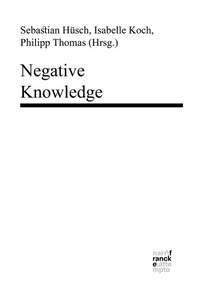
Negative Knowledge
1st Edition
Published on 10. August 2020
411 pages
978-3-7720-5686-4 (ISBN)
Description

The advent of Modernity was accompanied by a radical criticism of traditional metaphysics. In particular since the 20th century, rationality is predominantly conceived of as positivistic and scientistic, reducing reality to what is positively knowable. The price to pay is the cutting out of any kind of phenomenon of negativity. The present volume explicitly explores the philosophical and epistemological potential of negativity. The contributions brought together in this book tackle the question of negativity from historical as well as from systematical perspectives. From different angles, they defend the claim that philosophical approaches recurring to negativity can build a non-reductive conceptualization of rationality, and thus offer a valuable contribution to the orientation of humankind in the 20th and 21st century.
This volume contains contributions in English, French, and German.
This volume contains contributions in English, French, and German.
More details
Other editions
Additional editions
Sebastian Hüsch | Isabelle Koch | Philipp Thomas
Negative Knowledge
Book
08/2020
1st Edition
Narr Francke Attempto
€88.00
Shipment within 5-7 days
Persons
Prof. Dr. Sebastian Hüsch ist Professor für Ideengeschichte an der Universität Aix-Marseille. Seine Forschungsschwerpunkte liegen in der europäischen Philosophie des 19.-21. Jahrhunderts, mit Schwerpunkt auf existenzphilosophische Problemstellungen, das Verhältnis von Philosophie und Literatur, sowie die Religionsphilosophie.
Dr. Isabelle Koch ist Maître de conférences HDR in antiker Philosophie an der Universität Aix-Marseille. Ihr Forschungsschwerpunkt ist die Spätantike (Plotin, Augustinus) und Diskussionen über den stoischen Determinismus, insbesondere bei Cicero, Galenos und Alexander von Aphrodisias. Kürzlich ist von ihr eine Studie zu Alexanders De fato erschienen (Classiques Garnier, 2019).
Prof. Dr. Philipp Thomas ist außerplanmäßiger Professor am Philosophischen Seminar der Universität Tübingen mit dem Schwerpunkt Philosophie und Bildung (Philosophiedidaktik, Bildungsphilosophie). Forschungsschwerpunkte liegen auf Gebieten der Gegenwartsphilosophie wie Phänomenologie, Negativitätstheorie, Postmoderne und Existenzphilosophie.
Dr. Isabelle Koch ist Maître de conférences HDR in antiker Philosophie an der Universität Aix-Marseille. Ihr Forschungsschwerpunkt ist die Spätantike (Plotin, Augustinus) und Diskussionen über den stoischen Determinismus, insbesondere bei Cicero, Galenos und Alexander von Aphrodisias. Kürzlich ist von ihr eine Studie zu Alexanders De fato erschienen (Classiques Garnier, 2019).
Prof. Dr. Philipp Thomas ist außerplanmäßiger Professor am Philosophischen Seminar der Universität Tübingen mit dem Schwerpunkt Philosophie und Bildung (Philosophiedidaktik, Bildungsphilosophie). Forschungsschwerpunkte liegen auf Gebieten der Gegenwartsphilosophie wie Phänomenologie, Negativitätstheorie, Postmoderne und Existenzphilosophie.
Content
Sebastian Hüsch, Isabelle Koch, Philipp Thomas
Introduction
CHAPTER 1 Ontologies and Metaphysics of Negativity
Jean-Marc Narbonne
Connaissances négatives et autolimitation critique du savoir. Réflexions sur l'héritage métaphysique grec
Ada Bronowski
Le vide sans qualité chez Lucrèce et Leopardi
Tilo Eilebrecht
Leitung des Verhaltens durch das Unsagbare. Das Daodejing im Vergleich mit Plotin
CHAPTER 2 Negative Anthropologies
Jörg Disse
Connaissance négative et conscience (de) soi
Emil Angehrn
"Erschließung des Humanen aus seiner Verleugnung und Abwesenheit". Zwischen methodischem und inhaltlichem Negativismus
Oliver Victor
Der Mensch als Wanderer ohne Ziel. Nietzsches negative Anthropologie
CHAPTER 3 Negative Theology and Apophasis
Daniel Bloom
Plotinus' Thinking About Thought Thinking Itself
Florin Crismareanu
Jean Scot Érigène. Entre l'apophatisme dionysien et la christologie maximienne
Romain Debluë
Au Principe positif de la voie négative chez Thomas d'Aquin
Pierre Delain
Jacques Derrida : de la théologie négative aux inconditionnalités
CHAPTER 4 Languages of Negativity
Sebastian Gäb
Languages of ineffability. The rediscovery of apophaticism in contemporary analytic philosophy of religion
Sebastian Hüsch
Sprachen der Negativität. Negative Kommunikationsstrukturen bei Søren
Kierkegaard und im Zen-Buddhismus
Mathias Le Gargasson
De la nuit à la Nuit. L'épistémologie négative de la dissimilarité chez Georges Bataille
Miguel Alirangues
"Nichts,/nichts ist verloren.". Negativity and Memory in Paul
Celan's "Engführung"
CHAPTER 5 Phenomenology and Negativity
Daniel Roland Sobota
Von Nicht zu Nichts. Johannes Dauberts phänomenologische Auffassung des Problems der Negation vor dem Hintergrund der logischen
Diskussionen im neunzehnten und ihres metaphysischen Nachhalls im zwanzigsten Jahrhundert
Tomas Sodeika
Zu Heideggers Auffassung der Gelassenheit als negativen Erkennen
Frederik-Emil Friis Jakobsen
Injustice and Infinity. Reflections on Two Negatives in Emmanuel Levinas' Thinking about Knowledge
CHAPTER 6 Structures of Negativity in Adorno
Giovanna Caruso
Die geschichtlich-existenziale Struktur der Konstellation. Die Positivität von Adornos negativem Denken des Nichtidentischen
Christian Rößner
Ultima Utopia. Oder: Das Absolute jenseits der Totalität. Negative Dialektik bei Levinas und Adorno
Leonie Wellmann
Die Sisyphusarbeit, das Unsagbare zu sagen. Zur erkenntnistheoretischen Bedeutung einer kritischen Theorie der Sprache nach Adorno
CHAPTER 7 Negative epistemic procedures and philosophy of Education
Pierre Livet
Connaissances négatives, montée épistémique et comparaison entre modes de connaissances
Galit Caduri
Within Reasonable Doubt. Reclaiming Popper's Criterion of Refutation in Philosophical Research in Education
Philipp Thomas
Negative Knowledge in Twentieth Century Philosophy. An Example of Philosophy as Transformative Practice
Editors and contributors
Introduction
CHAPTER 1 Ontologies and Metaphysics of Negativity
Jean-Marc Narbonne
Connaissances négatives et autolimitation critique du savoir. Réflexions sur l'héritage métaphysique grec
Ada Bronowski
Le vide sans qualité chez Lucrèce et Leopardi
Tilo Eilebrecht
Leitung des Verhaltens durch das Unsagbare. Das Daodejing im Vergleich mit Plotin
CHAPTER 2 Negative Anthropologies
Jörg Disse
Connaissance négative et conscience (de) soi
Emil Angehrn
"Erschließung des Humanen aus seiner Verleugnung und Abwesenheit". Zwischen methodischem und inhaltlichem Negativismus
Oliver Victor
Der Mensch als Wanderer ohne Ziel. Nietzsches negative Anthropologie
CHAPTER 3 Negative Theology and Apophasis
Daniel Bloom
Plotinus' Thinking About Thought Thinking Itself
Florin Crismareanu
Jean Scot Érigène. Entre l'apophatisme dionysien et la christologie maximienne
Romain Debluë
Au Principe positif de la voie négative chez Thomas d'Aquin
Pierre Delain
Jacques Derrida : de la théologie négative aux inconditionnalités
CHAPTER 4 Languages of Negativity
Sebastian Gäb
Languages of ineffability. The rediscovery of apophaticism in contemporary analytic philosophy of religion
Sebastian Hüsch
Sprachen der Negativität. Negative Kommunikationsstrukturen bei Søren
Kierkegaard und im Zen-Buddhismus
Mathias Le Gargasson
De la nuit à la Nuit. L'épistémologie négative de la dissimilarité chez Georges Bataille
Miguel Alirangues
"Nichts,/nichts ist verloren.". Negativity and Memory in Paul
Celan's "Engführung"
CHAPTER 5 Phenomenology and Negativity
Daniel Roland Sobota
Von Nicht zu Nichts. Johannes Dauberts phänomenologische Auffassung des Problems der Negation vor dem Hintergrund der logischen
Diskussionen im neunzehnten und ihres metaphysischen Nachhalls im zwanzigsten Jahrhundert
Tomas Sodeika
Zu Heideggers Auffassung der Gelassenheit als negativen Erkennen
Frederik-Emil Friis Jakobsen
Injustice and Infinity. Reflections on Two Negatives in Emmanuel Levinas' Thinking about Knowledge
CHAPTER 6 Structures of Negativity in Adorno
Giovanna Caruso
Die geschichtlich-existenziale Struktur der Konstellation. Die Positivität von Adornos negativem Denken des Nichtidentischen
Christian Rößner
Ultima Utopia. Oder: Das Absolute jenseits der Totalität. Negative Dialektik bei Levinas und Adorno
Leonie Wellmann
Die Sisyphusarbeit, das Unsagbare zu sagen. Zur erkenntnistheoretischen Bedeutung einer kritischen Theorie der Sprache nach Adorno
CHAPTER 7 Negative epistemic procedures and philosophy of Education
Pierre Livet
Connaissances négatives, montée épistémique et comparaison entre modes de connaissances
Galit Caduri
Within Reasonable Doubt. Reclaiming Popper's Criterion of Refutation in Philosophical Research in Education
Philipp Thomas
Negative Knowledge in Twentieth Century Philosophy. An Example of Philosophy as Transformative Practice
Editors and contributors
