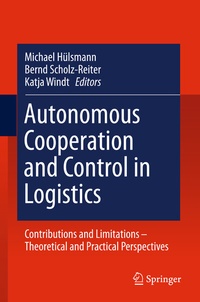
Autonomous Cooperation and Control in Logistics
Description

Many new technologies - like RFID, GPS, and sensor networks - that dominate innovative developments in logistics are based on the idea of autonomous cooperation and control. This self-organisational concept describes "...processes of decentralized decision-making in heterarchical structures. It presumes interacting elements in non-deterministic systems, which possess the capability and possibility to render decisions. The objective of autonomous cooperation and control is the achievement of increased robustness and positive emergence of the total system due to distributed and flexible coping with dynamics and complexity" (Hülsmann & Windt, 2007). In order to underlie these technology-driven developments with a fundamental theoretical foundation this edited volume asks for contributions and limitations of applying the principles of autonomous cooperation and control to logistics processes and systems. It intends to identify, describe, and explain - in the context of production and distribution logistics - the effects on performance and robustness, the enablers and impediments for the feasibility, the essential cause-effect-relations, etc. of concepts, methods, technologies, and routines of autonomous cooperation and control in logistics. Therefore, the analyses collected in this edited volume aim to develop a framework for finding the optimal degree as well as the upper and lower boundaries of autonomous cooperation and control of logistics processes from the different perspectives of production technology, electronics and communication engineering, informatics and mathematics, as well as management sciences and economics.
More details
Other editions
Additional editions