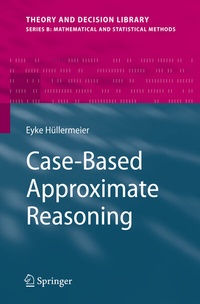
Case-Based Approximate Reasoning
Description

Case-based reasoning (CBR) has received a great deal of attention in recent years and has established itself as a core methodology in the field of artificial intelligence. The key idea of CBR is to tackle new problems by referring to similar problems that have already been solved in the past. More precisely, CBR proceeds from individual experiences in the form of cases. The generalization beyond these experiences typically relies on a kind of regularity assumption demanding that 'similar problems have similar solutions'.
Making use of different frameworks of approximate reasoning and reasoning under uncertainty, notably probabilistic and fuzzy set-based techniques, this book develops formal models of the above inference principle, which is fundamental to CBR. The case-based approximate reasoning methods thus obtained especially emphasize the heuristic nature of case-based inference and aspects of uncertainty in CBR. This way, the book contributes to a solid foundation of CBR which is grounded on formal concepts and techniques from the aforementioned fields. Besides, it establishes interesting relationships between CBR and approximate reasoning, which not only cast new light on existing methods but also enhance the development of novel approaches and hybrid systems.
This books is suitable for researchers and practioners in the fields of artifical intelligence, knowledge engineering and knowledge-based systems.
Reviews / Votes
From the reviews:
"In the last years developments were very successful that have been based on the general concept of case-based reasoning. . will get a lot of attention and for a good while will be the reference for many applications and further research. . the book can be used as an excellent guideline for the implementation of problem-solving programs, but also for courses in Artificial and Computional Intelligence. Everybody who is involved in research, development and teaching in Artificial Intelligence will get something out of it." (Christian Posthoff, Zentralblatt MATH, Vol. 1119 (21), 2007)
More details
Other editions
Additional editions