

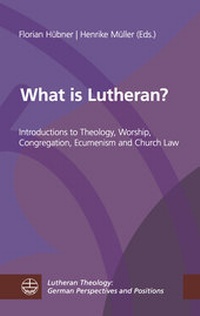
What is Lutheran?
Introductions to Theology, Worship, Congregation, Ecumenism and Church Law
1st Edition
Published on 18. November 2019
208 pages
978-3-374-05976-8 (ISBN)
Description

In the 21st century, Lutheran theology takes place on a global level. Just as the Lutheran communion has spread into all parts of the world, so also theology is now practised in a variety of linguistic and cultural contexts. For this reason, the United Evangelical Lutheran Church of Germany (VELKD), in cooperation with the German National Committee of the Lutheran World Federation, is starting a series of English translations of current VELKD publications.
The first volume contains five texts by well-known German theologians on core topics of the Lutheran Church: Theology (Michael Roth), Worship (Christian Lehnert), Congregations (Martin Kumlehn), Ecumenism (Bernd Oberdorfer) and Church Law (Hendrik Munsonius).
[Was bedeutet Lutherisch? Beiträge zu Theologie, Gottesdienst, Gemeinde, Ökumene und Kirchenrecht]
Lutherische Theologie im 21. Jahrhundert ist global. So, wie die lutherische Gemeinschaft auf der ganzen Welt vertreten ist, so wird heute auch Theologie in einer Vielzahl sprachlicher und kultureller Kontexte getrieben. Aus diesem Grund eröffnet die Vereinigte Evangelisch-Lutherische Kirche Deutschlands in Kooperation mit dem Deutschen Nationalkomitee des Lutherischen Weltbundes eine Reihe mit englischen Übersetzungen aktueller VELKD-Publikationen.
Den Auftakt macht in diesem Band eine Zusammenstellung von fünf Texten bekannter deutscher Theologen zu Kernthemen der Kirche aus lutherischer Perspektive: Theologie (Michael Roth), Gottesdienst (Christian Lehnert), Gemeinde (Martin Kumlehn), Ökumene (Bernd Oberdorfer) und Kirchenrecht (Hendrik Munsonius).
The first volume contains five texts by well-known German theologians on core topics of the Lutheran Church: Theology (Michael Roth), Worship (Christian Lehnert), Congregations (Martin Kumlehn), Ecumenism (Bernd Oberdorfer) and Church Law (Hendrik Munsonius).
[Was bedeutet Lutherisch? Beiträge zu Theologie, Gottesdienst, Gemeinde, Ökumene und Kirchenrecht]
Lutherische Theologie im 21. Jahrhundert ist global. So, wie die lutherische Gemeinschaft auf der ganzen Welt vertreten ist, so wird heute auch Theologie in einer Vielzahl sprachlicher und kultureller Kontexte getrieben. Aus diesem Grund eröffnet die Vereinigte Evangelisch-Lutherische Kirche Deutschlands in Kooperation mit dem Deutschen Nationalkomitee des Lutherischen Weltbundes eine Reihe mit englischen Übersetzungen aktueller VELKD-Publikationen.
Den Auftakt macht in diesem Band eine Zusammenstellung von fünf Texten bekannter deutscher Theologen zu Kernthemen der Kirche aus lutherischer Perspektive: Theologie (Michael Roth), Gottesdienst (Christian Lehnert), Gemeinde (Martin Kumlehn), Ökumene (Bernd Oberdorfer) und Kirchenrecht (Hendrik Munsonius).
More details
Other editions
Additional editions
Florian Hübner | Henrike Müller
What is Lutheran?
Introductions to Theology, Worship, Congregation, Ecumenism and Church Law
E-Book
11/2019
1st Edition
Evangelische Verlagsanstalt
€16.99
Available for download
Florian Hübner | Henrike Müller
What is Lutheran?
Introductions to Theology, Worship, Congregation, Ecumenism and Church Law
Book
10/2019
1st Edition
Evangelische Verlagsanstalt
€20.00
Shipment within 5-7 days
Content
- Cover
- Title
- Copyright
- Foreword
- Table of Contents
- Michael Roth: Given for You. Lutheran Theology
- 1. Introduction: A booklet on accounting for faith
- 2. Faith in practice
- 3. The object of faith: sinful humans and the justifying God
- 4. Freed into the present - life and action in faith
- Christian Lehnert: Descent and Ascent. On Lutheran Worship
- 1. An exotic metaphor to start with
- 2. »The former ascends, and the latter descends«
- 3. The form of the Mass
- 4. The opening
- 5. Kyrie eleison
- 6. Glory to God in the highest
- 7. The Collect of the Day
- 8. The readings
- 9. The creed spoken together
- 10. Intercessions and collections
- 11. Holy Communion
- 12. The river and the banks: the sermon
- 13. The blessing
- 14. The language of a church service
- 15. Music in worship
- 16. »A moment now here and then gone«
- 17. In conclusion: Luther's ribald language
- Martin Kumlehn: Church for the People. Guidelines for Protestant Parish Work
- 1. Welcome!
- 2. How it all began - on the road with Jesus
- 3. Community of the baptised
- 4. Plurality of local church forms
- 5. Institution of freedom - turning points of the Reformation
- 7. Religion in practice
- 8. Lively diversity - diverse participation
- 9. Occasional church
- 10. Church as a resource for the religious interpretation of life
- 12. Church as a companion
- 13. Church and social media
- 14. Free - and free of charge
- Bernd Oberdorfer: Fellowship in Practice. Ecumenism from a Lutheran Perspective
- 1. Introduction
- 2. Unity and diversity - a historical overview
- 3. The ecumenical movement
- 4. The search for doctrinal consensus
- 5. What is ecumenism?
- 6. Denominational perspectives on church unity
- 7. Ecumenical models for the unity of the church
- 8. Aspects of the cultivation of ecumenical connections
- 9. Outlook: A post-ecumenical age?
- 10. Literature
- Hendrik Munsonius: The Church and Its Law. An Introduction
- 1. Why is law necessary?
- 2. Church activity
- 3. Law
- 4. Church law
- 5. Persons
- 6. Structures
- 7. Procedures
- 8. Literature
- Authors
- Editors
