

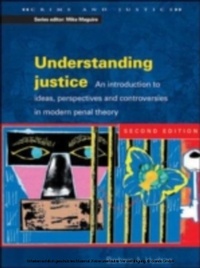
Understanding Justice 2/E
1st Edition
Published on 1. March 2003
230 pages
978-0-335-22581-1 (ISBN)
Description

This revised and updated edition of a highly successful text provides a comprehensive account of the ideas and controversies that have arisen within law, philosophy, sociology and criminology about the punishment of criminals. Written in a clear, accessible style, it summarises major philosophical ideas - retribution, rehabilitation, incapacitation - and discusses their strengths and weaknesses.
More details
Other editions
Additional editions
Barbara Hudson
UNDERSTANDING JUSTICE 2/E
An introduction to Ideas, Perspectives and Controversies in Modern Penal Therory
Book
03/2003
2nd Edition
Open University Press
€59.67
Article exhausted; check different version
Content
- Front cover
- Half Title
- Title
- Copyright
- Contents
- Series editors foreword
- Acknowledgements
- Chapter 01 Perspectives on punishment
- Defining modern penology
- The goals of punishment
- Punishment and society: the social role and the characteristics of penal systems
- Punishing effectively: the criminological tradition
- Transgressing crime and punishment: abolition and deconstruction
- Summary
- Part One The goals of punishment: the juridical perspective
- Chapter 02 Utilitarian approaches
- Introduction
- Deterrence
- Evaluating the deterrent effects of punishment
- Individual deterrence
- Reform/rehabilitation
- Criticisms of rehabilitative penalties
- Prevention through incapacitation
- Problems with prevention
- Conclusion
- Chapter 03 Retribution
- Introduction
- Modern retributivism: the just-deserts movement
- Proportionality and seriousness
- Retribution and the justification of punishment
- Deterrence and retribution in distribution
- Summary and conclusion
- Chapter 04 Hybrids, compromises and syntheses
- Introduction
- Desert and deterrence: crime reduction within limits
- Desert and rehabilitation: reform with rights
- Targets and constraints: syntheses of Utilitarian and retributive theories
- Conclusion
- Chapter 05 Restorative justice: diversion, compromise or replacement discourse?
- Introduction
- Definition, principles and models
- The range and limits of restorative justice
- Retribution, rights and restorative justice
- Conclusion
- Part Two Punishment and modernity: the sociological perspective
- Chapter 06 Punishment and progress: the Durkheimian tradition
- Introduction
- Durkheim: punishment and solidarity
- Durkheim's sociology of law: critical evaluation
- Weber: bureaucracy and rationality
- Durkheimian and Weberian themes: some contemporary applications
- Punishment and culture: contemporary formulations
- Conclusion
- Chapter 07 The political economy of punishment: Marxist approaches
- Introduction
- Key concepts in Marxist sociology
- Punishment and the labour market
- Why prison?
- Ideology and the control of surplus populations
- Summary and conclusion: Foucault's legacy
- Introduction
- Foucault's disciplinary penality
- Delinquency and normalization
- Critique and controversy
- Periodicity
- Overgeneralization
- Partiality
- Functionalism
- Politics
- Summary and conclusion: Foucault's legacy
- Chapter 09 Understanding contemporary penality
- Introduction: punishment and contemporary culture
- Governmentality, risk and actuarialism
- Penal policy as problem-solving
- The mass imprisonment society
- Summary and conclusions: punishment in the twenty-first century
- Part Three Towards justice?
- Chapter 10 The struggle for justice: critical criminology and critical legal studies
- Introduction
- Challenges to mainstream penology
- Abolitionism
- Feminist jurisprudence
- Concluding comments
- Postscript
- Introduction
- Human rights and the politics of public safety
- Justice and postmodernity
- Glossary of key terms
- Suggestions for further reading
- References
- Index
- Back Cover
