

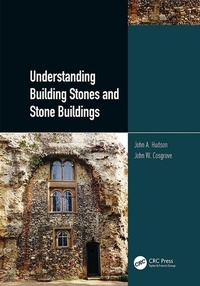
Understanding Building Stones and Stone Buildings
1st Edition
Published on 24. April 2019
364 pages
978-1-351-58534-7 (ISBN)
Description

This book covers the wide spectrum of subjects relating to obtaining and using building stones, starting with their geological origin and then describing the nature of granites, volcanics, limestones, sandstones, flint, metamorphic stones, breccias and conglomerates, with emphasis being placed on how to recognise the different stones via the many illustrated examples from Great Britain and other countries. The life of a building stone is explained from its origin in the quarry, through its exposure to the elements when used for a building, to its eventual deterioration. The structure of stone buildings is then discussed, with explanations of the mechanics of pillars, lighthouses and walls, arches, bridges, buttresses and roof vaults, plus castles and cathedrals.
The sequence of the historical architectural styles of stone buildings is explained-from the early days through to postmodern buildings. Special attention is paid to two famous architects: the Roman Vitruvius and the English Sir Christopher Wren who designed and supervised the construction of St. Paul's Cathedral in London. To demonstrate many of the concepts presented, two exemplary stone buildings are described in detail: the Albert Memorial in London and Durham Cathedral in northern England. The former building is interesting because it is comprised of a cornucopia of different building stones and the latter building because of its architecture and sandstone decay mechanisms. In the final Chapter, ruined stone buildings are discussed-the many reasons for their decay and the possibility of their 'rebirth' via digital recording of their geometry.
The book has over 350 pages and is illustrated with more than 450 diagrams and colour photographs of both the various stones and the associated stone buildings. Readers' knowledge of the subject will be greatly enhanced by these images and the related explanatory text. A wide-ranging references and bibliography section is also included.
The sequence of the historical architectural styles of stone buildings is explained-from the early days through to postmodern buildings. Special attention is paid to two famous architects: the Roman Vitruvius and the English Sir Christopher Wren who designed and supervised the construction of St. Paul's Cathedral in London. To demonstrate many of the concepts presented, two exemplary stone buildings are described in detail: the Albert Memorial in London and Durham Cathedral in northern England. The former building is interesting because it is comprised of a cornucopia of different building stones and the latter building because of its architecture and sandstone decay mechanisms. In the final Chapter, ruined stone buildings are discussed-the many reasons for their decay and the possibility of their 'rebirth' via digital recording of their geometry.
The book has over 350 pages and is illustrated with more than 450 diagrams and colour photographs of both the various stones and the associated stone buildings. Readers' knowledge of the subject will be greatly enhanced by these images and the related explanatory text. A wide-ranging references and bibliography section is also included.
Reviews / Votes
"Life is much richer the more one understands about one's surrounding environment, whether it be the natural or the built environment." Citing this motivation, Hudson and Cosgrove (both, Imperial College London) introduce their amazing work, which provides, in nine chapters, a complete understanding of stone from origins in the quarry to ultimate deterioration. The reader learns about the geological origin of various building stones in chapter 2 and how to recognize their types in chapter 3. The authors discuss each stone, its composition, its different appearances based on location, and ornamental uses. A fuller understanding of stone is developed in chapter 4, on quarrying and exposure, while some of its unique applications, ranging from use in lighthouse buildings to lettering, are presented in chapter 5. Chapter 6 delves into architectural styles, while chapter 7 focuses on two specific structures, taking the previous discussions into real life. Chapter 8 discusses deterioration in detail, focusing on mechanisms such as entropy and digital reconstruction for the sake of conservation. Peppered with color photographs, diagrams, and tables that clearly support the text, and including examples across Great Britain, this is an outstanding companion to older books like Stone, Brick and Mortar, by Pavia and Bolton (2000), and a significant contribution to the literature.Summing Up: Highly recommended. All readers.
L.B. Allsopp (Arizona State University) in CHOICE, July 2020 Vol. 57, No. 11
More details
Edition
1. Auflage
Language
English
Place of publication
London
United Kingdom
Publishing group
Taylor & Francis Ltd
Target group
College/higher education
Professional and scholarly
Adult education
File size
68,54 MB
ISBN-13
978-1-351-58534-7 (9781351585347)
Copyright in bibliographic data and cover images is held by Nielsen Book Services Limited or by the publishers or by their respective licensors: all rights reserved.
Schweitzer Classification
Other editions
Additional editions
John Hudson | John Cosgrove
Understanding Building Stones and Stone Buildings
Book
03/2021
1st Edition
CRC Press
€104.20
Shipment within 15-20 days
John Hudson | John Cosgrove
Understanding Building Stones and Stone Buildings
Book
05/2019
1st Edition
CRC Press
€193.13
Shipment within 10-20 days
Persons
Coming from a long line of stone masons and mining engineers, John A Hudson graduated from the Heriot-Watt University, UK, and obtained his PhD at the University of Minnesota, USA. He spent his professional career in consulting, research, teaching and publishing in engineering rock mechanics, and was awarded the DSc. degree by the Heriot-Watt University for his contributions to the subject. He authored many scientific papers and books, and was the editor of the 1993 five-volume "Comprehensive Rock Engineering" compendium, and from 1983-2006 editor of the International Journal of Rock Mechanics and Mining Sciences. Since 1983, he has been affiliated with Imperial College London as Reader, Professor and Emeritus Professor. In 1998, he became a Fellow of the UK Royal Academy of Engineering and was President of the International Society for Rock Mechanics (ISRM) for the period 2007-2011. Additionally, he completed consulting assignments in many countries. In 2015, the prestigious ISRM Mueller Award was conferred on Professor Hudson in recognition of "an outstanding career that combines theoretical and applied rock engineering with a profound understanding of the basic sciences of geology and mechanics".
John Cosgrove is a Professor in the Department of Earth Sciences and Engineering, Imperial College London, UK. He obtained both his MSc (1969) and PhD (1972) from Imperial College. Following a two-year Post-doctoral Fellowship at MacMaster University, Hamilton, Ontario, Canada, he returned in 1973 to Imperial College to take up a Lectureship and has since been promoted to Professor. He won the Paul Fourmarier Gold Medal, awarded by the Royal Academy of Belgium in 2005 for work on fluid induced failure in the crust and has also received awards for excellence in teaching from Imperial College. He was responsible for the M.Sc. course in Structural Geology & Rock Mechanics for the period (1978-1998). His present research interests relate to the interplay between stress, fractures and fluid flow in the Earth's crust. His earlier co-authored book (Price N.J. & Cosgrove J.W. 1990 "Analysis of Geological Structures") has been used worldwide. He has worked extensively on research for the hydrocarbon and mining industry (the dewatering of basins and the impact of the resulting fluids on mineralisation and hydrocarbon migration & concentration), radioactive waste disposal and other rock mechanics applications. He has a strong interest in the many geological aspects of building stones and the related architectural aspects as is manifested in this book.
John Cosgrove is a Professor in the Department of Earth Sciences and Engineering, Imperial College London, UK. He obtained both his MSc (1969) and PhD (1972) from Imperial College. Following a two-year Post-doctoral Fellowship at MacMaster University, Hamilton, Ontario, Canada, he returned in 1973 to Imperial College to take up a Lectureship and has since been promoted to Professor. He won the Paul Fourmarier Gold Medal, awarded by the Royal Academy of Belgium in 2005 for work on fluid induced failure in the crust and has also received awards for excellence in teaching from Imperial College. He was responsible for the M.Sc. course in Structural Geology & Rock Mechanics for the period (1978-1998). His present research interests relate to the interplay between stress, fractures and fluid flow in the Earth's crust. His earlier co-authored book (Price N.J. & Cosgrove J.W. 1990 "Analysis of Geological Structures") has been used worldwide. He has worked extensively on research for the hydrocarbon and mining industry (the dewatering of basins and the impact of the resulting fluids on mineralisation and hydrocarbon migration & concentration), radioactive waste disposal and other rock mechanics applications. He has a strong interest in the many geological aspects of building stones and the related architectural aspects as is manifested in this book.
Content
1 Introduction. 2 The geological origin of building stones 3 Recognising the different types of building stone. 4 The life of a building stone: quarrying and emplacement through to deterioration. 5 Stone buildings-pillars, lighthouses, walls, arches, bridges, buttresses, roof vaults, castles, cathedrals and lettering. 6 The architecture of stone buildings. 7 Two exemplary stone structures: the Albert Memorial and Durham Cathedral. 8 Deterioration of building stones and stone buildings. 9 Concluding comments.
