

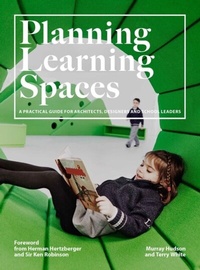
Planning Learning Spaces
A Practical Guide for Architects, Designers, School Leaders
1st Edition
Published on 21. October 2019
144 pages
978-1-78627-757-2 (ISBN)
Description

"A welcome and timely addition to the subject of school design at a time of great change."-Professor Alan Jones, President of the Royal Institute of British Architects
"Comprehensive but also very practical approach."-Andreas Schleicher, Director for the Directorate of Education and Skills in Paris, France
"Any community building a new school should read this book."-Michael B. Horn, Clayton Christensen Institute for Disruptive Innovation in Boston, USA
"Builds a bridge from the simple to the extraordinary... awash in opportunity and inspiration."-Professor Stephen Heppell, Chair in Learning Innovation at the Universidad Camilo Jose Cela in Madrid, Spain
Can school design help us to realize a new vision for education that equips young people for life in a fast-changing world? This is the big question at the heart of Planning Learning Spaces, a new guide for anyone involved in the planning and design of learning environments.
Murray Hudson and Terry White have brought together educators and innovative school architects to pool their collective expertise and inspire the design of more intelligent learning spaces.
The authors prompt readers to question common assumptions about how schools should look and how children should be educated:
. Why have so many schools changed relatively little in more than a century?
. What form should a school library take in the Internet age?
. Do classrooms really have to be square?
The book also tackles vital elements of learning space design such as the right lighting, heating and acoustics, and explores the key role of furniture, fixtures, and fittings.
With contributions from leading professionals around the world, including Herman Hertzberger and Sir Ken Robinson, Planning Learning Spaces is an invaluable resource for architects, interior designers, and educators hoping that their project will make a genuine difference.
Highly recommended reading for anyone involved with the process of building or updating an educational space.
"Comprehensive but also very practical approach."-Andreas Schleicher, Director for the Directorate of Education and Skills in Paris, France
"Any community building a new school should read this book."-Michael B. Horn, Clayton Christensen Institute for Disruptive Innovation in Boston, USA
"Builds a bridge from the simple to the extraordinary... awash in opportunity and inspiration."-Professor Stephen Heppell, Chair in Learning Innovation at the Universidad Camilo Jose Cela in Madrid, Spain
Can school design help us to realize a new vision for education that equips young people for life in a fast-changing world? This is the big question at the heart of Planning Learning Spaces, a new guide for anyone involved in the planning and design of learning environments.
Murray Hudson and Terry White have brought together educators and innovative school architects to pool their collective expertise and inspire the design of more intelligent learning spaces.
The authors prompt readers to question common assumptions about how schools should look and how children should be educated:
. Why have so many schools changed relatively little in more than a century?
. What form should a school library take in the Internet age?
. Do classrooms really have to be square?
The book also tackles vital elements of learning space design such as the right lighting, heating and acoustics, and explores the key role of furniture, fixtures, and fittings.
With contributions from leading professionals around the world, including Herman Hertzberger and Sir Ken Robinson, Planning Learning Spaces is an invaluable resource for architects, interior designers, and educators hoping that their project will make a genuine difference.
Highly recommended reading for anyone involved with the process of building or updating an educational space.
More details
Other editions
Additional editions
Murray Hudson | Terry White
Planning Learning Spaces
A Practical Guide for Architects, Designers and School Leaders
Book
10/2019
1st Edition
Laurence King Publishing
€30.00
Shipment within 3-4 weeks
Persons
Murray Hudson, Terry White
Content
- Intro
- Content
- Introduction
- Preface
- Foreword by Herman Hertzberger - Rethinking school design
- Foreword by Sir Ken Robinson - Building creativity into school design
- The learning agenda for the twenty-first century
- Crucial Choices
- How to approach school design
- How to begin
- How space can provoke learning
- How to engage learners
- The Learning Journey
- Designing for pre-school and early years
- Designing the primary landscape
- Designing for the transition to secondary and beyond
- Primary libraries
- Designing for community use and engagement
- Specialist Spaces
- How to approach specialist spaces
- Science laboratories and preparation rooms
- STEM, maker and studio spaces
- Art
- Music and Performance
- Technology and Communications
- Artificial intelligence
- Media
- Applied and technical learning
- A place to gather
- A place for staff
- Places for external learning
- Bringing It Together
- Flow and navigation
- How the spaces can come together
- Early years
- Primary school
- Secondary school
- Equipping The Space
- Furniture, fitting-out and equipment
- Acoustics and includive environments
- The Importance of Research
- Post-occupancy evaluation
- Learning from the work of others
- Intelligent classroom design can improve learning outcomes
- Implementing your vision
- Reference
- Further reading
- Index
- Contributors
- Picture credits
- Thanks
