


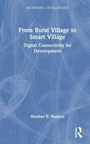
From Rural Village to Smart Village
Description

This book investigates how the rise of information and communications technologies is transforming life for Indigenous communities and those living in rural and developing areas.
The global reach of the internet and the proliferation of mobile phones, broadband and social media have created an interconnected global village of communicators able to access and share information almost instantaneously. More recently, the COVID-19 pandemic has further increased reliance on online services for access to education, health, and ecommerce, especially in rural areas. This book provides an essential overview of the impacts of digital technologies including recent case studies and research, and key policy issues for planners, policy makers and researchers to consider concerning ICTs in rural and developing regions. It concludes by examining policy solutions and strategies to help to address barriers in availability, affordability, and digital skills, in order to make universal access to the electronic means to create, locate and share information a reality.
Written by renowned international expert Heather E. Hudson, this book will be ideal for researchers or students of communications and development, and for practitioners and policy makers working for governments, consultancies, international organizations and development agencies.
More details
Other editions
Additional editions

Person
Heather E. Hudson is a leading global authority on communications for development. She is Professor Emerita at the University of San Francisco, and former Director of the Institute of Social and Economic Research (ISER), University of Alaska Anchorage, and was previously the founding professor in new communication technology and policy at the University of Texas at Austin. Her research focuses on applications and impacts of communication technologies for socio-economic development, regulatory issues, and policies and strategies to extend affordable access to digital connectivity in rural and developing regions. She has planned and evaluated communication projects in northern Canada and Alaska and in more than 50 developing countries and emerging economies in Africa, Asia, the Caribbean and the South Pacific. She has consulted for government agencies, consumer and Indigenous organizations, the private sector, and international organizations including USAID, the World Bank, the ITU, UNDP, UNESCO, CIDA, IDRC, and the Commonwealth of Learning. Professor Hudson has held a Fulbright Policy Research Chair and a Fulbright Asia-Pacific Distinguished Lectureship. She has published numerous articles and written or co-authored eight previous books on information and communications technologies (ICTs) for development, international communications, communications policy, and satellites.
Content
1. Introduction: Digital Connectivity and Development 2. The Information Society and the Digital Economy 3. Digital Learning: Education and Training 4. Telemedicine and E-Health 5. Agriculture, Natural Resources, and the Environment 6. E-Commerce 7. E-Government and Nonprofit Services 8. Languages, Cultures, and Gender 9. Field Research and Evaluation 10. Technologies to Extend Digital Connectivity 11. Digital Policy Issues and Strategies 12. The Era of Artificial Intelligence Epilogue: Lessons and Future Directions
