
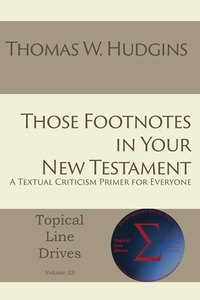
Those Footnotes in Your New Testament
Description
Alles über E-Books | Antworten auf Fragen rund um E-Books, Kopierschutz und Dateiformate finden Sie in unserem Info- & Hilfebereich.
Have you ever seen a passage in the New Testament that was placed in brackets, or a footnote at the bottom of a page referring to "ancient authorities" or "manuscripts"?
Most people scratch their heads and just keep reading, but these notes are very important. So is understanding why they're even there.
In this short introduction, Thomas W. Hudgins explains for the average reader the need for, criteria of, and some misconceptions associated with New Testament textual criticism.
More details
Other editions
Additional editions
Content
- Intro
- Introduction
- Explaining the Need for Textual Criticism
- Exploring the Criteria of Textual Criticism
- Engaging Some Misconceptions with Textual Criticism
- Conclusion
- Bibliography

System requirements
File format: ePUB
Copy protection: Watermark-DRM (Digital Rights Management)
System requirements:
- Computer (Windows; MacOS X; Linux): Use a reading software that can process the file format ePUB: e.g., Adobe Digital Editions or FBReader – both free (see eBook Help).
- Tablet/Smartphone (Android; iOS): Before downloading, install the free app Adobe Digital Editions (see eBook Help).
- E-reader: Bookeen, Kobo, Pocketbook, Sony, Tolino and many more (not Kindle).
The file format ePUB works well for novels and non-fiction books – i.e., „flowing” text without complex layout. On an e-reader or smartphone, line and page breaks automatically adjust to fit the small displays.
This eBook uses Watermark-DRM, a „soft” copy protection. This means that there are no technical restrictions to prevent illegal distribution. However, there is a personalised watermark embedded in the eBook that can be used to identify the purchaser of the eBook in the event of misuse and to provide evidence for legal purposes.
For more information, see our eBook Help page.