

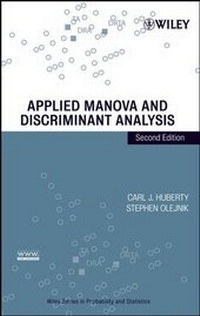
Applied MANOVA and Discriminant Analysis
Description

Reviews / Votes
"...This is a valuable addition to the literature on MANOVA andDA, with emphasis on applications." (Zentralblatt MATH,2007) "...a useful addition to the literature...I am veryhappy to have this book on my shelf." (Journal of the AmericanStatistical Association, September 2007)More details
Other editions
Additional editions
Persons
Content
List of Figures.
List of Tables.
Preface to Second Edition.
Acknowledgments.
Preface to First Edition.
Notation.
I INTRODUCTION.
1 Discriminant Analysis in Research.
1.1 A Little History.
1.2 Overview.
1.3 Descriptive Discriminant Analysis.
1.4 Predictive Discriminant Analysis.
1.5 Design in Discriminant Analysis.
2 Preliminaries.
2.1 Introduction.
2.2 Research Context.
2.3 Data, Analysis Units, Variables, and Constructs.
2.4 Summarizing Data.
2.5 Matrix Operations.
2.6 Distance.
2.7 Linear Composite.
2.8 Probability.
2.9 Statistical Testing.
2.10 Judgment in Data Analysis.
2.11 Summary.
II ONE-FACTOR MANOVA/DDA.
3 Group Separation.
3.1 Introduction.
3.2 Two-Group Analyses.
3.3 Test for Covariance Matrix Equality.
3.4 Yao Test.
3.5 Multiple-Group Analyses-Single Factor.
3.6 Computer Application.
3.7 Summary.
4 Assessing MANOVA Effects.
4.1 Introduction.
4.2 Strength of Association.
4.3 Computer Application I.
4.4 Group Contrasts.
4.5 Computer Application II.
4.6 Covariance Matrix Heterogeneity.
4.7 Sample Size.
4.8 Summary.
5 Describing MANOVA Effects.
5.1 Introduction.
5.2 Omnibus Effects.
5.3 Computer Application I.
5.4 Standardized LDFWeights.
5.5 LDF Space Dimension.
5.6 Computer Application II.
5.7 Computer Application III.
5.8 Contrast Effects.
5.9 Computer Application IV.
5.10 Summary.
6 Deleting and Ordering Variables.
6.1 Introduction.
6.2 Variable Deletion.
6.3 Variable Ordering.
6.4 Contrast Analyses.
6.5 Computer Application II.
6.6 Comments.
7 Reporting DDA Results.
7.1 Introduction.
7.2 Example of Reporting DDA Results.
7.3 Computer Package Information.
7.4 Reporting Terms.
7.5 MANOVA/DDA Applications.
7.6 Concerns.
7.7 Overview.
III FACTORIAL MANOVA, MANCOVA, AND REPEATED MEASURES.
8 Factorial MANOVA.
8.1 Introduction.
8.2 Research Context.
8.3 Univariate Analysis.
8.4 Multivariate Analysis.
8.5 Computer Application I.
8.6 Computer Application II.
8.7 Nonorthogonal Design.
8.8 Outcome Variable Ordering and Deletion.
8.9 Summary.
9 Analysis of Covariance.
9.1 Introduction.
9.2 Research Context.
9.3 Univariate ANCOVA.
9.4 Multivariate ANCOVA (MANCOVA).
9.5 Computer Application I.
9.6 Comparing Adjusted Means-Omnibus Test.
9.7 Computer Application II.
9.8 Contrast Analysis.
9.9 Computer Application III.
9.10 Summary.
10 Repeated-Measures Analysis.
10.1 Introduction.
10.2 Research Context.
10.3 Univariate Analyses.
10.4 Multivariate Analysis.
10.5 Computer Application I.
10.6 Univariate and Multivariate Analyses.
10.7 Testing for Sphericity.
10.8 Computer Application II.
10.9 Contrast Analysis.
10.10 Computer Application III.
10.11 Summary.
11 Mixed-Model Analysis.
11.1 Introduction.
11.2 Research Context.
11.3 Univariate Analysis.
11.4 Multivariate Analysis.
11.5 Computer Application I.
11.6 Contrast Analysis.
11.7 Computer Application II.
11.8 Summary.
IV GROUP MEMBERSHIP PREDICTION.
12 Classification Basics.
12.1 Introduction.
12.2 Notion of Distance.
12.3 Distance and Classification.
12.4 Classification Rules in General.
12.5 Comments.
13 Multivariate Normal Rules.
13.1 Introduction.
13.2 Normal Density Functions.
13.3 Classification Rules Based on Normality.
13.4 Classification Functions.
13.5 Summary of Classification Statistics.
13.6 Choice of Rule Form.
13.7 Comments.
14 Classification Results.
14.1 Introduction.
14.2 Research Context.
14.3 Computer Application.
14.4 Individual Unit Results.
14.5 Group Results.
14.6 Comments.
15 Hit Rate Estimation.
15.1 Introduction.
15.2 True Hit Rates.
15.3 Hit Rate Estimators.
15.4 Computer Application.
15.5 Choice of Hit Rate Estimator.
15.6 Outliers and In-Doubt Units.
15.7 Sample Size.
15.8 Comments.
16 Effectiveness of Classification Rules.
16.1 Introduction.
16.2 Proportional Chance Criterion.
16.3 Maximum-Chance Criterion.
16.4 Improvement over Chance.
16.5 Comparison of Rules.
16.6 Computer Application I.
16.7 Effect of Unequal Priors.
16.8 PDA Validity/Reliability.
16.9 Applying a Classification Rule to New Units.
16.10 Comments.
17 Deleting and Ordering Predictors.
17.1 Introduction.
17.2 Predictor Deletion.
17.3 Computer Application.
17.4 Predictor Ordering.
17.5 Reanalysis.
17.6 Comments.
17.7 Side Note.
18 Two-Group Classification.
18.1 Introduction.
18.2 Two-Group Rule.
18.3 Regression Analogy.
18.4 MRA-PDA Relationship.
18.5 Necessary Sample Size.
18.6 Univariate Classification.
19 Nonnormal Rules.
19.1 Introduction.
19.2 Continuous Variables.
19.3 Categorical Variables.
19.4 Predictor Mixtures.
19.5 Comments.
20 Reporting PDA Results.
20.1 Introduction.
20.2 Example of Reporting PDA Results.
20.3 Some Additional Specific PDA Information.
20.4 Computer Package Information.
20.5 Reporting Terms.
20.6 Sources of PDA Applications.
20.7 Concerns.
20.8 Overview.
Further Reading.
Exercises.
21 PDA-Related Analyses.
21.1 Introduction.
21.2 Nonlinear Methods.
21.3 Other Methods.
V ISSUES AND PROBLEMS.
22 Issues in PDA and DDA.
22.1 Introduction.
22.2 Five Choices in PDA.
22.3 Stepwise Analyses.
22.4 StandardizedWeights Versus Structure r's.
22.5 Data-Based Structure.
23 Problems in PDA and DDA.
23.1 Introduction.
23.2 Missing Data.
23.3 Outliers and Influential Observations.
23.4 Initial Group Misclassification.
23.5 Misclassification Costs.
23.6 Statistical Versus Clinical Prediction.
23.7 Other Problems.
Appendix A: Data Set Descriptions.
Appendix B: Some DA-Related Originators.
Appendix C: List of Computer Syntax.
Appendix D: Contents ofWileyWebsite.
References.
Answers to Exercises.
Index.
