

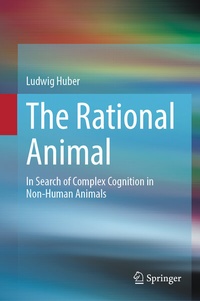
The Rational Animal
Description

In this book, the major and at the same time most difficult questions of comparative cognition research - here called the sextet of animal intelligence - are presented using good examples, discussed in all their facets and finally answered with due caution. Starting with the question of human rationality, which is illuminated historically at the beginning and presented as a framework concept, the latest research is dealt with, which either revises preferred interpretation schemes or calls for new ones. It is particularly important to critically question hastily conceived categorisations, often derived from research on the human species and from everyday psychological notions, and to consider so-called animal irrationality, a.k.a. (mis)performance, from the perspective of species-specific, natural requirements. Why is it at all important to know whether animals can act rationally, intentionally or consciously? The answer is because it is of both theoretical and practical relevance. Theoretical relevance is twofold: because it is good in itself to understand animals better, but this knowledge is then also of great importance for assessing ourselves. This brings up the practical relevance: we are not only surrounded by animals, we live with animals, we live from animals. Yet we see ourselves as separate from them in important ways. Consciousness, language and rationality are essential characteristics with which we justify our human uniqueness and thus our superiority and ultimately our right to dominate and use animals in many ways. If an animal can feel pain, we feel obliged to avoid inflicting unnecessary pain on it. But yet we do not accord it the special inherent value and dignity associated with consciousness and rationality. This has far-reaching consequences for human action and the coexistence of humans and animals.
More details
Other editions
Additional editions
Person
Ludwig Huber is a Professor of Comparative Cognition, as well as of the Natural Science Foundations of Animal Ethics and Human-Animal Interactions at the Messerli Research Institute, an interdisciplinary institute of the University of Veterinary Medicine Vienna, the Medical University of Vienna, and the University of Vienna. His research focuses on animal cognition in a broad, comparative manner, including such diverse species as humans, marmosets, dogs, kea, cockatoos, pigeons, tortoises, lizards, poison frogs and archer fish. He has (co-)authored ca. 200 research articles, 40 book chapters and 3 books about these topics (including, as co-editor, The Evolution of Cognition, MIT Press, 2000).
Content
1. Historical Outline of the Basic Questions of Animal Cognition.- 2. Can Animals be Rational?.- 3. Tool use.- 4. Causal Understanding.- 5. Looking into the Future.- 6. Episodic Memory.- 7. Metacognition.- 8. Mind Reading.- 9. Do Animals Have Language?.- 10. Do Animals Have Consciousness?.- 11. How Do Animals Think? A Seven-point Summary.- . Epiligue.- . References.- .
