

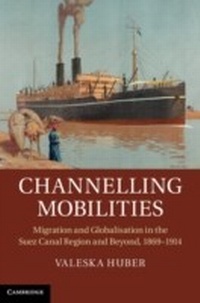
Channelling Mobilities
Migration and Globalisation in the Suez Canal Region and Beyond, 1869-1914
1st Edition
Published on 1. June 2013
978-1-107-24048-3 (ISBN)
Description

The history of globalisation is usually told as a history of shortening distances and acceleration of the flows of people, goods and ideas. Channelling Mobilities refines this picture by looking at a wide variety of mobile people passing through the region of the Suez Canal, a global shortcut opened in 1869. As an empirical contribution to global history, the book asks how the passage between Europe and Asia and Africa was perceived, staged and controlled from the opening of the Canal to the First World War, arguing that this period was neither an era of unhampered acceleration, nor one of hardening borders and increasing controls. Instead, it was characterised by the channelling of mobilities through the differentiation, regulation and bureaucratisation of movement. Telling the stories of tourists, troops, workers, pilgrims, stowaways, caravans, dhow skippers and others, the book reveals the complicated entanglements of empires, internationalist initiatives and private companies.
Reviews / Votes
'Valeska Huber's richly detailed study of the Suez canal confounds a view of history as ever-increasing connections across space. She shows that the canal was a choke point as well as a connector, a 'decelerator' as much as an 'accelerator' of movement, and a site where governing elites sought to control migration and to elaborate and enforce distinctions among people, not simply to facilitate their mobility and interaction.' Frederick Cooper, co-author of Empires in World History: Power and the Politics of Difference 'A sophisticated examination of a variety of global connections and systems of control as they impacted the peoples affected by the opening of the Suez Canal. This invaluable contribution to the growing literature on nineteenth-century globalization provides a marvelous model for the study of the interaction of the global and the local everywhere.' E. Roger Owen, author of State, Power and Politics in the Making of the Modern Middle East 'This is a fascinating book. The opening of the Suez Canal in 1869 typically serves as a short-hand for the dynamic processes of transportation, communication, and globalization in the nineteenth century. As Valeska Huber vividly shows, the story was much more complex. Multiple forms of mobility overlapped in the Canal region; some were accelerated, others slowed down. We learn of steamships and long-distance travel, of military strategies and global trade - but also of camel caravans and Bedouins, of passports and pilgrims to Mecca. This superbly researched book demonstrates that the best global histories are grounded locally.' Sebastian Conrad, author of German Colonialism: A Short Introduction 'Channelling Mobilities takes up a host of binaries related to historical and analytical values and puts them under rigorous historical examination. The result, which is a highly readable and thought-provoking book, is therefore majorly recommended for historians working on late nineteenth- and early twentieth-century 'imperial' and/or 'global' history.' Nitin Sinha, The International Journal of Maritime HistoryMore details
Language
English
Place of publication
Cambridge
United Kingdom
Target group
Professional and scholarly
Illustrations
1 Maps; 24 Halftones, unspecified
File size
10,92 MB
ISBN-13
978-1-107-24048-3 (9781107240483)
Copyright in bibliographic data and cover images is held by Nielsen Book Services Limited or by the publishers or by their respective licensors: all rights reserved.
Schweitzer Classification
Other editions
Additional editions
Valeska Huber
Channelling Mobilities
Migration and Globalisation in the Suez Canal Region and Beyond, 1869-1914
Book
08/2013
Cambridge University Press
€98.80
Shipment within 15-20 days
Person
Valeska Huber is a Research Associate at the German Historical Institute in London.
Content
Introduction: mobility and its limits; Part I. Imperial Relay Station: Global Space, New Thresholds, 1870s-90s: 1. Rites de passage and perceptions of global space; 2. Regimes of passage: troops in the canal zone; 3. Companies and workers; Part II. Frontier of the Civilising Mission: Mobility Regulation East of Suez, 1880s-1900s: 4. Bedouin and caravans; 5. Dhows and slave trading in the Red Sea; 6. Mecca pilgrims under imperial surveillance; Part III. Checkpoint: Tracking Microbes and Tracing Travellers, 1890s-1914: 7. Contagious mobility and the filtering of disease; 8. Rights of passage and the identification of individuals; Conclusion: rites de passage and rights of passage in the Suez Canal region and beyond; Bibliography.
