

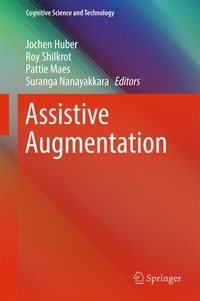
Assistive Augmentation
Description

This book addresses Assistive Augmentation, highlighting the design and development of assistive technologies, user interfaces, and interactions that seamlessly integrate with a user's mind, body, and behavior, providing an enhanced perception.
Our senses are the dominant channel we use to perceive the world around us. Whether they have impairments or not, people often find themselves at the limits of their sensorial capabilities. Some seek assistive or enhancing devices that enable them to carry out specific tasks or even transform them into a "superhuman" with capabilities well beyond the ordinary. The overarching topic of this book revolves around the design and development of technologies and interfaces that provide enhanced physical, sensorial and cognitive capabilities: "Assistive Augmentation".
The Assistive Augmentation community convened at an interdisciplinary workshop at the 2014 International Conference on Human Factors in Computing Systems (CHI) in Toronto, Canada. The community is comprised of researchers and practitioners who work at the junction of human-computer interaction, assistive technology and human augmentation.
This edited volume, which represents the first tangible outcome of the workshop, presents stimulating discussions on the challenges of Assistive Augmentation as examined through case studies. These studies focus on two main areas: (1) Augmented Sensors and Feedback Modalities, and (2) Design for Assistive Augmentation.
More details
Other editions
Additional editions
Persons
Dr. Roy Shilkrot is an Assistant Professor of Computer Science at Stony Brook University, where he heads the Human Interaction lab. He is affiliated with the Consortium for Digital Arts, Culture, and Technology (cDACT). He completed his Ph.D. at Massachusetts Institute of Technology (MIT) under the supervision of Prof. Pattie Maes in July 2015.
Prof. Pattie Maes is the Alexander W. Dreyfoos (1954) Professor at MIT's Media Laboratory and the associate department head for the Program in Media Arts and Sciences. She founded and directs the Media Lab's Fluid Interfaces research group, whose goal is to design and develop computer interfaces that are a more natural extension of our minds, bodies and behaviour.
Prof. Suranga Nanayakkara founded the "Augmented Human Lab" at Singapore University of Technology and Design to explore ways of creating 'enabling' human-computer interfaces. Because of his emphasis on "enabling" rather than "fixing," the technologies that Suranga has developed have a meaningful impact on people with and without disabilities.
