

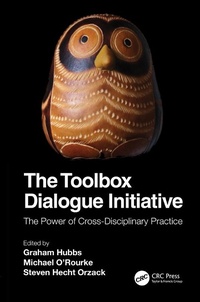
The Toolbox Dialogue Initiative
The Power of Cross-Disciplinary Practice
1st Edition
Published on 10. September 2020
274 pages
978-0-429-80175-4 (ISBN)
Description

Cross-disciplinary scientific collaboration is emerging as standard operating procedure for many scholarly research enterprises. And yet, the skill set needed for effective collaboration is neither taught nor mentored. The goal of the Toolbox Dialogue Initiative is to facilitate cross-disciplinary collaboration. This book, inspired by this initiative, presents dialogue-based methods designed to increase mutual understanding among collaborators so as to enhance the quality and productivity of cross-disciplinary collaboration. It provides a theoretical context, principal activities, and evidence for effectiveness that will assist readers in honing their collaborative skills.
Key Features
Introduces the Toolbox Dialogue method for improving cross-disciplinary collaboration
Reviews the theoretical background of cross-disciplinary collaboration and considers the communication and integration challenges associated with such collaboration
Presents methods employed in workshop development and implementation
Uses various means to examine the effectiveness of team-building exercises
Related Titles
Fam, D., J. Palmer, C. Riedy, and C. Mitchell. Transdisciplinary Research and Practice for Sustainability Outcomes (ISBN: 978-1-138-62573-0)
Holland, D. Integrating Knowledge through Interdisciplinary Research: Problems of Theory and Practice (ISBN: 978-1-138-91941-9)
Padmanabhan, M. Transdisciplinary Research and Sustainability: Collaboration, Innovation and Transformation (ISBN: 978-1-138-21640-2)
Key Features
Introduces the Toolbox Dialogue method for improving cross-disciplinary collaboration
Reviews the theoretical background of cross-disciplinary collaboration and considers the communication and integration challenges associated with such collaboration
Presents methods employed in workshop development and implementation
Uses various means to examine the effectiveness of team-building exercises
Related Titles
Fam, D., J. Palmer, C. Riedy, and C. Mitchell. Transdisciplinary Research and Practice for Sustainability Outcomes (ISBN: 978-1-138-62573-0)
Holland, D. Integrating Knowledge through Interdisciplinary Research: Problems of Theory and Practice (ISBN: 978-1-138-91941-9)
Padmanabhan, M. Transdisciplinary Research and Sustainability: Collaboration, Innovation and Transformation (ISBN: 978-1-138-21640-2)
More details
Edition
1. Auflage
Language
English
Place of publication
London
United Kingdom
Publishing group
Taylor & Francis Ltd
Target group
College/higher education
Illustrations
23 Tables, black and white; 4 Illustrations, color; 22 Illustrations, black and white
ISBN-13
978-0-429-80175-4 (9780429801754)
Copyright in bibliographic data and cover images is held by Nielsen Book Services Limited or by the publishers or by their respective licensors: all rights reserved.
Schweitzer Classification
Other editions
Additional editions
Graham Hubbs | Michael O'Rourke | Steven Hecht Orzack
The Toolbox Dialogue Initiative
The Power of Cross-Disciplinary Practice
Book
09/2020
1st Edition
CRC Press
€196.50
Shipment within 10-20 days
Graham Hubbs | Michael O'Rourke | Steven Hecht Orzack
The Toolbox Dialogue Initiative
The Power of Cross-Disciplinary Practice
Book
09/2020
1st Edition
CRC Press
€68.00
Shipment within 10-20 days
Persons
Dr. Graham Hubbs is Chair of the Department of Politics and Philosophy at the University of Idaho. He studies the structure of practical rationality and the nature of democratic institutions. He has worked as a Fulbright Fellow at the Universita di Genova, a Visiting Scholar at LUISS Guido Carli in Rome, and a Visiting Fellow at the University of Edinburgh's Institute for the Advanced Study of the Humanities.
Dr. Michael O'Rourke is a Professor of Philosophy in the Department of Philosophy and a faculty member in AgBioResearch at Michigan State University. He studies epistemology, communication, and epistemic integration in cross-disciplinary research. Dr. O'Rourke is Director of the TDI.
Dr. Steven Hecht Orzack is a Senior Research Scientist at the Fresh Pond Research Institute. He studies ecology and evolution, the history and philosophy of biology, and engages in practical efforts to improve collaborative science.
Dr. Michael O'Rourke is a Professor of Philosophy in the Department of Philosophy and a faculty member in AgBioResearch at Michigan State University. He studies epistemology, communication, and epistemic integration in cross-disciplinary research. Dr. O'Rourke is Director of the TDI.
Dr. Steven Hecht Orzack is a Senior Research Scientist at the Fresh Pond Research Institute. He studies ecology and evolution, the history and philosophy of biology, and engages in practical efforts to improve collaborative science.
Content
Preface
Chapter 1. Communication Failure and Cross-Disciplinary Research - Stephen Crowley and Michael O'Rourke
Chapter 2. How It Works: The Toolbox Dialogue Method in Practice - Michael O'Rourke and Stephen Crowley
Chapter 3. A Narrative History of the Toolbox Dialogue Initiative - Graham Hubbs
Chapter 4. The Landscape of Challenges for Cross-Disciplinary Activity - Shannon Donovan
Chapter 5. Communication and Integration in Cross-Disciplinary Activity - Michael O'Rourke and Brian Robinson
Chapter 6. The Power of Philosophy - Chad Gonnerman, Graham Hubbs, Bethany K. Laursen, and Anna Malavisi
Chapter 7. The Power of Dialogue - Michael O'Rourke, Troy E. Hall, and Bethany K. Laursen
Chapter 8. Best Practices for Planning and Running a Toolbox Workshop - Marisa A. Rinkus and Stephanie E. Vasko
Chapter 9. Enhancing Cross-Disciplinary Science through Philosophical Dialogue: Evidence of Improved Group Metacognition for Effective Collaboration - Brian Robinson and Chad Gonnerman
Chapter 10. Qualitative Analyses of the Effectiveness of Toolbox Dialogues - Marisa A. Rinkus and Michael O'Rourke
Chapter 11. Future Directions for the Toolbox Dialogue Initiative - Sanford D. Eigenbrode, Stephanie E. Vasko, Anna Malavisi, Bethany K. Laursen, and Michael O'Rourke
Chapter 12. Toolbox Workshop Case Studies - Graham Hubbs, Michael O'Rourke, Sanford D. Eigenbrode, Marisa A. Rinkus, and Anna Malavisi
Appendix A. Scientific Research Toolbox Instrument
Appendix B. Examples of Toolbox Dialogue
Chapter 1. Communication Failure and Cross-Disciplinary Research - Stephen Crowley and Michael O'Rourke
Chapter 2. How It Works: The Toolbox Dialogue Method in Practice - Michael O'Rourke and Stephen Crowley
Chapter 3. A Narrative History of the Toolbox Dialogue Initiative - Graham Hubbs
Chapter 4. The Landscape of Challenges for Cross-Disciplinary Activity - Shannon Donovan
Chapter 5. Communication and Integration in Cross-Disciplinary Activity - Michael O'Rourke and Brian Robinson
Chapter 6. The Power of Philosophy - Chad Gonnerman, Graham Hubbs, Bethany K. Laursen, and Anna Malavisi
Chapter 7. The Power of Dialogue - Michael O'Rourke, Troy E. Hall, and Bethany K. Laursen
Chapter 8. Best Practices for Planning and Running a Toolbox Workshop - Marisa A. Rinkus and Stephanie E. Vasko
Chapter 9. Enhancing Cross-Disciplinary Science through Philosophical Dialogue: Evidence of Improved Group Metacognition for Effective Collaboration - Brian Robinson and Chad Gonnerman
Chapter 10. Qualitative Analyses of the Effectiveness of Toolbox Dialogues - Marisa A. Rinkus and Michael O'Rourke
Chapter 11. Future Directions for the Toolbox Dialogue Initiative - Sanford D. Eigenbrode, Stephanie E. Vasko, Anna Malavisi, Bethany K. Laursen, and Michael O'Rourke
Chapter 12. Toolbox Workshop Case Studies - Graham Hubbs, Michael O'Rourke, Sanford D. Eigenbrode, Marisa A. Rinkus, and Anna Malavisi
Appendix A. Scientific Research Toolbox Instrument
Appendix B. Examples of Toolbox Dialogue
