

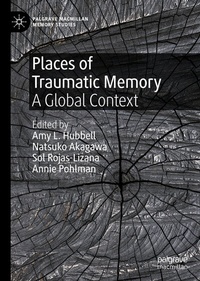
Places of Traumatic Memory
Description

This volume explores the relationship between place, traumatic memory, and narrative. Drawing on cases from Africa, Asia, Europe, Oceania, and North and South America, the book provides a uniquely cross-cultural and global approach. Covering a wide range of cultural and linguistic contexts, the volume is divided into three parts: memorial spaces, sites of trauma, and traumatic representations. The contributions explore how acknowledgement of past suffering is key to the complex inter-relationship between the politics of memory, expressions of victimhood, and collective memory. Contributors take note of differing aspects of memorial culture, such as those embedded in war memorials, mass grave sites, and exhibitions, as well as journalistic, literary and visual forms of commemorations, to investigate how narratives of memory can give meaning and form to places of trauma.
More details
Other editions
Additional editions
Persons
Amy L. Hubbell is Senior Lecturer in French at the University of Queensland, Australia. Her research focuses on French narratives of trauma in autobiography and art. She is the author of Hoarding Memory: Covering the Wounds of the Algerian War (2020) and Remembering French Algeria: Pieds-Noirs, Identity, and Exile (2015).
Natsuko Akagawa is Senior Lecturer at the University of Queensland, Australia. She researches heritage politics, practice and discourse in a global context and is Series General Editor for Routledge Research on Museums and Heritage in Asia. Her recent books include Heritage Conservation and Cultural Diplomacy (2015), and Safeguarding Intangible Heritage (2019).
Sol Rojas-Lizana is Lecturer of Spanish Studies at the University of Queensland, Australia. She is a discourse analyst researching discrimination, memory, trauma, and translation, using decolonial thought. Her latest monograph is The Discourse of Perceived Discrimination (2019). Her co-authored historical graphic memoir Historias Clandestinas (2014) is being made into a film.
Annie Pohlman is Senior Lecturer in Indonesian Studies at the University of Queensland, Australia. She researches Indonesian history, comparative genocide studies, torture, gendered experiences of violence, and oral testimony.
Content
1. Acknowledging trauma in a global context: Narrative, memory and place.- 2. Long Tan, Coral-Balmoral and Binh Ba: Remembered, un-remembered and dis-remembered battlefields from Australia's Vietnam war.- 3. 'Difficult heritage', silent witnesses: Dismembering traumatic memories, narratives, and emotions of firebombing in Japan.- 4. No place to remember: Haunting and the search for mass graves in Indonesia.- 5. The visitor's gaze in the Museum of Memory and Human Rights in Chile.- 6. Remembering World War One in Australia: Hyde Park as memory space.- 7. Sites of memory, sites of ruination in postcolonial France and the francosphere.- 8. 'The most intimate familiarity and the most extreme existential alienation': Ilse Aichinger's memories of Nazi-era Vienna.- 9. Black skin as site of memory: Stories of trauma from the Black Atlantic.- 10. Humanitarian journalism and the representation of survivors of Bosnia-Herzegovina's mass violence.- 11. Remembering the 5 July 1962 massacre in Oran, Algeria.- 12. Cultural practices as sites of trauma and empathic distress in Like Cotton Twines (2016) and Grass between my Lips (2008).- 13. Screen memories in true crime documentary: Trauma, bodies and places in The Keepers (2017) and Casting JonBenet (2017).- 14. Chile 1988: Trauma and resistance in Pablo Larraín's No (2012).
