

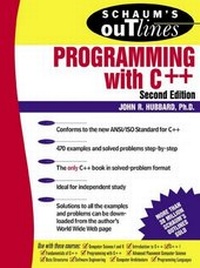
Schaum's Outline of Programming with C++
1st Edition
Published on 22. April 1996
434 pages
978-0-07-136811-7 (ISBN)
Description

Tough Test Questions? Missed Lectures? Not Enough Time? Fortunately for you, there's Schaum's Outlines. More than 40 million students have trusted Schaum's to help them succeed in the classroom and on exams. Schaum's is the key to faster learning and higher grades in every subject. Each Outline presents all the essential course information in an easy-to-follow, topic-by-topic format. You also get hundreds of examples, solved problems, and practice exercises to test your skills. This Schaum's Outline gives you Practice problems with full explanations that reinforce knowledge Coverage of the most up-to-date developments in your course field In-depth review of practices and applications Fully compatible with your classroom text, Schaum's highlights all the important facts you need to know. Use Schaum's to shorten your study time-and get your best test scores! Schaum's Outlines-Problem Solved.
More details
Other editions
Additional editions
John Hubbard
Schaum's Outline of Programming with C++
Book
06/2000
2nd Edition
Schaum Outline Series
€34.00
Shipment within 15-20 days
Content
- Intro
- Contents
- Chapter 1 Elementary C++ Programming
- 1.1 GETTING STARTED
- 1.2 SOME SIMPLE PROGRAMS
- 1.3 THE OUTPUT OPERATOR
- 1.4 CHARACTERS AND LITERALS
- 1.5 VARIABLES AND THEIR DECLARATIONS
- 1.6 PROGRAM TOKENS
- 1.7 INITIALIZING VARIABLES
- 1.8 OBJECTS, VARIABLES, AND CONSTANTS
- 1.9 THE INPUT OPERATOR
- Chapter 2 Fundamental Types
- 2.1 NUMERIC DATA TYPES
- 2.2 THE BOOLEAN TYPE
- 2.3 ENUMERATION TYPES
- 2.4 CHARACTER TYPES
- 2.5 INTEGER TYPES
- 2.6 ARITHMETIC OPERATORS
- 2.7 THE INCREMENT AND DECREMENT OPERATORS
- 2.8 COMPOSITE ASSIGNMENT OPERATORS
- 2.9 FLOATING-POINT TYPES
- 2.10 TYPE CONVERSIONS
- 2.11 NUMERIC OVERFLOW
- 2.12 ROUND-OFF ERROR
- 2.13 THE E-FORMAT FOR FLOATING-POINT VALUES
- 2.14 SCOPE
- Chapter 3 Selection
- 3.1 THE if STATEMENT
- 3.2 THE if..else STATEMENT
- 3.3 KEYWORDS
- 3.4 COMPARISON OPERATORS
- 3.5 STATEMENT BLOCKS
- 3.6 COMPOUND CONDITIONS
- 3.7 SHORT-CIRCUITING
- 3.8 BOOLEAN EXPRESSIONS
- 3.9 NESTED SELECTION STATEMENTS
- 3.10 THE else if CONSTRUCT
- 3.11 THE switch STATEMENT
- 3.12 THE CONDITIONAL EXPRESSION OPERATOR
- Chapter 4 Iteration
- 4.1 THE while STATEMENT
- 4.2 TERMINATING A LOOP
- 4.3 THE do..while STATEMENT
- 4.4 THE for STATEMENT
- 4.5 THE break STATEMENT
- 4.6 THE continue STATEMENT
- 4.7 THE goto STATEMENT
- 4.8 GENERATING PSEUDO-RANDOM NUMBERS
- Chapter 5 Functions
- 5.1 INTRODUCTION
- 5.2 STANDARD C++ LIBRARY FUNCTIONS
- 5.3 USER-DEFINED FUNCTIONS
- 5.4 TEST DRIVERS
- 5.5 FUNCTION DECLARATIONS AND DEFINITIONS
- 5.6 LOCAL VARIABLES AND FUNCTIONS
- 5.7 void FUNCTIONS
- 5.8 BOOLEAN FUNCTIONS
- 5.9 I/O FUNCTIONS
- 5.10 PASSING BY REFERENCE
- 5.11 PASSING BY CONSTANT REFERENCE
- 5.12 INLINE FUNCTIONS
- 5.13 SCOPE
- 5.14 OVERLOADING
- 5.15 THE main() FUNCTION
- 5.16 DEFAULT ARGUMENTS
- Chapter 6 Arrays
- 6.1 INTRODUCTION
- 6.2 PROCESSING ARRAYS
- 6.3 INITIALIZING AN ARRAY
- 6.4 ARRAY INDEX OUT OF BOUNDS
- 6.5 PASSING AN ARRAY TO A FUNCTION
- 6.6 THE LINEAR SEARCH ALGORITHM
- 6.7 THE BUBBLE SORT ALGORITHM
- 6.8 THE BINARY SEARCH ALGORITHM
- 6.9 USING ARRAYS WITH ENUMERATION TYPES
- 6.10 TYPE DEFINITIONS
- 6.11 MULTIDIMENSIONAL ARRAYS
- Chapter 7 Pointers and References
- 7.1 THE REFERENCE OPERATOR
- 7.2 REFERENCES
- 7.3 POINTERS
- 7.4 THE DEREFERENCE OPERATOR
- 7.5 DERIVED TYPES
- 7.6 OBJECTS AND LVALUES
- 7.7 RETURNING A REFERENCE
- 7.8 ARRAYS AND POINTERS
- 7.9 DYNAMIC ARRAYS
- 7.10 USING const WITH POINTERS
- 7.11 ARRAYS OF POINTERS AND POINTERS TO ARRAYS
- 7.12 POINTERS TO POINTERS
- 7.13 POINTERS TO FUNCTIONS
- 7.14 NUL, NULL, AND void
- Chapter 8 C-Strings
- 8.1 INTRODUCTION
- 8.2 REVIEW OF POINTERS
- 8.3 C-STRINGS
- 8.4 STRING I/O
- 8.5 SOME cin MEMBER FUNCTIONS
- 8.6 STANDARD C CHARACTER FUNCTIONS
- 8.7 ARRAYS OF STRINGS
- 8.8 STANDARD C STRING FUNCTIONS
- Chapter 9 Standard C++ Strings
- 9.1 INTRODUCTION
- 9.2 FORMATTED INPUT
- 9.3 UNFORMATTED INPUT
- 9.4 THE STANDARD C++ string TYPE
- 9.5 FILES
- 9.6 STRING STREAMS
- Chapter 10 Classes
- 10.1 INTRODUCTION
- 10.2 CLASS DECLARATIONS
- 10.3 CONSTRUCTORS
- 10.4 CONSTRUCTOR INITIALIZATION LISTS
- 10.5 ACCESS FUNCTIONS
- 10.6 PRIVATE MEMBER FUNCTIONS
- 10.7 THE COPY CONSTRUCTOR
- 10.8 THE CLASS DESTRUCTOR
- 10.9 CONSTANT OBJECTS
- 10.10 STRUCTURES
- 10.11 POINTERS TO OBJECTS
- 10.12 STATIC DATA MEMBERS
- 10.13 static FUNCTION MEMBERS
- Chapter 11 Overloading Operators
- 11.1 INTRODUCTION
- 11.2 OVERLOADING THE ASSIGNMENT OPERATOR
- 11.3 THE this POINTER
- 11.4 OVERLOADING ARITHMETIC OPERATORS
- 11.5 OVERLOADING THE ARITHMETIC ASSIGNMENT OPERATORS
- 11.6 OVERLOADING THE RELATIONAL OPERATORS
- 11.7 OVERLOADING THE STREAM OPERATORS
- 11.8 CONVERSION OPERATORS
- 11.9 OVERLOADING THE INCREMENT AND DECREMENT OPERATORS
- 11.10 OVERLOADING THE SUBSCRIPT OPERATOR
- Chapter 12 Composition and Inheritance
- 12.1 INTRODUCTION
- 12.2 COMPOSITION
- 12.3 INHERITANCE
- 12.4 protected CLASS MEMBERS
- 12.5 OVERRIDING AND DOMINATING INHERITED MEMBERS
- 12.6 private ACCESS VERSUS protected ACCESS
- 12.7 virtual FUNCTIONS AND POLYMORPHISM
- 12.8 VIRTUAL DESTRUCTORS
- 12.9 ABSTRACT BASE CLASSES
- 12.10 OBJECT-ORIENTED PROGRAMMING
- Chapter 13 Templates and Iterators
- 13.1 INTRODUCTION
- 13.2 FUNCTION TEMPLATES
- 13.3 CLASS TEMPLATES
- 13.4 CONTAINER CLASSES
- 13.5 SUBCLASS TEMPLATES
- 13.6 PASSING TEMPLATE CLASSES TO TEMPLATE PARAMETERS
- 13.7 A CLASS TEMPLATE FOR LINKED LISTS
- 13.8 ITERATOR CLASSES
- Chapter 14 Standard C++ Vectors
- 14.1 INTRODUCTION
- 14.2 ITERATORS ON VECTORS
- 14.3 ASSIGNING VECTORS
- 14.4 THE erase() and insert() FUNCTIONS
- 14.5 THE find() FUNCTION
- 14.6 THE C++ STANDARD vector CLASS TEMPLATE
- 14.7 RANGE CHECKING
- Chapter 15 Container Classes
- 15.1 ANSI/ISO STANDARD C++
- 15.2 THE STANDARD TEMPLATE LIBRARY
- 15.3 STANDARD C++ CONTAINER CLASS TEMPLATES
- 15.4 STANDARD C++ GENERIC ALGORITHMS
- 15.5 HEADER FILES
- Appendix A Character Codes
- A.1 The ASCII Code
- A.2 Unicode
- Appendix B Standard C++ Keywords
- Appendix C Standard C++ Operators
- Appendix D Standard C++ Container Classes
- D.1 THE vector CLASS TEMPLATE
- D.2 THE deque CLASS TEMPLATE
- D.3 THE stack CLASS TEMPLATE
- D.4 THE queue CLASS TEMPLATE
- D.5 THE priority_queue CLASS TEMPLATE
- D.6 THE list CLASS TEMPLATE
- D.7 THE map CLASS TEMPLATE
- D.8 THE set CLASS TEMPLATE
- Appendix E Standard C++ Generic Algorithms
- Appendix F The Standard C Library
- Appendix G Hexadecimal Numbers
- Appendix H References
- Index
