
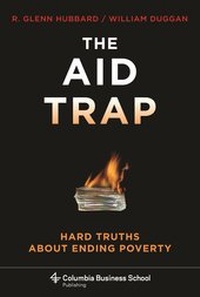
The Aid Trap
Description
Alles über E-Books | Antworten auf Fragen rund um E-Books, Kopierschutz und Dateiformate finden Sie in unserem Info- & Hilfebereich.
Over the past twenty years more citizens in China and India have raised themselves out of poverty than anywhere else at any time in history. They accomplished this through the local business sector¿the leading source of prosperity for all rich countries. In most of Africa and other poor regions the business sector is weak, but foreign aid continues to fund government and NGOs. Switching aid to the local business sector in order to cultivate a middle class is the oldest, surest, and only way to eliminate poverty in poor countries.
A bold fusion of ethics and smart business, The Aid Trap shows how the same energy, goodwill, and money that we devote to charity can help local business thrive. R. Glenn Hubbard and William Duggan, two leading scholars in business and finance, demonstrate that by diverting a major share of charitable aid into the local business sector of poor countries, citizens can take the lead in the growth of their own economies. Although the aid system supports noble goals, a local well-digging company cannot compete with a foreign charity that digs wells for free. By investing in that local company a sustainable system of development can take root.
All prices
More details
Other editions
Additional editions
Persons
William Duggan is senior lecturer at Columbia Business School, where he teaches strategy in graduate and executive courses. He has twenty years of experience in foreign aid. His most recent book, Strategic Intuition, was named Best Strategy Book by Strategy + Business.
Content
- Intro
- Preface: The Software of Prosperity
- 1. Introduction: The Charity Trap
- 2. Business First: The Roots of Prosperity in the Modern World
- 3. Business Last: The Roots of Failure in Poverty Aid
- 4. Strong Medicine: The Marshall Plan as a Business Model
- 5. Chase the Devil: Details for a Marshall Model
- 6. Conclusion: Make It Your Business
- Appendix I: A Note on Related Research
- Appendix II: A Marshall Plan Budget
- Bibliography
- Index
- CON TEN TS

System requirements
File format: ePUB
Copy protection: Adobe-DRM (Digital Rights Management)
System requirements:
- Computer (Windows; MacOS X; Linux): Install the free reader Adobe Digital Editions prior to download (see eBook Help).
- Tablet/smartphone (Android; iOS): Install the free app Adobe Digital Editions or the app PocketBook before downloading (see eBook Help).
- E-reader: Bookeen, Kobo, Pocketbook, Sony, Tolino and many more (not Kindle).
The file format ePub works well for novels and non-fiction books – i.e., „flowing” text without complex layout. On an e-reader or smartphone, line and page breaks automatically adjust to fit the small displays.
This eBook uses Adobe-DRM, a „hard” copy protection. If the necessary requirements are not met, unfortunately you will not be able to open the eBook. You will therefore need to prepare your reading hardware before downloading.
Please note: We strongly recommend that you authorise using your personal Adobe ID after installation of any reading software.
For more information, see our ebook Help page.
File format: ePUB
Copy protection: Watermark-DRM (Digital Rights Management)
System requirements:
- Computer (Windows; MacOS X; Linux): Use a reading software that can process the file format ePUB: e.g., Adobe Digital Editions or FBReader – both free (see eBook Help).
- Tablet/Smartphone (Android; iOS): Before downloading, install the free app Adobe Digital Editions (see eBook Help).
- E-reader: Bookeen, Kobo, Pocketbook, Sony, Tolino and many more (not Kindle).
The file format ePUB works well for novels and non-fiction books – i.e., „flowing” text without complex layout. On an e-reader or smartphone, line and page breaks automatically adjust to fit the small displays.
This eBook uses Watermark-DRM, a „soft” copy protection. This means that there are no technical restrictions to prevent illegal distribution. However, there is a personalised watermark embedded in the eBook that can be used to identify the purchaser of the eBook in the event of misuse and to provide evidence for legal purposes.
For more information, see our eBook Help page.