

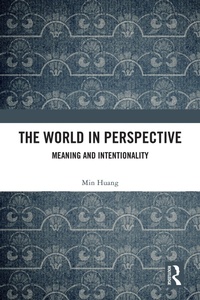
The World in Perspective
Meaning and Intentionality
1st Edition
Published on 16. December 2024
176 pages
978-1-040-27045-5 (ISBN)
Description

This book aims to reclaim the significance of meaning within the philosophical thinking that has evolved from Descartes and Locke through Kant, Husserl, and Frege, focusing on intentionality-the mind's directedness toward the reality.
The author opens with an epistemological account of analyticity and illustrates the central role of intentionality within it. A transcendentalist view on intentionality is then adopted, in contrast with the prevalent naturalist stance. Addressing key themes in the philosophy of language-truth, representation, propositions, predication, reference, and sense- the book presents a framework for a meaning-intentionality theory, which integrates key insights from Frege, Husserl, Wittgenstein, Dummett, and Davidson.
The book will appeal to scholars and graduate students of epistemology, philosophy of language, philosophy of mind, theory of meaning, and theory of intentionality.
The author opens with an epistemological account of analyticity and illustrates the central role of intentionality within it. A transcendentalist view on intentionality is then adopted, in contrast with the prevalent naturalist stance. Addressing key themes in the philosophy of language-truth, representation, propositions, predication, reference, and sense- the book presents a framework for a meaning-intentionality theory, which integrates key insights from Frege, Husserl, Wittgenstein, Dummett, and Davidson.
The book will appeal to scholars and graduate students of epistemology, philosophy of language, philosophy of mind, theory of meaning, and theory of intentionality.
Reviews / Votes
"This is an ambitious book that synthesizes analytic philosophy with Husserlian phenomenology, reconceiving reference within a framework of transcendental intentionality and developing a theory of meaning accordingly. The idea that drives the strategy is promising. According primacy to the first-person perspective provides for direct reference, while taking our linguistic activities (and not just the mind) to generate intersubjective intentionality allows the third-person perspective to emerge from the first-person perspective. The book draws on a rich range of work in analytic philosophy and phenomenology in developing the approach."Michael Beaney, Regius Professor of Logic, University of Aberdeen, and Honorary Professor of History of Analytic Philosophy, Humboldt University of Berlin
"It is an ambitious theory of meaning-intentionality proposed in the fascinating book. Professor Min Huang, a worldwide-known philosopher of language and logic, explores the mysteries of dimensions of language by presenting his fresh insights on analyticity, intentionality, representation, proposition, predicate, and reference. It is well worth reading for anyone interested in contemporary philosophy."
Yi Jiang, Professor of Philosophy at Shanxi University
"In this original and thought-provoking book, Min Huang articulates a response to Quinean skepticism about meaning and analyticity by synthesizing the principal insights of Husserlian intentionality with the later Wittgenstein's rule-following considerations. Huang argues for meaning stability through a conception of intentionality essentially connected to language use. The resulting theoretical framework underpins accounts of representation and truth, of the rehabilitation of negative facts, and of the crucial notion of predication that has been at the center of recent controversies over propositions. Altogether these constitute a valuable intervention in philosophy of language and philosophy of mind."
Sanford Shieh, Professor of Philosophy, Wesleyan University
More details
Edition
1. Auflage
Language
English
Place of publication
London
United Kingdom
Publishing group
Taylor & Francis Ltd
Target group
College/higher education
Professional and scholarly
ISBN-13
978-1-040-27045-5 (9781040270455)
Copyright in bibliographic data and cover images is held by Nielsen Book Services Limited or by the publishers or by their respective licensors: all rights reserved.
Schweitzer Classification
Other editions
Additional editions
Book
05/2026
1st Edition
Routledge
€57.00
Shipment within 10-20 days
Book
12/2024
1st Edition
Routledge
€195.80
Shipment within 10-20 days

Book
12/2024
Routledge
Unfortunately, price unknown
Available (delivery time upon request)
Person
Min Huang is Professor in the Department of Philosophy at Sun Yat-sen University, Mainland China. He works on the philosophy of language, epistemology, philosophy of science, and early analytic philosophy.
Content
1. Analyticity 2. Intentionality 3. Representation 4. Proposition 5. Predicate 6. Reference
