

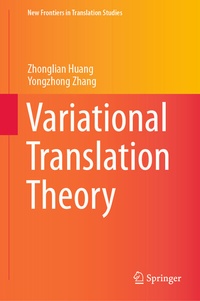
Variational Translation Theory
Description

This book, adopting the perspective of cross-cultural communication, theoretically justifies and addresses human variational translation practice for the first time in the area of translation studies, focusing on the adaptation techniques and variational translation methods, as well as general features and laws of the variational translation process. It classifies and summarizes seven main adaptation techniques and eleven translation methods applicable to all variational translation activities. These techniques and methods, quite different from those used in complete translation or full translation, are systematically studied together with examples, allowing readers to not only understand their interrelations and differences within the context of variational translation methods, but also to master them in order to improve their translation efficacy and efficiency. Readers will gain a better understanding of how variational translation is produced, and of its important role in advancing cross-cultural communication and in reconstructing human knowledge and culture.
This book is intended for translation scholars, translation practitioners, students, and others whose work involves the theory and practice of translation and who want to enhance their translation proficiency in cross-cultural communication for the Information Age.
More details
Other editions
Additional editions
Persons
Zhonglian Huang is a Professor of Translation at Guangdong University of Foreign Studies. He is a distinguished translation theorist, the initiator of variational translation theory, and founder of science translatology and applied translation studies. His main interests lie in translatology and the comparative study of translational Chinese and foreign languages. He has conducted four research projects sponsored by the National Office for Philosophy and Social Sciences and six projects funded by the Ministry of Education. He is the author of 26 monographs and translated works, and over 300 academic articles and the Editor-in-Chief of three academic book series. His current titles include Expert of the 100-Talent Program of Shannxi Province, Pearl River Scholar of Guangdong Province, board member of the accreditation committee of academic programs of the State Council, and committee member of the National Social Science Foundation.
Yongzhong Zhang isan Associate Professor of Translation at Hubei University of Economics, China. Holding a Ph.D. degree in Translation and Intercultural Studies, he has published two monographs and 23 academic articles in these areas.
