

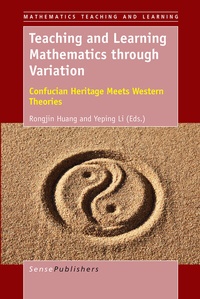
Teaching and Learning Mathematics through Variation
Description

More details
Other editions
Additional editions
Content
Foreword.- Acknowledgements.- Part I: Theoretical Perspectives.- Introduction.- Theory and Development of Teaching through Variation in Mathematics in China.- 'Bianshi' and the Variation Theory of Learning: Illustrating Two Frameworks of Variation and Invariance in the Teaching of Mathematics.- Variation in Tool-Based Mathematics Pedagogy: The Case of Dynamic Virtual Tool.- Pedagogy of Variations: Synthesis of Various Notions of Variation Pedagogy.- Part II: Variation as a Pedagogical Perspective for Classroom Instruction in China.- Introduction.- Characteristics of Teaching Mathematical Problem Solving in China: Analysis of a Lesson from the Perspective of Variation.- Teaching the Formula of Perfect Square through Bianshi Teaching.- Teaching Geometrical Concepts through Variation: A Case Study of a Shanghai Lesson.- Teaching Geometry Review Lesson through Variation: A Case Study.- Teaching Algebra through Variations: Contrast, Generalization, Fusion, and Separation.- Part III: The Pedagogical Perspective of Variations as a Principle for Curriculum Development and Teacher Professional Development in China.- Introduction: "The Lesson Plan is Only the Teacher's Hypothesis of Students' Learning".- Strategies for Using Variation Tasks in Selected Mathematics Textbooks in China.- An Expert Teacher's Use of Teaching with Variation to Support a Junior Mathematics Teacher's Professional Learning.- Teaching and Learning Mathematics through Variation in Lesson Study.- Part IV: Use of the Pedagogy of Variation Around the World.- Introduction: Putting Variation Theory to Work.- Improving Teaching through Variation: A Japanese Perspective.- Developing Algebraic Reasoning through Variation in the U.S..- Using Variation of Multiplicity in Highlighting Critical Aspects of Multiple Solution Tasks and Modeling Tasks.- Learning to Teach with Variation: Experiences from Learning Study in Sweden.- Part V: Commentary and Conclusion.- Teaching through Variation: An Asian Perspective - Is the Variation Theory of Learning Varying?.- Teaching through Variation: A European Perspective.- Issues in Variation Theory and How It Could Inform Pedagogical Choices.- About the Authors.- Subject Index.
