

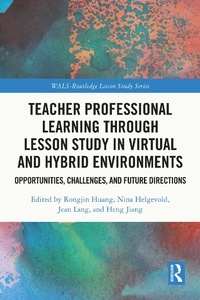
Teacher Professional Learning through Lesson Study in Virtual and Hybrid Environments
Opportunities, Challenges, and Future Directions
1st Edition
Published on 18. August 2023
302 pages
978-1-000-93130-3 (ISBN)
Description

Offering a rich, critical investigation of how technology can be used to strengthen and promote lesson study in both virtual and hybrid environments, this edited book presents insights into the numerous challenges as well as opportunities for supporting teachers' and teacher educators' professional learning in such a novel setting.
Providing an international perspective, research in this book highlights on the one hand the necessity of exploring how the known theoretical perspectives and methodological approaches for researching on lesson study and effective characteristics of conducting lesson study can be adapted to the new environments. On the other hand, further analysis reveals the benefits of using various advanced technologies in lesson study, the new practice of professional development of teachers and teacher educators, and also documents related issues of conducting lesson study in such complex contexts. The chapters focus on online cross-cultural lesson study; the key aspects of conducting online lesson study and the effectiveness of it. Features of facilitation and the development of facilitators for online lesson study are explored, alongside the ways in which online lesson study can help address various problems of practice such as implementing equitable teaching, facilitating student interaction in virtual environments, and migration to remote teaching in STEM.
This resourceful text provides needed support to both researchers and practitioners, from primary to higher education, with special attention to both teacher and student learning.
Providing an international perspective, research in this book highlights on the one hand the necessity of exploring how the known theoretical perspectives and methodological approaches for researching on lesson study and effective characteristics of conducting lesson study can be adapted to the new environments. On the other hand, further analysis reveals the benefits of using various advanced technologies in lesson study, the new practice of professional development of teachers and teacher educators, and also documents related issues of conducting lesson study in such complex contexts. The chapters focus on online cross-cultural lesson study; the key aspects of conducting online lesson study and the effectiveness of it. Features of facilitation and the development of facilitators for online lesson study are explored, alongside the ways in which online lesson study can help address various problems of practice such as implementing equitable teaching, facilitating student interaction in virtual environments, and migration to remote teaching in STEM.
This resourceful text provides needed support to both researchers and practitioners, from primary to higher education, with special attention to both teacher and student learning.
Reviews / Votes
The chapters in this book provide informative descriptions of a wide range of lesson studies undertaken during COVID-19 and so in a context of rapidly developing digital and remote connections across participants and cultures. Readers interested in the research and practice of lesson study will find rich and critical reflection on how lesson study programs were adapted, new programs set up, the possibilities these opened up, and in some instances their affordances and constraints relative to face-to-face lesson study. The book is a welcome addition to the extensive literature on cross cultural lesson study, with inspiration and professional wisdom towards innovation and hybridization in a new digital era.Jill Alder, Professor of Mathematics Education, School of Education, at the University of the Witwatersrand, South Africa.
Past President, International Commission on Mathematical Instruction
Huang, Helgevold, Lang, Jiang and the contributing authors move our field forward from conceptualizing online/hybrid lesson study to highlighting and researching the innovative practices that show promise for LS. The book is helpful for practitioners who want to innovate LS to include digital technology that may afford opportunities for better access and equity for different stakeholders (including, students, teachers, math leaders, and LS facilitators) as well as researchers who want to consider theories and research methodology to propel this research forward. Scaling up and sustaining LS has always been a challenge and the promise of online/hybrid LS provides LS advocates with a lot of lessons learned from the contribution of the many leading LS researchers around the world.
Jennifer Suh, Professor of Mathematics Education, Director, Center for Outreach for Mathematics Professional learning/Educational Technology George Mason University, USA.
Board of Directors of National Council of Teachers of Mathematics, USA
More details
Series
Edition
1. Auflage
Language
English
Place of publication
London
United Kingdom
Publishing group
Taylor & Francis Ltd
Target group
College/higher education
Professional and scholarly
Illustrations
15 Tables, black and white; 3 Line drawings, black and white; 25 Halftones, black and white; 28 Illustrations, black and white
ISBN-13
978-1-000-93130-3 (9781000931303)
Copyright in bibliographic data and cover images is held by Nielsen Book Services Limited or by the publishers or by their respective licensors: all rights reserved.
Schweitzer Classification
Other editions
Additional editions
Rongjin Huang | Nina Helgevold | Jean Lang
Teacher Professional Learning through Lesson Study in Virtual and Hybrid Environments
Opportunities, Challenges, and Future Directions
Book
12/2024
1st Edition
Routledge
€61.70
Shipment within 10-20 days
Rongjin Huang | Nina Helgevold | Jean Lang
Teacher Professional Learning through Lesson Study in Virtual and Hybrid Environments
Opportunities, Challenges, and Future Directions
Book
08/2023
1st Edition
Routledge
€206.80
Shipment within 10-20 days
Persons
Rongjin Huang is a Professor of Mathematics Education at Middle Tennessee State University, USA.
Nina Helgevold is a Professor of Pedagogy in the Department of Teacher Education at the University of Stavanger, Norway.
Jean Lang is currently completing a PhD in educational research at the University of Exeter, following a long career as an educator. She is also a member of the Executive Committee of WALS and was previously its Honorary General Secretary.
Heng Jiang is an Associate Professor in Policy, Curriculum, and Leadership at the National Institute of Education, Nanyang Technological University in Singapore.
Nina Helgevold is a Professor of Pedagogy in the Department of Teacher Education at the University of Stavanger, Norway.
Jean Lang is currently completing a PhD in educational research at the University of Exeter, following a long career as an educator. She is also a member of the Executive Committee of WALS and was previously its Honorary General Secretary.
Heng Jiang is an Associate Professor in Policy, Curriculum, and Leadership at the National Institute of Education, Nanyang Technological University in Singapore.
Content
1. Teacher professional learning through hybrid lesson study 2. Potential of online experience of Lesson Study: Learning from the IMPULS efforts to provide research lesson observation online 3. Hybrid cross-cultural lesson study impacts teacher learning 4. What can online lesson study offer? Findings from an Australian - Japanese collaboration 5. An intercultural blended lesson study for teaching an in-service teacher education course: Collaboration between Singapore and Finland teacher educators 6. Analysing and facilitating collaboration in online lesson study 7. Online lesson study: Solving authentic problems of practice 8. Examining teacher professional learning: Transitions to online lesson study in STEM university contexts 9. Developing teacher educators' researcherly disposition through lesson study in a virtual environment 10. Teachers' awareness of classroom interactions in the hybrid distance education through Lesson Study 11. Brokering at the boundaries: A critical reflection on leading online lesson study 12. Changes in high school distance education science teachers' pedagogical content knowledge during remote lesson study 13. Learning opportunities and problematic issues provided by online lesson study during a pandemic: Insights from WALS 2020 and 2021 14. Lesson study in a time of change: Working towards a new pedagogy in the digital age 15. Conclusion 16. Afterword: What to learn from and adopt, and what not-to-forget in the post pandemic world of lesson study and online professional learning
