

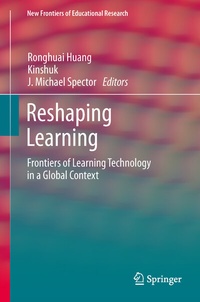
Reshaping Learning
Description

More details
Other editions
Additional editions
Content
Forward.- Preface.- PART ONE: New shape of learning.- Chapter 1 Emerging Learning mode in the era of transformation: from information society to knowledge society. Ronghuai Huang.- Chapter 2 Emerging dimensions of learning. Erkki Sutinen.- Chapter 3 Schools as Learning Communities. Victoria J. Marsick, Karen E. Watkins, Sarah A. Boswell.- PART TWO: New insights of future students.- Chapter 4 The new shape of the student. Chris Jones.- Chapter5 Digital Natives: Exploring the diversity of young people's experience with technology. Linda Corrin, Sue Bennett, Lori Lockyer.- Chapter 6 Adapting for a Personalized Learning Experience. Margaret Martinez.- PART THREE: The future of learning content.- Chapter 7 E-books in K-12 education. Guang Chen.- Chapter 8 The changing nature of eLearning Content. Robby Robson.- Chapter 9 The Open Future of Course Content Development and Dissemination. M.S. Vijay Kumar.- Chapter 10 National pilot courses in mainland China. Yanyan Li.- PART FOUR: New dimensions of learning technologies.- Chapter 11 Mobile Learning - Shaping The Frontiers of Learning Technologies in Global Context. John Traxler.- Chapter 12 Paradigm shifts in e-learning: From web-based learning to context-aware ubiquitous learning. Gwo-Jen Hwang.- Chapter 13 Reusable Authentic Learning Scenario Creation inUbiquitous Learning Environments. Kinshuk and Ryan Jesse.- Chapter 14 Educational use of computer games: where're we, and what's next. Morris S. Y. Jong, Jimmy H. M. Lee, Fong-Lok Lee Junjie Shang.- Chapter 15 Supplemental vs Essential Use of Computing Devices in the Classroom: An Analysis. Cathie Norris, Akhlaq Hossain, Elliot Soloway.- PART FIVE: Emerging trends in learning technologies.- Chapter 16 Application of Cloud Technology, Social Networking Sites and Sensing Technology to E-Learning. Yueh-Min Huang, Hsin-Chin Chen, Jan-Pan Hwang, Yong-Ming Huang.- Chapter 17 Design of a Holistic Curriculum Embodied with an Immersive Environment for Learning: Virtual Reality Immersion, Agent Mediation and Teacher Moderation. Longkai Wu, Chee-Kit Looi, Beaumie Kim, Chunyan Miao Chapter 18 Augmented Reality and Education: Applications and Potentials. Steve Chi-Yin Yuen, Gallayanee Yaoyuneyong, Erik Johnson Chapter 19 Facilitating Complex Learning by Mobile Augmented Reality Learning Environments. Dirk Ifenthaler.- Chapter 20"Mobilising" web sites at an open university: The Athabasca University experience. Regina Wasti, Rory McGreal.
