

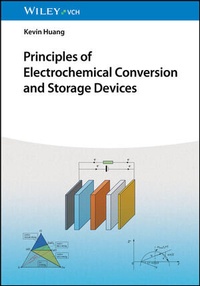
Principles of Electrochemical Conversion and Storage Devices
1st Edition
Published on 4. December 2024
288 pages
978-3-527-83830-1 (ISBN)
Description

Comprehensive resource covering fundamental principles of electrochemical energy conversion and storage technologies including fuel cells, batteries, and capacitors
Starting with the importance and background of electrochemical foundations, Principles of Electrochemical Conversion and Storage Devices explains the working principles and electrochemistry of electrochemical cells. After a summary of thermodynamic and kinetics, different types of fuel cells as well as batteries and capacitors are covered.
This book is written in the style of a textbook, providing illustrative examples and inspiring problems to facilitate the understanding of essential principles of electrochemical cells while offering practical insights for research pursuits. Various application examples are provided at the end of each chapter to strengthen reader understanding of energy storage from a practical point of view.
Written by a highly qualified and awarded academic and based on a culmination of his two decades of personal teaching and research experience in the field, Principles of Electrochemical Conversion and Storage Devices includes information on:
* Common reference electrodes and potentials, standard electrode potentials in aqueous solutions, and current functions for the charge transfer process
* Standard Gibbs free energy of formation of selected compounds, standard heat of combustion of common fuels, and commonly used physical constants
* Latest developments in the field, especially surrounding clean energy technologies, and various experimental methods essential for conducting rigorous electrochemical research
* Characterizing methods, key materials, and governing principles behind all of the covered devices
Providing comprehensive coverage of the subject, Principles of Electrochemical Conversion and Storage Devices is an excellent resource tailored for researchers and students from all technical and natural science disciplines seeking to understand more about the most promising energy-related devices and the potential they hold to change the world.
Starting with the importance and background of electrochemical foundations, Principles of Electrochemical Conversion and Storage Devices explains the working principles and electrochemistry of electrochemical cells. After a summary of thermodynamic and kinetics, different types of fuel cells as well as batteries and capacitors are covered.
This book is written in the style of a textbook, providing illustrative examples and inspiring problems to facilitate the understanding of essential principles of electrochemical cells while offering practical insights for research pursuits. Various application examples are provided at the end of each chapter to strengthen reader understanding of energy storage from a practical point of view.
Written by a highly qualified and awarded academic and based on a culmination of his two decades of personal teaching and research experience in the field, Principles of Electrochemical Conversion and Storage Devices includes information on:
* Common reference electrodes and potentials, standard electrode potentials in aqueous solutions, and current functions for the charge transfer process
* Standard Gibbs free energy of formation of selected compounds, standard heat of combustion of common fuels, and commonly used physical constants
* Latest developments in the field, especially surrounding clean energy technologies, and various experimental methods essential for conducting rigorous electrochemical research
* Characterizing methods, key materials, and governing principles behind all of the covered devices
Providing comprehensive coverage of the subject, Principles of Electrochemical Conversion and Storage Devices is an excellent resource tailored for researchers and students from all technical and natural science disciplines seeking to understand more about the most promising energy-related devices and the potential they hold to change the world.
More details
Other editions
Additional editions
Book
01/2025
1st Edition
Wiley-VCH
€122.00
Available immediately
Person
Prof. Kevin Huang is currently a SmartState endowed chair and director of solid oxide fuel cell center at University of South Carolina. His research interest covers rechargeable batteries, reversible fuel cells, gas separation membranes and multiscale computational modeling. He has published 230+ peer-reviewed journal papers, 2 books, 3 book chapters and been granted 14 US patents. He is currently the principal investigator of 6 federal projects and co-PI of other 2 federal projects. He is the associate editor of Journal of Electrochemical Energy Conversion and Storage and past associate editor of RSC Advances. He is the recipient of numerous awards, including 2018 Breakthrough Leadership in Research Award, 2017 Educational Foundation Award for Research in Science, Mathematics and Engineering, 2015 College of Engineering and Computing Research Achievement Award, and 2014 University of South Carolina Breakthrough Stars. He currently teaches Advanced Thermodynamics and Energy Storage for graduate student.
Content
1. INTRODUCTION
1.1 Importance of EECS
1.2 Current status of EECS
1.3 Motivation
1.4 Coverage
2. THERMODYNAMICS FOR ELECTROCHEMICAL CELLS
2.1 Chemical potentials
2.2 Gibbs free energy, enthalpy and entropy
2.3 Nernst equation
2.4 Temperature and pressure coefficients of Nernst potential
2.5 Electrode potentials
2.6 Problems
3. KINETICS FOR ELECTROCHEMICAL CELLS
3.1 Transport of charged particles in solids
3.2 Mass transfer by migration and diffusion in liquids
3.3 Kinetics of electrode reactions
3.4 Double layer structure and adsorption
3.5 Problems
4. FUNDAMENTALS OF FUEL CELLS, BATTERIES, AND CAPACITORS
4.1 Working principles and key metrics of fuel cells
4.2 Working principles and key metrics of batteries
4.3 Working principles and key metrics of capacitors
4.4 Problems
5. BASIC METHODS FOR CHARACTERIZING ELECTROCHEMICAL CELLS
5.1 Potential step methods
5.2 Potential sweep methods
5.3 AC impedance spectroscopy
5.4 Bulk electrolysis methods (Coulometric titration)
5.5 Galvanic intermittent titration technique
5.6 Ionic conductivity/transport number measurement
5.7 Problems
6. KEY MATERIALS FOR ELECTROCHEMICAL CELLS
6.1 Electrolyte materials
6.2 Cathode materials
6.3 Anode materials
6.4 Current collector materials
6.5 Problems
7. MULTIPHYSICS MODELING OF ELECTROCHEMICAL CELLS
7.1 Basic electrochemical processes
7.2 Governing equations
7.3 Computational procedures
7.4 Experimental validation
7.5 Performance predictions
7.6 Problems
8. EXEMPLARY APPLICATIONS OF ELECTROCHEMICAL ENERGY CONVERSION AND STORAGE DEVICES
8.1 Proton exchange membrane fuel cells
8.2 Solid oxide fuel cells
8.3 Lead-acid batteries
8.4 Ni-Cd batteries
8.5 Ni-MH batteries
8.6 Zn-ion batteries
8.7 Li-ion batteries
8.8 Na-ion batteries
8.9 K--ion batteries
8.10 Metal-air batteries
8.11 Problems
1.1 Importance of EECS
1.2 Current status of EECS
1.3 Motivation
1.4 Coverage
2. THERMODYNAMICS FOR ELECTROCHEMICAL CELLS
2.1 Chemical potentials
2.2 Gibbs free energy, enthalpy and entropy
2.3 Nernst equation
2.4 Temperature and pressure coefficients of Nernst potential
2.5 Electrode potentials
2.6 Problems
3. KINETICS FOR ELECTROCHEMICAL CELLS
3.1 Transport of charged particles in solids
3.2 Mass transfer by migration and diffusion in liquids
3.3 Kinetics of electrode reactions
3.4 Double layer structure and adsorption
3.5 Problems
4. FUNDAMENTALS OF FUEL CELLS, BATTERIES, AND CAPACITORS
4.1 Working principles and key metrics of fuel cells
4.2 Working principles and key metrics of batteries
4.3 Working principles and key metrics of capacitors
4.4 Problems
5. BASIC METHODS FOR CHARACTERIZING ELECTROCHEMICAL CELLS
5.1 Potential step methods
5.2 Potential sweep methods
5.3 AC impedance spectroscopy
5.4 Bulk electrolysis methods (Coulometric titration)
5.5 Galvanic intermittent titration technique
5.6 Ionic conductivity/transport number measurement
5.7 Problems
6. KEY MATERIALS FOR ELECTROCHEMICAL CELLS
6.1 Electrolyte materials
6.2 Cathode materials
6.3 Anode materials
6.4 Current collector materials
6.5 Problems
7. MULTIPHYSICS MODELING OF ELECTROCHEMICAL CELLS
7.1 Basic electrochemical processes
7.2 Governing equations
7.3 Computational procedures
7.4 Experimental validation
7.5 Performance predictions
7.6 Problems
8. EXEMPLARY APPLICATIONS OF ELECTROCHEMICAL ENERGY CONVERSION AND STORAGE DEVICES
8.1 Proton exchange membrane fuel cells
8.2 Solid oxide fuel cells
8.3 Lead-acid batteries
8.4 Ni-Cd batteries
8.5 Ni-MH batteries
8.6 Zn-ion batteries
8.7 Li-ion batteries
8.8 Na-ion batteries
8.9 K--ion batteries
8.10 Metal-air batteries
8.11 Problems
