

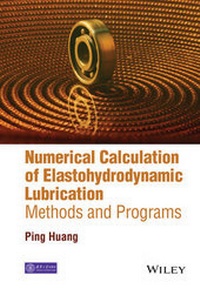
Numerical Calculation of Elastohydrodynamic Lubrication
Description

More details
Other editions
Additional editions
Person
Content
Introduction xi
Preface xiii
Nomenclature xvii
1 Basic equations of elastohydrodynamic lubrication 1
1.1 Basic equations 1
1.1.1 One-dimensional Reynolds equation of elastohydrodynamic lubrication 1
1.1.2 Two-dimensional Reynolds equation of EHL 3
1.1.3 EHL Reynolds equation with two direction velocities 3
1.1.4 Time-dependent EHL Reynolds equation 4
1.2 Film thickness equation without elastic deformation 4
1.2.1 Film thickness equation in line contact 4
1.2.2 Film thickness equation in point contact 5
1.2.3 Film thickness equation in ellipse contact 5
1.3 Surface elastic deformation 6
1.3.1 One-dimensional elastic deformation equation 6
1.3.2 Two-dimensional elastic deformation equation 6
1.4 Viscosity and density equations varying with pressure and temperature 7
1.4.1 Viscosity equations 7
1.4.2 Density equation 9
1.5 Load balancing condition 10
1.5.1 Load balancing equation 10
1.5.2 Numerical calculation of load balancing 11
1.6 Finite difference method of Reynolds equation 15
1.6.1 Discretization of equation 15
1.6.2 Different forms of Reynolds equation 17
1.6.3 Iteration of differential equation 18
1.6.4 Iteration convergence condition 18
2 Numerical calculation method and program of elastic deformation 21
2.1 Numerical method and program of elastic deformation in line contact 21
2.1.1 Equations of elastic deformation 21
2.1.2 Numerical method of elastic deformation 22
2.1.3 Calculation diagram and program 23
2.1.4 Example 25
2.2 Numerical method and program of elastic deformation in point contact 27
2.2.1 Equation of elastic deformation 27
2.2.2 Numerical method for elastic deformation in point contact 28
2.2.3 Calculation diagram 29
2.2.4 Program 30
2.2.5 Example 31
2.3 Numerical calculation method and program for elastic deformation in ellipse contact 33
2.3.1 Contact geometry 33
2.3.2 Contact pressure and contact zone 36
2.3.3 Calculation program 38
2.3.4 Calculation results 44
2.4 Calculation of elastic deformation with multigrid integration technique 44
2.4.1 Principle of multigrid integration 44
2.4.2 Calculation programs and examples 49
3 Numerical calculation method and program for energy equation 61
3.1 Energy equation 61
3.1.1 One-dimensional energy equation 62
3.1.2 Two-dimensional energy equation 62
3.2 Numerical method and program for thermal hydrodynamic lubrication 64
3.2.1 One-dimensional thermal hydrodynamic lubrication 64
3.2.2 Two-dimensional thermal hydrodynamic lubrication 68
4 Numerical calculation method and program of isothermal EHL in line contact 75
4.1 Basic equations and Nondimensional equations 75
4.1.1 Basic equations 75
4.1.2 Nondimensional equations 76
4.1.3 Discrete equations 77
4.2 Numerical calculation method and program 78
4.2.1 Iterative method 78
4.2.2 Program and example 79
5 Newton-Raphson method and programs to solve EHL problems in line contact 87
5.1 Basic equations 87
5.2 Newton-Raphson iterative method 88
5.2.1 Coefficient matrix 88
5.2.2 Calculation of variables in equations 89
5.3 Numerical method and program of Newton-Raphson 90
5.3.1 Coefficient treatment in nonlubricated region 90
5.3.2 Determination of ¿eHe 90
5.3.3 Determination and correction of initial rigid film thickness 91
5.3.4 Calculation Program 91
5.3.5 Example 96
6 Numerical calculation method and program of isothermal EHL in point contact 99
6.1 Basic equations of isothermal EHL in point contact 99
6.1.1 Basic equations 99
6.1.2 Nondimensional equations 100
6.2 Numerical calculation method and program 101
6.2.1 Differential equations 101
6.2.2 Iteration method 102
6.2.3 Calculation diagram 102
6.2.4 Calculation program 106
6.2.5 Example 111
7 Numerical calculation method and programs of multigrid method for isothermal EHL 113
7.1 Basic principles of multigrid method 113
7.1.1 Grid structure 113
7.1.2 Equation discrete 114
7.1.3 Restriction and extension 114
7.2 Nonlinear full approximation scheme of multigrid method 116
7.2.1 Parameter transformation downwards 116
7.2.2 Correction of lower grid parameters 116
7.2.3 Parameter transformation upwards 118
7.2.4 V and W loops 118
7.3 Key factors to solve EHL problem with multigrid method 119
7.3.1 Iteration methods 119
7.3.2 Relaxation factors selection 121
7.4 Program of EHL in line contact with multigrid method 122
7.4.1 Specification of program 122
7.4.2 Calculation program 123
7.4.3 Example 133
7.5 Program of EHL in point contact with multigrid method 133
7.5.1 Specification of the program 133
7.5.2 Calculation program 134
7.5.3 Example 143
8 Numerical calculation method and program for isothermal EHL in ellipse contact 145
8.1 Basic equation 145
8.1.1 Reynolds equation 145
8.1.2 Film thickness equation 146
8.1.3 Viscosity-pressure equation 146
8.1.4 Density-pressure equation 147
8.1.5 Load balancing equation 147
8.2 Calculation program 148
8.2.1 Calculation diagram 148
8.2.2 Calculation program 149
8.2.3 Example 157
9 Numerical calculation method and program of isothermal EHL in elliptical contact with two-dimensional velocities 159
9.1 Basic equations 159
9.2 Velocity treatment 160
9.3 Numerical calculation method and program 161
9.3.1 Flowchart 161
9.3.2 Program 161
9.3.3 Example 171
10 Numerical calculation method and program for thermal EHL 173
10.1 Basic equations for thermal EHL 173
10.1.1 Thermal EHL in line contact 173
10.1.2 TEHL in point contact 176
10.2 Viscosity and temperature across film thickness 179
10.2.1 Calculation of fluid velocity field 179
10.2.2 Continuity equation 181
10.2.3 Energy equation 182
10.2.4 Temperature boundary conditions 185
10.2.5 Calculation of linear equation set 187
10.2.6 Program to calculate temperature 187
10.3 Numerical calculation method and program for TEHL in line contact 189
10.3.1 Flowchart 189
10.3.2 Program 190
10.3.3 Example 201
10.4 Numerical calculation method and program of TEHL in point contact 202
10.4.1 Flowchart 202
10.4.2 Calculation program 204
10.4.3 Example 216
11 Numerical calculation method and program of grease EHL 217
11.1 Basic equations of grease EHL 217
11.2 Numerical calculation and program of isothermal grease EHL 220
11.2.1 Line contact problem 220
11.2.2 Point contact problem 231
11.3 Numerical calculation method and program of thermal GEHL 243
11.3.1 Line contact problem 243
11.3.2 Point contact problem 262
12 Numerical calculation method and program of EHL considering effect of electric double layer 279
12.1 Structure of electric double layer 279
12.2 Reynolds equation considering EDL effect 279
12.2.1 Modified Reynolds equation 279
12.2.2 Expression of electroviscosity 284
12.3 Calculation program and example 285
12.3.1 Calculation program 285
12.3.2 Example 293
13 Numerical calculation method and program of time-dependent EHL in line contact 295
13.1 Time-dependent EHL Reynolds equation 295
13.1.1 Nondimensional Reynolds equation 295
13.1.2 Discrete Reynolds equation 296
13.2 Numerical calculation method and program 296
13.2.1 Iteration method 296
13.2.2 Calculation diagram 297
13.2.3 Calculation program 297
13.2.4 Example 304
14 Numerical calculation method and program of isothermal EHL with rough surface 305
14.1 Film thickness equation with surface roughness 305
14.2 Calculation of rough surface EHL problem with Newton-Raphson method 306
14.2.1 Sine roughness 306
14.2.2 Single depression 311
14.3 EHL solution with random roughness in line contact 317
14.3.1 Description of the program 317
14.3.2 Calculation program 317
14.3.3 Example 321
14.4 EHL solution with random roughness in point contact 322
14.4.1 Description of the program 322
14.4.2 Calculation program 322
14.4.3 Example 326
14.5 Random roughness generation program 328
15 Numerical calculation method and program of micropolar fluid EHL 329
15.1 Reynolds equation of micropolar fluid EHL 329
15.1.1 Basic equations 329
15.1.2 Reynolds equation 330
15.2 Calculation program of EHL of micropolar fluid in line contact 334
15.2.1 Description of the program 334
15.2.2 Calculation program 334
15.2.3 Example 338
15.3 Calculation program of EHL with micropolar fluid in point contact 339
15.3.1 Calculation program 339
15.3.2 Example 343
References 345
Index 000
Nomenclature
a is the half-width in the point or ellipse contact region in the x direction (the velocity direction). For the point contact, a is the characteristic length in the x direction b is the half-width in the line contact region, b is the radius of the elliptical contact region in the y direction (cross the velocity direction) b is the characteristic length in the y direction cp is the specific heat capacity of lubricant c is the pressure viscosity coefficient of Cameron equation, which is approximate to a/15 c1 and c2 are the specific heats of the materials on the up and down surfaces D is the density-temperature coefficient, D = -0.00065?K-1 are the two-dimensional elastic deformation stiffnesses ek is the ellipse rate, E is the equivalent elastic modulus of the two contact surface materials, E1 and E2 are the elastic modulus corresponding to the up and down surfaces of the materials G* is a material parameter, G* = aE h is the lubricant film thickness h1 is the minimum lubricant thickness film h0 is the central film thickness to be determined based on the load balancing condition H is the nondimensional film thickness, for the line contact , for the point or elliptical contact H0 is the nondimensional central film thickness J is the mechanical equivalent of heat J is the inertia factor of micropolar fluid k is the thermal conductivity of lubricant k1 and k2 are the thermal conductivities of the up and down surfaces Kij is the one-dimensional elastic deformation stiffness l is the characteristic length of micropolar fluid L is the nondimensional characteristic length of micro-polar fluid m is the number of nodes in the y direction n is the number of nodes in the x direction n is the rheological index, =1 N is the coupling coefficient of micropolar fluid p is the pressure p0 is the pressure-viscosity coefficient, p0 = 1.96?×?108 pH is Hertz contact pressure, for the line contact , for the point contact , and for the elliptic contact P is the nondimensional pressure, P = p/pH Ptr the deformation coefficient of elliptical contact, R is the equivalent radius of curvature, ; for the outer contact, take + and for the inner contact, take - R1 and R2 are the integrated radii of curvature of the up and down surfaces in the line or point contact Rx and Ry are the equivalent radii of curvature in the x and y direction of both surfaces s is the sliding-rolling ratio, s = (u1?-?u2)/us t is the time T is the temperature T is one of the nondimensional time, T = Ut/b T0 is the initial temperature, here T0 = 303?K T* is the nondimensional temperature, T* = T/T0 is the average velocity of the up and down surfaces along the x direction u is the fluid velocity component in the x direction u1 and u2 are the tangential velocities respectively to the up and down surface in the x direction U* is the velocity parameters, for the line contact , for the point or ellipse contact v is the fluid velocity component in the y direction vs is the average speed in y direction along the two surfaces, vs = (v1 + v2)/2 v1 and v2 are the tangential velocities respectively to the up and down surface in the y direction v(x) is the displacement of the elastic deformation generated by pressure V* is the velocity parameter, w is the load, for line contact w is the load per unit length of the contact, and for the point or ellipse contact w is the total load w is the fluid velocity component in the z direction W is the nondimensional load, for the line contact , for the point contact , and for the elliptical contact W* is the load parameters, for the line contact , for the point or elliptical contact x is the coordinate which is in the same direction of the main speed x0 is the inlet coordinate xe is the outlet coordinate X is nondimensional coordinate of x, for the line contact X = x/b, for the point contact X = x/a X0 and Xe are the nondimensional coordinates of the inlet and outlet y is the coordinate which is vertical to the main speed Y is the nondimensional coordinate in the y direction, Y = y/a z is the coordinate in the film thickness direction z is the coefficient of viscosity pressure formula, for a mineral oil it is generally z = 0.68 Z is the nondimensional coordinate of z, for the line contact , for the point or ellipse contact a is the pressure coefficient of oil or base oil of grease in Barus viscosity-pressure formula a is the length proportional factor of the contact ellipse, a = a/b aT is the coefficient in the density-temperature equation, its unit is °C-1 ß is the viscosity-temperature coefficient in the Barus formula, for oil it usually is 0.03°C-1 ?X is the equally divided nondimensional increment between the nodes of the mesh, e is the Reynolds coefficient, for oil , for grease f is the plastic viscosity f0 is the plastic viscosity of grease at the normal pressure and at the room temperature f* is the nondimensional viscosity, f* = f/f0 ? is the material constant of micropolar fluid ? is the parameter of the coefficients e, for the line contact , for the point or elliptical contact , for grease ? is the viscosity of the lubricant ?0 is the...
