

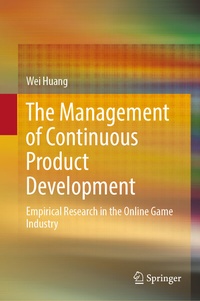
The Management of Continuous Product Development
Description

This book discusses theoretically and empirically the trade-off relationship between the frequency of product adaptation activities and the constraints on development resources, and how companies can respond to these constraints. The objective of this book is to identify effective management practices in continuous product development. With the continuation of development activities, companies are required to constantly adapt their products to changes in the external environment. In continuous product development, the development process extends beyond product release, and interaction with the external environment is not limited to the planning stage but occurs multiple times throughout the process. What impact does the multiple adaptation activities have on the product performance as development activities become more continuous, and how to use limited development resources to provide stable and constant high-quality adaptation activities with optimal frequency have become urgent issues in the development sites. To address these research questions, this book focuses primarily on the development activities of the online game industry. The factors that bring about superior product performance are examined by combining case studies and questionnaire surveys on online game development projects. Furthermore, user community management is also discussed from the perspective of the interaction process between multiple user groups.
More details
Other editions
Additional editions
Person
Wei Huang is an associate professor at the Graduate School of Technology Management, Ritsumeikan University. He received his Ph.D. in Management from the University of Tokyo. Previously, he had been an assistant professor and research fellow at the Graduate School of Economics, the University of Tokyo. He also serves as a visiting research fellow at Hitotsubashi University's TDB Center for Advanced Empirical Research on Enterprise and Economy. His research interests include product innovation, product development in software and game industries, production management systems in manufacturing.
