
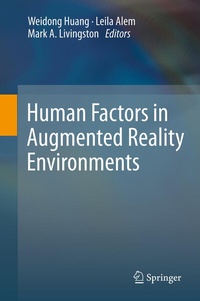
Human Factors in Augmented Reality Environments
Description
Alles über E-Books | Antworten auf Fragen rund um E-Books, Kopierschutz und Dateiformate finden Sie in unserem Info- & Hilfebereich.
Advances in hardware and networking have made possible a wide use of augmented reality (AR) technologies. However, simply putting those hardware and technologies together does not make a "good" system for end users to use. New design principles and evaluation methods specific to this emerging area are urgently needed to keep up with the advance in technologies.
Human Factors in Augmented Reality Environments is the first book on human factors in AR, addressing issues related to design, development, evaluation and application of AR systems. Topics include surveys, case studies, evaluation methods and metrics, HCI theories and design principles, human factors and lessons learned and experience obtained from developing, deploying or evaluating AR systems. The contributors for this cutting-edge volume are well-established researchers from diverse disciplines including psychologists, artists, engineers and scientists.
Human Factors in Augmented Reality Environments is designed for a professional audience composed of practitioners and researchers working in the field of AR and human-computer interaction. Advanced-level students in computer science and engineering will also find this book useful as a secondary text or reference.
More details
Other editions
Additional editions

Content
System requirements
File format: PDF
Copy protection: Watermark-DRM (Digital Rights Management)
System requirements:
- Computer (Windows; MacOS X; Linux): Use the free software Adobe Reader, Adobe Digital Editions, or any other PDF viewer of your choice (see eBook Help).
- Tablet/Smartphone (Android; iOS): Install the free app Adobe Digital Editions or another reading app for eBooks, e.g., PocketBook (see eBook Help).
- E-reader: Bookeen, Kobo, Pocketbook, Sony, Tolino and many more (only limited: Kindle).
The file format PDF always displays a book page identically on any hardware. This makes PDF suitable for complex layouts such as those used in textbooks and reference books (images, tables, columns, footnotes). Unfortunately, on the small screens of e-readers or smartphones, PDFs are rather annoying, requiring too much scrolling.
This eBook uses Watermark-DRM, a „soft” copy protection. This means that there are no technical restrictions to prevent illegal distribution. However, there is a personalised watermark embedded in the eBook that can be used to identify the purchaser of the eBook in the event of misuse and to provide evidence for legal purposes.
For more information, see our eBook Help page.