

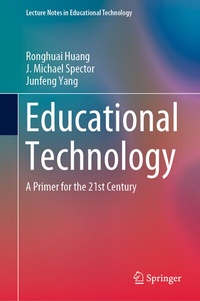
Educational Technology
A Primer for the 21st Century
Published on 27. February 2019
XIV, 248 pages
978-981-13-6643-7 (ISBN)
Description

The aim of this book is to prepare students with knowledge and skills to understand the organizational needs and requirements of educational technology. Students should be able to use and manage both existing and emerging technologies effectively and be able to apply associated pedagogies to suit the environment, but also evaluate and manage technological advances of future and the requisite pedagogical shifts to achieve efficiency and effectiveness.
The demand of educational technology has been rising steadily, primarily due to the fact that e-learning is a huge and significantly expanding world-wide industry. Commercial e-learning companies, training departments in large companies and organizations, computer software companies and educational institutions the world over employ large numbers of educational technology specialists. There is a strong demand for technologists who understand educational theories and for instructional designers and teachers who understand technologies.
This book is targeted towards those who are looking for career in educational technology, instructional design, or media and information systems, or may want to continue their studies in graduate programs in learning and instructional technology, and those who are interested in becoming teacher in K-12 setting but need background in educational technology. This book will also act as a valuable resource in teacher education programs where primary focus on mainstream education and requires an authentic resource in instructional design and educational technology. Keeping in mind the varied needs of the organizations, employees and potential students, this book adopts a competency approach to learning and assessment. The themes and topics take a multi-disciplinary approach, and are aimed at preparing students for competent and innovative educational technology professionals.
The demand of educational technology has been rising steadily, primarily due to the fact that e-learning is a huge and significantly expanding world-wide industry. Commercial e-learning companies, training departments in large companies and organizations, computer software companies and educational institutions the world over employ large numbers of educational technology specialists. There is a strong demand for technologists who understand educational theories and for instructional designers and teachers who understand technologies.
This book is targeted towards those who are looking for career in educational technology, instructional design, or media and information systems, or may want to continue their studies in graduate programs in learning and instructional technology, and those who are interested in becoming teacher in K-12 setting but need background in educational technology. This book will also act as a valuable resource in teacher education programs where primary focus on mainstream education and requires an authentic resource in instructional design and educational technology. Keeping in mind the varied needs of the organizations, employees and potential students, this book adopts a competency approach to learning and assessment. The themes and topics take a multi-disciplinary approach, and are aimed at preparing students for competent and innovative educational technology professionals.
Reviews / Votes
"This book makes a clear appeal to the role of the educational technologies in learning institutions instead of addressing the ambiguous roles instructional designers often assume. This educational technology book is a strong classroom text and an indispensable reference for the educational technologist." (Jennifer L. Culbertson and Craig D. Howard, TechTrends, Vol. 64, 2020)
More details
Other editions
Additional editions
Ronghuai Huang | J. Michael Spector | Junfeng Yang
Educational Technology
A Primer for the 21st Century
Book
02/2019
1st Edition
Springer
€139.09
Shipment within 15-20 days
Persons
Ronghuai Huang is a Professor in Faculty of Education and Dean of Smart Learning Institute in Beijing Normal University. He received "Chang Jiang Scholar" award in 2017, which is the highest academic award issued to an individual in higher education by the Ministry of Education in China. He now serves as the Director of the National Engineering Lab for Intelligent Cyber-Learning Technology, and Director of Beijing Key Laboratory for Educational Technology. He is also the president of International Association of Smart Learning Environments, Editor-in-Chief of Springer's
Smart Learning Environments
and
Journal of Computers in Education
, as well as Editor-in-Chief of Springer's series
Lecture Notes in Educational Technology
and
Smart Computing and Intelligence
.
J. Michael Spector is a Professor and Former Chair of Learning Technologies at the University of North Texas. He earned a Ph.D. in Philosophy from the University of Texas at Austin. His research focuses on intelligent support for instructional design, assessing learning in complex domains, and technology integration in education. He is editor of Educational Technology Research and Development and serves on numerous other editorial boards. He edited the third and fourth editions of Handbook of Research on Educational Communications and Technology , as well as Encyclopedia of Educational Technology , and has more than 150 publications to his credit.
Junfeng Yang is a professor and dean of Department of Educational Technology at Hangzhou Normal University. He earned the title of "Zhejiang Young Zhijiang social science scholar", "Hangzhou new century 131 scholar". He has published more than 30 academic papers, including SSCI journal papers and outstanding Chinese journal papers. He also serves as the associate editor of Springer's Smart Learning Environments .
J. Michael Spector is a Professor and Former Chair of Learning Technologies at the University of North Texas. He earned a Ph.D. in Philosophy from the University of Texas at Austin. His research focuses on intelligent support for instructional design, assessing learning in complex domains, and technology integration in education. He is editor of Educational Technology Research and Development and serves on numerous other editorial boards. He edited the third and fourth editions of Handbook of Research on Educational Communications and Technology , as well as Encyclopedia of Educational Technology , and has more than 150 publications to his credit.
Junfeng Yang is a professor and dean of Department of Educational Technology at Hangzhou Normal University. He earned the title of "Zhejiang Young Zhijiang social science scholar", "Hangzhou new century 131 scholar". He has published more than 30 academic papers, including SSCI journal papers and outstanding Chinese journal papers. He also serves as the associate editor of Springer's Smart Learning Environments .
Content
Section 1 Introduction and overview.- Introduction to educational technology.- Introduction to learning in context of existing and emerging technologies.- Foundations, evolution and developments in educational technology.- Section 2 Perspectives.- Typologies and key approaches to educational technology.- Systems' perspectives of educational technology.- Users' Perspectives of educational technology.- Learner Experiences and Perspectives of Educational Technology.- Section 3.- Design, implementation and evaluation.- Design requirements.- Design process and development lifecycles.- Instructional design and development.- Evaluation models, approaches and practices.- Section 4 Emerging technologies and advance applications.- Critical Issues in educational technology.- Emerging Issues in educational technology.
