

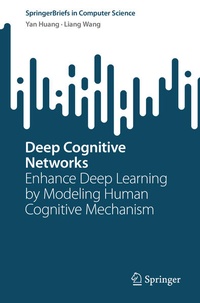
Deep Cognitive Networks
Description

Although deep learning models have achieved great progress in vision, speech, language, planning, control, and many other areas, there still exists a large performance gap between deep learning models and the human cognitive system. Many researchers argue that one of the major reasons accounting for the performance gap is that deep learning models and the human cognitive system process visual information in very different ways.
To mimic the performance gap, since 2014, there has been a trend to model various cognitive mechanisms from cognitive neuroscience, e.g., attention, memory, reasoning, and decision, based on deep learning models. This book unifies these new kinds of deep learning models and calls them deep cognitive networks, which model various human cognitive mechanisms based on deep learning models. As a result, various cognitive functions are implemented, e.g., selective extraction, knowledge reuse, and problem solving, for more effective information processing.
This book first summarizes existing evidence of human cognitive mechanism modeling from cognitive psychology and proposes a general framework of deep cognitive networks that jointly considers multiple cognitive mechanisms. Then, it analyzes related works and focuses primarily but not exclusively, on the taxonomy of four key cognitive mechanisms (i.e., attention, memory, reasoning, and decision) surrounding deep cognitive networks. Finally, this book studies two representative cases of applying deep cognitive networks to the task of image-text matching and discusses important future directions.
More details
Other editions
Additional editions
Persons
Yan Huang (PhD) is an associate professor at the Institute of Automation, Chinese Academy of Sciences (CASIA). His research interests include computer vision and deep cognitive networks. He has published more than 70 papers in leading international journals and conferences such as IEEE TPAMI and CVPR. He has obtained awards such as the Presidential Special Award of CAS, Excellent Doctoral Thesis of both CAS and CAAI, NVIDIA Pioneering Research Award, and Baidu Fellowship. He was selected as one of the Young Talents Project of China Association for Science and Technology and Beijing Outstanding Young Talents.
Liang Wang (PhD) is a professor at the Institute of Automation, Chinese Academy of Sciences (CASIA). His major research interests include machine learning, pattern recognition, and computer vision. He has widely published in highly ranked international journals, such as IEEE Transactions on Pattern Analysis and Machine Intelligence and the IEEE Transactions on Image Processing , and leading international conferences, such as CVPR, ICCV, and ECCV. He has served as an associate editor of the IEEE Transactions on Pattern Analysis and Machine Intelligence , IEEE Transactions on Image Processing , and PR. He is also an IEEE fellow and an IAPR fellow.
Content
Chapter 1. Introduction.- Chapter 2. General Framework.- Chapter 3. Attention-based DCNs.- Chapter 4. Memory-based DCNs.- Chapter 5. Reasoning-based DCNs.- Chapter 6. Decision-based DCNs.- Chapter 7. Conclusions and Future Trends.
