

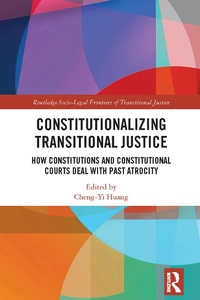
Constitutionalizing Transitional Justice
How Constitutions and Constitutional Courts Deal with Past Atrocity
1st Edition
Published on 11. November 2022
272 pages
978-0-429-99884-3 (ISBN)
Description

This book explores the complicated relationship between constitutions and transitional justice. It brings together scholars and practitioners from different countries to analyze the indispensable role of constitutions and constitutional courts in the process of overcoming political injustice of the past. Issues raised in the book include the role of a new constitution for the successful practice of transitional justice after democratization, revolution or civil war, and the difficulties faced by the court while dealing with mass human rights infringements with limited legal tools. The work also examines whether constitutionalizing transitional justice is a better strategy for new democracies in response to political injustice from the past. It further addresses the complex issue of backslides of democracy and consequences of constitutionalizing transitional justice. The group of international authors address the interplay of the constitution/court and transitional justice in their native countries, along with theoretical underpinnings of the success or unfulfilled promises of transitional justice from a comparative perspective.
The book will be a valuable resource for academics, researchers and policy-makers working in the areas of Transitional Justice, Comparative Constitutional Law, Human Rights Studies, International Criminal Law, Genocide Studies, Law and Politics, and Legal History.
The book will be a valuable resource for academics, researchers and policy-makers working in the areas of Transitional Justice, Comparative Constitutional Law, Human Rights Studies, International Criminal Law, Genocide Studies, Law and Politics, and Legal History.
Reviews / Votes
'Constitutions are forward-looking attempts to structure future politics, but also have to confront legacies of the past. This volume brings together a group of star scholars to consider the intersections of constitutions and transitional justice in a range of important and varied settings. Highly recommended!'Tom Ginsburg, Leo Spitz Professor of International Law, The University of Chicago Law School
'This book wonderfully illuminates the problems that arise when societies attempt to respond to their past record of injustice during the difficult period of transition. Its careful case studies alert us to the complexities of this process, including the problem that transitions may be retrogressive as well as progressive.'
David Dyzenhaus, University Professor of Law and Philosophy, University of Toronto
'Insightful and topical array of essays addressing the constitutionalism of transitional justice worldwide: this volume will be of profound interest to scholars and practitioners alike.'
Ruti Teitel, Ernst C. Stiefel Professor of Comparative Law, New York Law School
More details
Series
Edition
1. Auflage
Language
English
Place of publication
London
United Kingdom
Publishing group
Taylor & Francis Ltd
Target group
College/higher education
Illustrations
3 Tables, black and white; 1 Halftones, black and white
ISBN-13
978-0-429-99884-3 (9780429998843)
Copyright in bibliographic data and cover images is held by Nielsen Book Services Limited or by the publishers or by their respective licensors: all rights reserved.
Schweitzer Classification
Other editions
Additional editions
Cheng-Yi Huang
Constitutionalizing Transitional Justice
How Constitutions and Constitutional Courts Deal with Past Atrocity
Book
05/2024
1st Edition
Routledge
€63.50
Shipment within 10-20 days
Cheng-Yi Huang
Constitutionalizing Transitional Justice
How Constitutions and Constitutional Courts Deal with Past Atrocity
Book
11/2022
1st Edition
Routledge
€186.30
Shipment within 10-20 days
Person
Cheng-Yi Huang is Research Professor at the Institutum Iurisprudentiae, Academia Sinica, and Professor at the Institute of Law for Science and Technology, National Tsing Hua University, Taiwan.
Content
List of tables
List of contributors
Acknowledgements
Contexts of Constitutionalizing Transitional Justice: An introduction
Part 1 Constitutional Origins of Transitional Justice
Chapter 1: The Dilemmas of Transitional Justice and the South African Experience
Chapter 2: Facing the Shadows of the Past during Transitions: The Role of the Constitutions in the Case of Hungary
Chapter 3: Constitutional Divergence and Transitional Justice in South Korea and Taiwan
Part 2 Constitutional Process of Transitional Justice
Chapter 4: Constitutional Justice and Negotiated Peace in Colombia
Chapter 5: Constitutions, Courts, and the Quest for Transitional Justice: The Case of Chile
Chapter 6: Coordinated Transition in East Central Europe and the Role of Constitutional Courts in Transitional Justice: Experiences from Hungary and Moldova
Chapter 7: The Determinants of the Polish Transformation at the Turn of the 21st Century: In View of the Judgments of the Constitutional Tribunal of Poland
Part 3 Constitutional Consequences of Transitional Justice
Chapter 8: Transitional Justice in a 19th-Century Constitution: Cautionary Observations from the United States
Chapter 9: 'Cadres' in Post-communist Transition: Shifting the Loyalty Standards in Public Service after Regime Change
Chapter 10: Between Blaming and Naming: Constitutional Review of Bans on Communist Parties in Post-Soviet States
Index
List of contributors
Acknowledgements
Contexts of Constitutionalizing Transitional Justice: An introduction
Part 1 Constitutional Origins of Transitional Justice
Chapter 1: The Dilemmas of Transitional Justice and the South African Experience
Chapter 2: Facing the Shadows of the Past during Transitions: The Role of the Constitutions in the Case of Hungary
Chapter 3: Constitutional Divergence and Transitional Justice in South Korea and Taiwan
Part 2 Constitutional Process of Transitional Justice
Chapter 4: Constitutional Justice and Negotiated Peace in Colombia
Chapter 5: Constitutions, Courts, and the Quest for Transitional Justice: The Case of Chile
Chapter 6: Coordinated Transition in East Central Europe and the Role of Constitutional Courts in Transitional Justice: Experiences from Hungary and Moldova
Chapter 7: The Determinants of the Polish Transformation at the Turn of the 21st Century: In View of the Judgments of the Constitutional Tribunal of Poland
Part 3 Constitutional Consequences of Transitional Justice
Chapter 8: Transitional Justice in a 19th-Century Constitution: Cautionary Observations from the United States
Chapter 9: 'Cadres' in Post-communist Transition: Shifting the Loyalty Standards in Public Service after Regime Change
Chapter 10: Between Blaming and Naming: Constitutional Review of Bans on Communist Parties in Post-Soviet States
Index
