

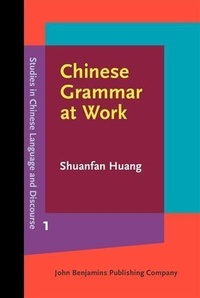
Chinese Grammar at Work
1st Edition
Published on 18. December 2013
XII, 458 pages
978-90-272-7136-5 (ISBN)
Description

Chinese Grammar at Work adopts a cognitive-functional approach and uses a corpus-based methodology to examine how Chinese syntax emerges from natural discourse context and what the evolving grammar at work looks like. In this volume the author weaves together an array of fresh perspectives on clause structure, constructions, interactional linguistics, cognitive science and complex dynamic systems to construct a grammar of spoken Chinese. The volume contains discussions of a large number of topics: contiguity relation, the roles of repair strategies in the shaping of constituent structure, non-canonical word order constructions, pragmatics of referring expressions, classifier constructions, noun-modifying constructions, verb complementation, ethnotheory of the person and constructions specific to the language of emotion, sequential sensitivity of linguistic materials, meaning potential in interaction, the nature of variability and stability in Chinese syntax from the perspective of complexity theory. The result is a volume that highlights the connections between language structure, situated and embodied nature of cognition and language use, and affords a true entrée to the exciting realm of Chinese grammar.
More details
Other editions
Additional editions
Shuanfan Huang
Chinese Grammar at Work
Book
12/2013
John Benjamins Publishing Co
€111.30
Shipment within 10-15 days
Person
Content
- Chinese Grammar at Work
- Editorial page
- Title page
- LCC data
- Table of contents
- Preface
- Abbreviations
- Glossing conventions
- Transcription conventions
- Chapter 1. Introduction
- 1.1 The empirical turn
- 1.2 Some findings from working with naturally occurring data
- 1.2.1 Syntax of the word of
- 1.2.2 Raising construction
- 1.2.3 Constancy of percentage of nouns
- 1.2.4 Emergence of epistemic formulae
- 1.2.5 Left dislocation
- 1.2.6 Syntax of adjectives
- 1.2.7 Classifiers
- 1.2.8 Adverbial clauses
- 1.3 Discourse pragmatics in the shaping of syntax
- 1.4 Database
- 1.5 Organization of the book
- Chapter 2. The dynamics of the clausal structure
- 2.1 Introduction
- 2.2 An illustration
- 2.3 Types of IUs
- 2.4 Clause fragments
- 2.5 Attached and unattached NP IUs
- 2.6 Topic hierarchy
- 2.7 Connectives linking IUs
- 2.8 Connectives and prosody
- 2.9 Pause markers and language production
- 2.10 Sources of messy syntax
- 2.11 Interactional and cognitive motivations
- 2.12 Conclusion
- Note
- Chapter 3. Constituency and patterns of syntactic contiguity
- 3.1 Sequential contiguity and constituent relation
- 3.2 Prosodic grouping
- 3.3 Emergent structural units
- 3.4 Locally contingent categories
- 3.5 Extensions
- 3.6 Repair and constituency
- 3.7 Conclusion
- Note
- Chapter 4. Pragmatics of word order
- 4.1 Introduction
- 4.2 Database
- 4.3 Methodology
- 4.4 Basic word order
- 4.5 Valency role orders
- 4.6 Word order and information statuses of NPs
- 4.7 Word order, identifiability and generality
- 4.8 Topicality hierarchy
- 4.9 "Subject"-like properties of NPs in clause-initial position
- 4.10 Indeterminacy in the semantics and syntax of non-canonical constructions
- 4.11 Discussion and conclusion
- Notes
- Chapter 5. Referring expressions
- 5.1 Introduction
- 5.2 Cognitive statuses and referring expressions in Mandarin
- 5.2.1 Givenness hierarchy
- 5.2.2 The indefinite yi N
- 5.2.3 The emergence of the definite article in Mandarin
- 5.2.4 Uses of demonstrative determiners in Conversation
- 5.2.5 Summary
- 5.3 Referring expressions and the accessibility scale
- 5.3.1 Database
- 5.3.2 Accessibility and referential distance
- 5.3.3 Accessibility and competition
- 5.3.4 Accessibility and saliency
- 5.3.5 Summary
- 5.4 Degrees of accessibility: Finer distinctions
- 5.4.1 High accessibility markers: ZA and pronoun
- 5.4.2 Medium accessibility markers: Determinate NPs
- 5.4.3 Low accessibility markers
- 5.5 Conclusion
- Notes
- Chapter 6. Classifiers and classifier constructions
- 6.1 Introduction
- 6.2 What classifers are
- 6.3 Types of numeral classifiers
- 6.4 Abstract nouns and an incipient mass/count distinction
- 6.5 Cognitive explanation
- 6.6 Affordance and blending classifiers: beyond sortal and mensural
- 6.7 Verbal classifiers
- 6.8 Classifier constructions
- 6.9 Some observations on the historical evolution of numeral classifiers
- 6.10 Conclusion
- Note
- Chapter 7. Noun-modifying constructions
- 7.1 Introduction
- 7.2 Multiple functions of de
- 7.3 Relativization strategies
- 7.4 The standard analysis of relative clause and its problems
- 7.5 Minor relativization strategy and other unusual relativization features
- 7.6 Absence of de in a clause
- 7.7 The absolutive hypothesis
- 7.8 Constituent structure of the relative clause
- 7.9 Conclusion
- Notes
- Chapter 8. Complementation constructions
- 8.1 Introduction
- 8.2 Methodology and database
- 8.3 Results
- 8.3.1 Matrix verb types
- 8.3.2 Mental verbs and verbs of saying
- 8.3.3 juede
- 8.3.4 kan
- 8.3.5 zhidao
- 8.3.6 xiang as the canonical mental predicate
- 8.4 Social action and complementation
- 8.5 Interim summary
- 8.6 Complementation and construction network
- 8.7 Conclusion
- Notes
- Chapter 9. Some more constructions in Chinese
- 9.1 Introduction
- 9.2 The presentative construction
- 9.3 The gei constructions
- 9.3.1 Stability and variability in the gei construction
- 9.3.2 Various grammaticization paths of the verb gei
- 9.4 Dative constructions and Dative-like markers: gen, dui, bang
- 9.5 The ethnotheory of the person and emotion constructions
- 9.6 The shi...de construction
- 9.7 Fluidity of transitivity
- 9.7.1 Accommodation construction
- 9.7.2 The middle construction
- 9.8 Conclusion
- Notes
- Chapter 10. The left and right peripheries in the clause and sequence structure
- 10.1 Introduction
- 10.2 Sequential nature of linguistic expressions
- 10.3 An illustration
- 10.4 Discourse functions of bo
- 10.5 Sequentially sensitive nature of the discourse marker bo
- 10.5.1 Grammaticalization chains for bo
- 10.6 Turn-final discourse markers
- 10.7 Turn-initial vs. turn-final particles
- 10.7.1 Final particles in Taiwanese
- 10.7.2 Particle clusters
- 10.7.3 Final particles and subjectivity
- 10.8 Conclusion
- Notes
- Chapter 11. Projection and repair
- 11.1 The predictive mind
- 11.2 Types of projection
- 11.2.1 Resources for projection
- 11.2.2 Shenme as a placeholder
- 11.2.3 The projective construction
- 11.3 Pre's
- 11.4 Repair
- 11.4.1 Repair in verb-initial languages
- 11.4.2 Repair in Mandarin
- 11.4.3 Repair patterns
- 11.5 Conclusion
- Chapter 12. Grammar, construction and social action
- 12.1 Introduction
- 12.2 Constructions in mandarin conversation
- 12.3 The qishi construction
- 12.3.1 Schematic representations of the qishi construction
- 12.3.2 Variation on the qishi schema
- 12.4 Conclusion
- Notes
- Chapter 13. Meaning in interaction
- 13.1 Posing the problem
- 13.2 Meaning negotiation
- 13.3 Natural kind terms
- 13.4 Nominal kind terms
- 13.5 Meaning and belief
- 13.6 Meaning adaptation
- 13.7 Conclusion
- Chapter 14. Language, cognition and the complexity turn in grammatical research
- 14.1 Language in its natural habitat
- 14.2 Language and situated cognition
- 14.3 Language and embodied cognition
- 14.4 Mirror neuron system and the foundation of language
- 14.5 How language use shapes grammar
- 14.6 Emergence of language structure
- 14.7 Language as a pastiche of subregularities
- 14.8 Language as a complex adaptive system
- 14.9 Concluding remarks
- Notes
- References
- Index
