

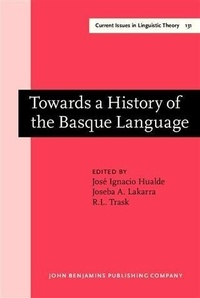
Towards a History of the Basque Language
1st Edition
Published on 1. January 1996
365 pages
978-90-272-8567-6 (ISBN)
Description

Questions related to the origin and history of the Basque language spark considerable interest, since it is the only surviving pre-Indo-European language in western Europe. However, until now, there was no readily available source in English providing answers to these questions or giving an overview of past and current research in this area. This book is intended to partly fill this void.
The book contains both state-of-the-art papers which summarize our knowledge about particular areas of Basque historical linguistics, and articles presenting new hypotheses and points of view based on hard evidence and careful analysis.
All contributors to this volume have demonstrated expertise in the topic within Basque historical linguistics that their chapter addresses. Two classical articles by the late Luis Michelena are included in English translation. In addition, the book includes studies on diachronic phonology, morphology and syntax. The relation of Basque to other languages is also investigated in a couple of chapters.
The book contains both state-of-the-art papers which summarize our knowledge about particular areas of Basque historical linguistics, and articles presenting new hypotheses and points of view based on hard evidence and careful analysis.
All contributors to this volume have demonstrated expertise in the topic within Basque historical linguistics that their chapter addresses. Two classical articles by the late Luis Michelena are included in English translation. In addition, the book includes studies on diachronic phonology, morphology and syntax. The relation of Basque to other languages is also investigated in a couple of chapters.
More details
Other editions
Additional editions
Jose Ignacio Hualde | Joseba A. Lakarra | R.L. Trask
Towards a History of the Basque Language
Book
01/1996
John Benjamins Publishing Co
€132.50
Shipment within 10-15 days
Persons
Content
- TOWARDS A HISTORY OF THE BASQUE LANGUAGE
- Editorial page
- Title page
- Copyright page
- Table of contents
- Editors' Foreword
- Note on Basque orthography
- Abbreviations
- The Basque Country and the Basque Language: An overview of the external history of the Basque language
- 0. Brief introductory notes
- 1. The long prehistory of Basque
- 2. The 16th and 17th centuries
- 3 . The 18th and 19th centuries
- 4. 1876-1936
- 5. The postwar period
- REFERENCES
- The Basque Language and Its Neighbors in Antiquity
- 1. Introduction
- 2. Aquitania
- 3. Hispania
- REFERENCES
- Origin and Relatives of the Basque Language: Review of the evidence
- 0. Introduction *
- 1. 'Old European'
- 2. Indo-European
- 3 . Iberian
- 4. Minoan, Etruscan, Pictish, Sumerian
- 5. Caucasian
- 6. Aquitanian
- 7. African languages
- 8. Basque and the Macro-families
- 9. Summary and Conclusions
- REFERENCES
- The Ancient Basque Consonants*
- REFERENCES
- The Latin and Romance Element in Basque*
- 0. Preface
- REFERENCES
- Reconstructing the Ancient Basque Accentual System: Hypotheses and evidence
- 0. Introduction*
- 1. Martinet's and Michelena's hypotheses
- 2. On the evolution of the modern-day accentual systems
- 3. Vowel deletion in compounds
- REFERENCES
- Reconstructing the Pre-Proto-Basque Root
- 0. Introduction*
- 1. The size of the root in Basque
- 2. Root-level constraints
- 3. Conclusion
- REFERENCES
- On the History of the Non-Finite Verb Forms in Basque
- 0. Introduction*
- 1. The prefix *e- and the four verb classes
- 2. The function of the prefix *e-
- 3. The origin of the perfective participle
- 4. The gerund
- 5. The verbs in -ki and -tsi.
- 6. Summary
- REFERENCES
- On the Origin of the Finite Forms of the Basque Verb
- 0. Introduction*
- 1. Analytical and synthetic forms
- 2. Agreement and valency
- 3. Origin of the person agreement markers
- 4. Some remarks on tense
- 5. On Ergative Displacement
- 6. On the formation of the Basque verbal complex
- REFERENCES
- The Development of the Basque System of Terms of Address and the Allocutive Conjugation
- 1. Terms of address in Basque: Present-day situation
- 2. The development of the system of forms of address
- 3. The development of the allocutive conjugation
- 4. The diachronic sequencing of the various forms of allocutivity
- 5. Hypotheses on the development of the Basque system of forms of address
- 6. The use of forms of address in Basque: Past, present, and future
- REFERENCES
- Nunc" in Old Basque
- 0. Introduction: The problem *
- 1. A first look at the solution
- 2. On the terminative case -raino
- 3. An etymology for -danik
- 4 . The locative form
- 5. A verbal prefix
- 6. Conclusion
- REFERENCES
- Weak and Strong Genitive Pronouns in Northern Basque: A diachronic perspective
- 0. Introduction*
- 1. Modern Northern Basque pronouns
- 2. Classical Labourdin (1600-1650)
- 3. Post-Classical Labourdin (1650-1750)
- 4. The Eastern dialects, 16th and 17th centuries
- 5. Further questions and conclusions
- REFERENCES
- GENERAL INDEX
- The series Current Issues in Linguistic Theory
